
Yakhyeon Church, Seoul
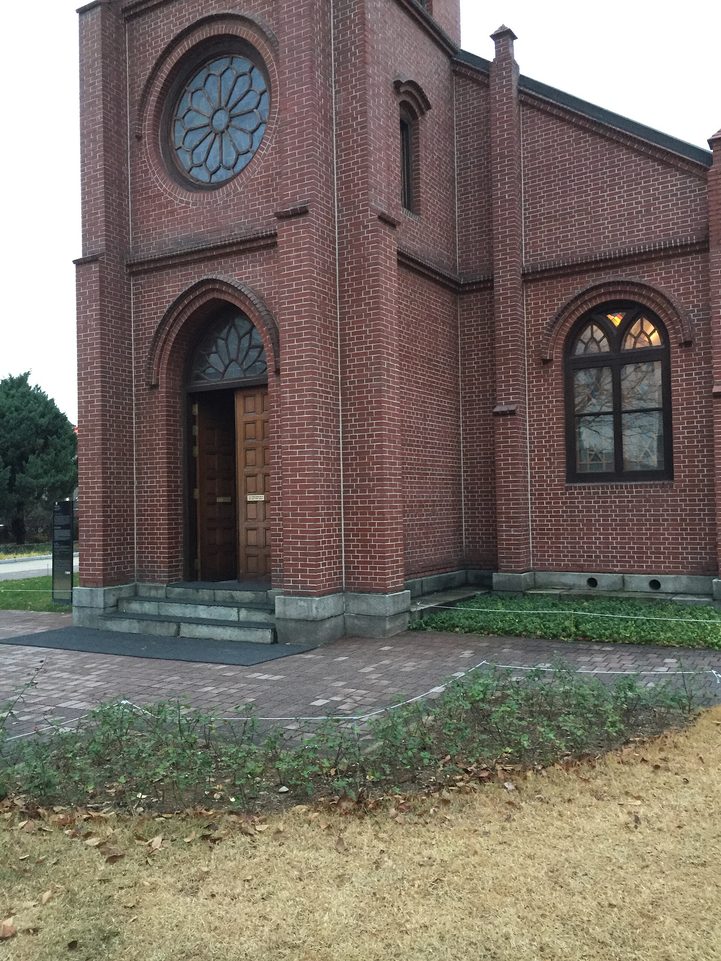
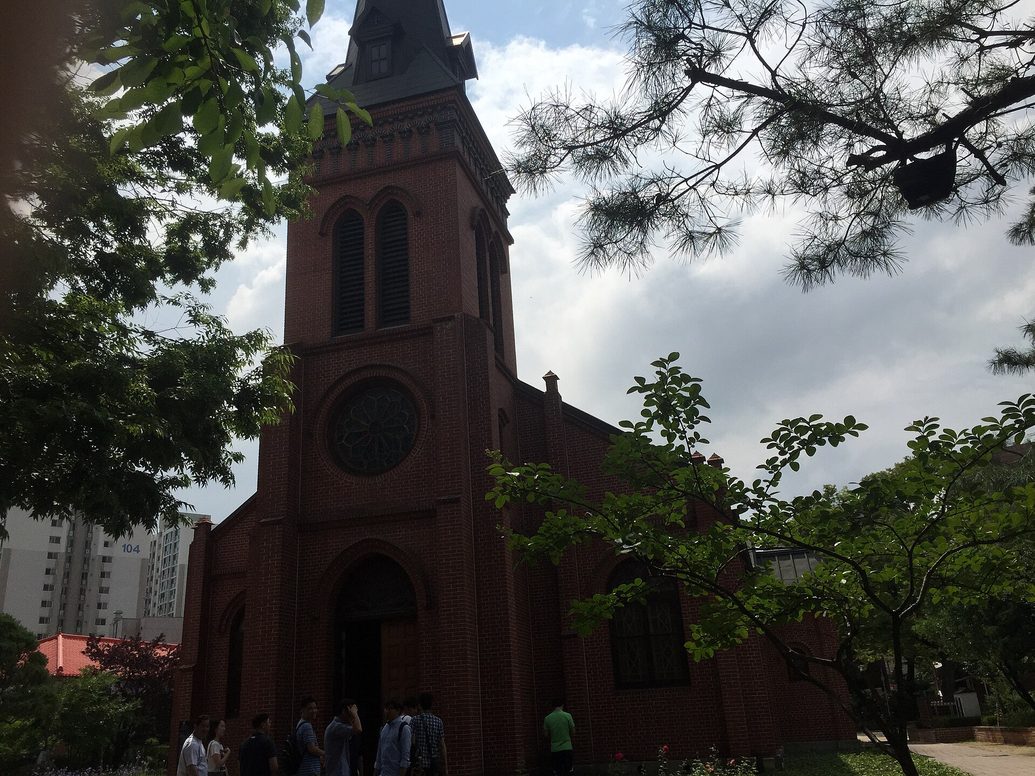
On a small hill behind Seoul Station stands a modest red-brick church with a slender spire. Finished in 1892, Yakhyeon was the first Western-style church built in Korea, a few years before the same French missionary designed Myeongdong Cathedral. It looks down on Seosomun, where Korea’s Catholic martyrs were put to death, and it is free to visit.

The first Western church in Korea
The name means “medicine hill”: herbs for medicine were once grown on its slopes. Catholics had been free to practise their faith in Korea only since the treaty with France of 1886, and the community here began as an offshoot of the mission at Myeongdong. The church was designed by Father Eugène Coste of the Paris Foreign Missions Society, who went on to design Myeongdong Cathedral, and built with Chinese bricklayers. The foundation stone was laid in October 1891; the building was finished in late 1892 and blessed in 1893.
The site was chosen with care. Just below the hill, outside the Small West Gate (Seosomun) of the old city wall, was the execution ground where Catholics were beheaded in the persecutions of 1801, 1839 and 1866. In 1977 Yakhyeon was listed as Historic Site of Korea No. 252.
The fire of 1998
In February 1998 an arsonist set the church alight. The roof fell in and the interior was gutted, leaving the brick walls standing. The church was rebuilt inside its old walls and rededicated in September 2000.
The visitor’s cheat sheet
| Where | Jungnim-dong, Jung-gu, Seoul, on a small hill north-west of Seoul Station |
|---|---|
| Opening hours | The garden is open daily, about 9am–6pm; the church itself is mainly open for Mass and ceremonies, so ring the parish (02-362-1891) to check |
| Admission | Free |
| Nearby museum | Seosomun Shrine History Museum, a few minutes’ walk away: free, 9.30am–5.30pm (some listings give a later Wednesday closing), closed Mondays |
| Mass | Saturday 6pm; Sunday 9.30am, 11am and 6pm |
| Photography | Not during Mass or weddings; otherwise quietly |
| Getting there | Seoul Station (Lines 1 and 4, AREX and KTX) or Chungjeongno (Lines 2 and 5), then a short uphill walk |
| How long | Half an hour; two hours with the Seosomun museum |
Hours and admission checked against the official site in November 2026. They change; the official site is always the last word.
What to see
The building
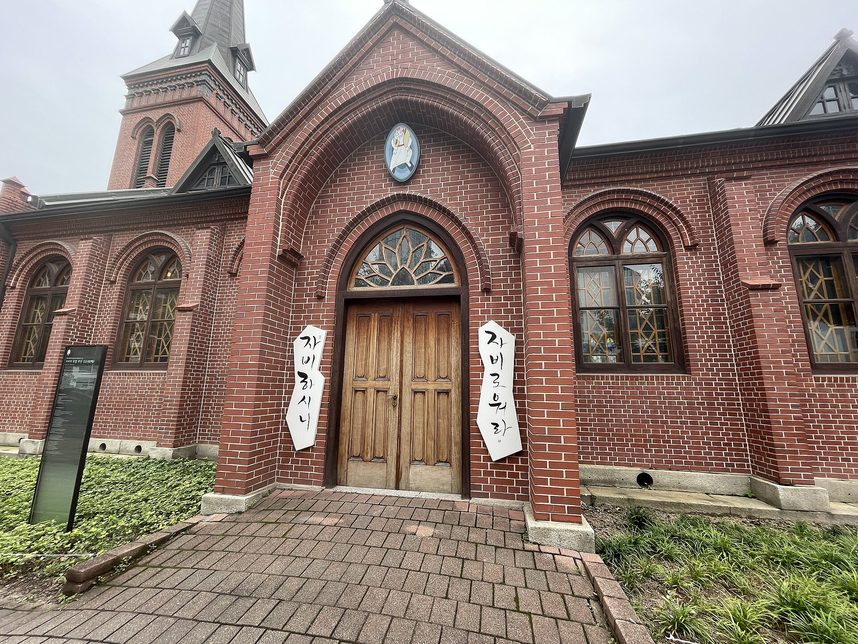
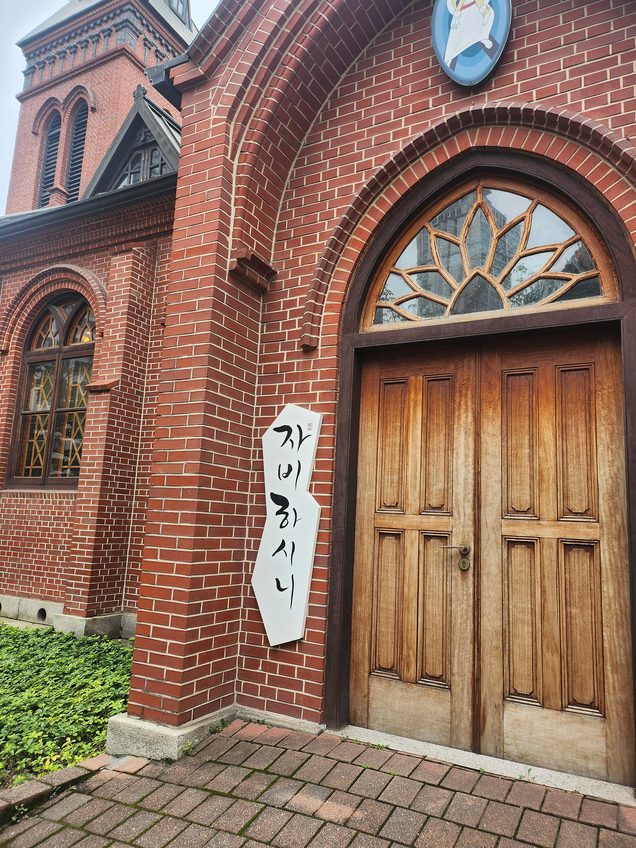
Yakhyeon is a small Latin-cross church of red brick, with a nave and two aisles. It mixes Romanesque and Gothic: round-arched windows along the sides, pointed arches at the entrance, and a bell tower with a tall spire at the front. It is a quiet, simple building, and much of its charm is its setting on the hill among pines and flowerbeds.


Inside
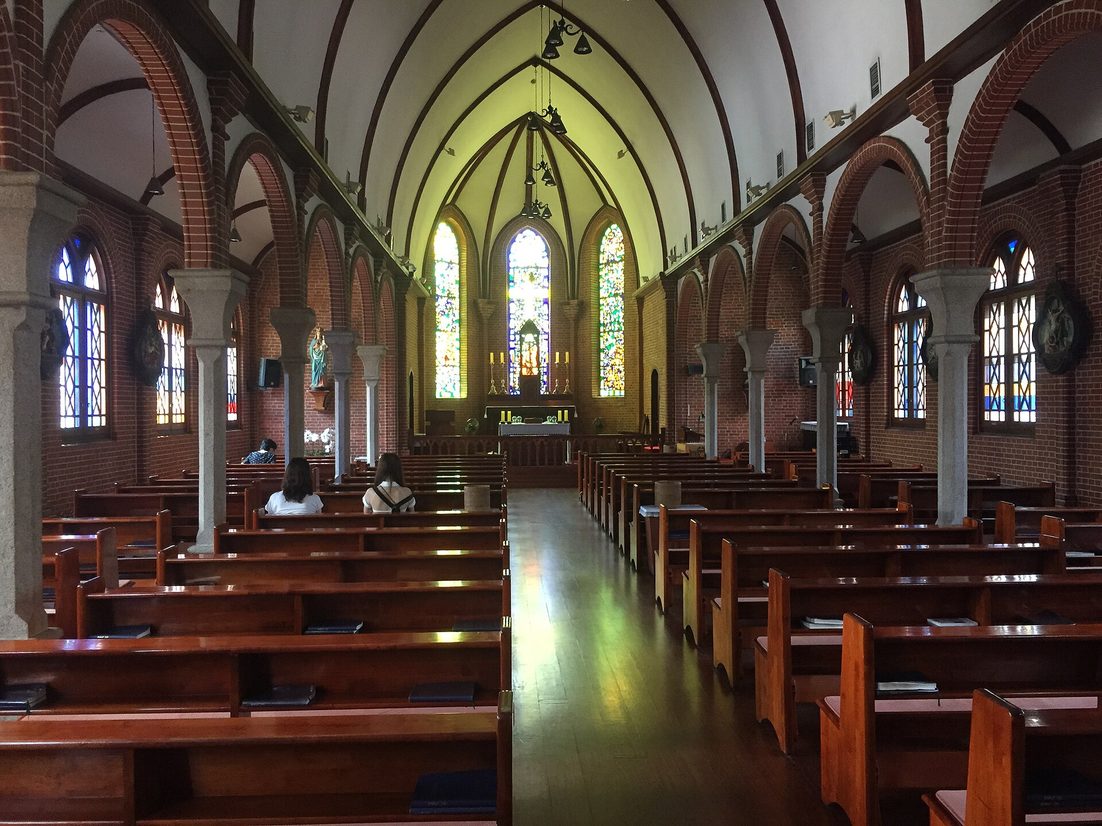
Slim columns divide the nave from the aisles, under a pointed vaulted ceiling. Behind the altar are windows of thick slab glass by the Korean artist Lee Nam-gyu, first put in during the 1970s and repaired after the fire. In the parish’s memorial hall, tablets name the martyrs executed at Seosomun.
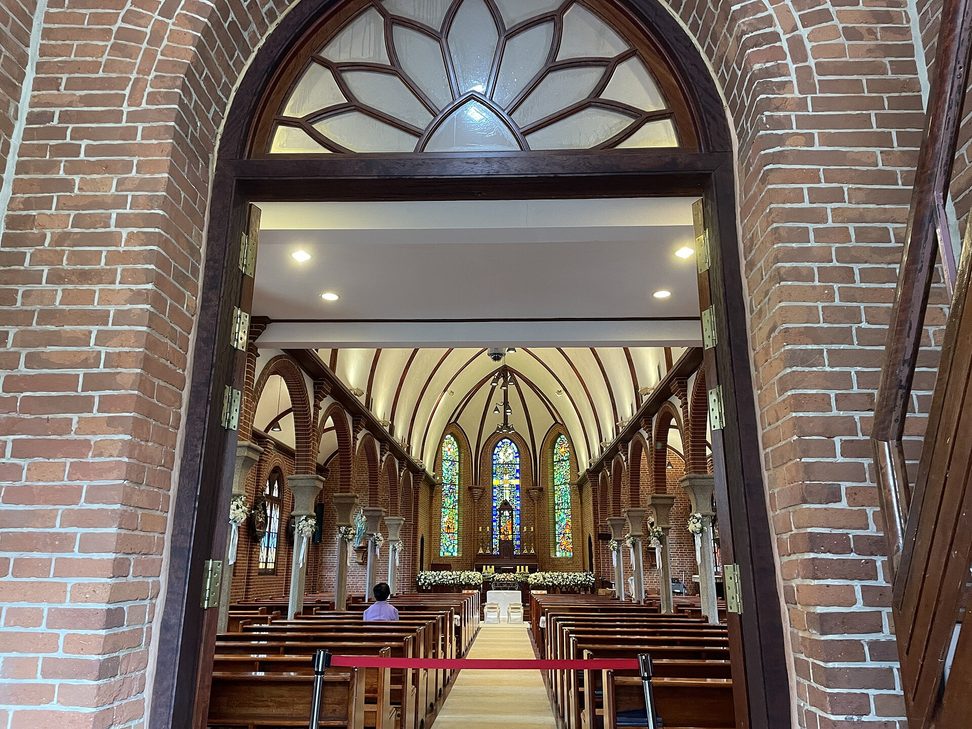
A note on our pictures. The windows behind the altar are modern works still in copyright, so our pictures do not show them close up.
Seosomun Shrine History Museum
A few minutes’ walk down the hill, the Seosomun Shrine History Museum opened in 2019 on the site of the old execution ground, in Seosomun Historic Park, beside the railway lines. Most of it lies underground, around a sunken courtyard open to the sky, and it tells the story of the Catholic martyrs and of others executed here. Pope Francis prayed at the shrine in August 2014. Entry is free; it is open 9.30am to 5.30pm and closed on Mondays.
Getting there
From Seoul Station, which has subway Lines 1 and 4 and the airport railway from Incheon, take Exit 1; the church is about 650 metres away, roughly eleven minutes’ walk, on the far side of the tracks from the Seoullo 7017 skygarden, the old highway flyover turned into a garden walk. From Exit 5 of Chungjeongno station on Lines 2 and 5 it is about 300 metres east. The church sits a little above the street, so expect some steps.
Where to stay
The Seoul Station area is a good base for a day of churches: Yakhyeon and Seosomun are on the doorstep and Myeongdong Cathedral is about half an hour on foot.
This link goes to Booking.com. This site earns nothing from it at present — it is here because it is the quickest way to check what is actually available.
Don’t miss
- The spire from the garden The best view is from the paths below the tower.
- The nave Rebuilt inside the walls of 1892 after the fire.
- Seosomun The museum on the martyrs’ execution ground, a few minutes away.
- Seoullo 7017 The skygarden walk over the tracks to Seoul Station.
Insider tips
Pair it with Myeongdong. Coste designed both churches. See Yakhyeon and Seosomun in the morning, then walk or take the subway to Myeongdong Cathedral.
Go on a weekday. Yakhyeon is a popular wedding church, and visitors are kept out while weddings and Masses are on, which makes weekends the hardest time to see inside.
Common questions
Is Yakhyeon Church free to visit?
Yes. There is no ticket, and the Seosomun Shrine History Museum down the hill is free as well.
Why is Yakhyeon Church important?
Finished in 1892, it was the first Western-style church built in Korea, and in 1977 it was listed as Historic Site No. 252, on the same day as Myeongdong Cathedral. It stands above Seosomun, where many of Korea’s Catholic martyrs were executed in the nineteenth century.
How do you get to Yakhyeon Church?
Walk from Seoul Station, or from Chungjeongno station on Lines 2 and 5. The church stands on a small hill north-west of Seoul Station, close to the Seoullo 7017 skygarden.
Can you go inside Yakhyeon Church?
Sometimes. The church is mainly open for Mass and ceremonies, and closed to visitors during weddings, so be ready to see it from the garden if the doors are shut, or come for Mass.
More churches to visit
- Myeongdong Cathedral, Seoul — the Gothic cathedral Coste designed next, consecrated in 1898.
- Seoul Anglican Cathedral — a Romanesque cathedral with Korean tiled roofs, beside Deoksugung Palace.
- Jeondong Cathedral, Jeonju — built on the ground of Korea’s first Catholic martyrdoms.