
Grossmünster, Zurich
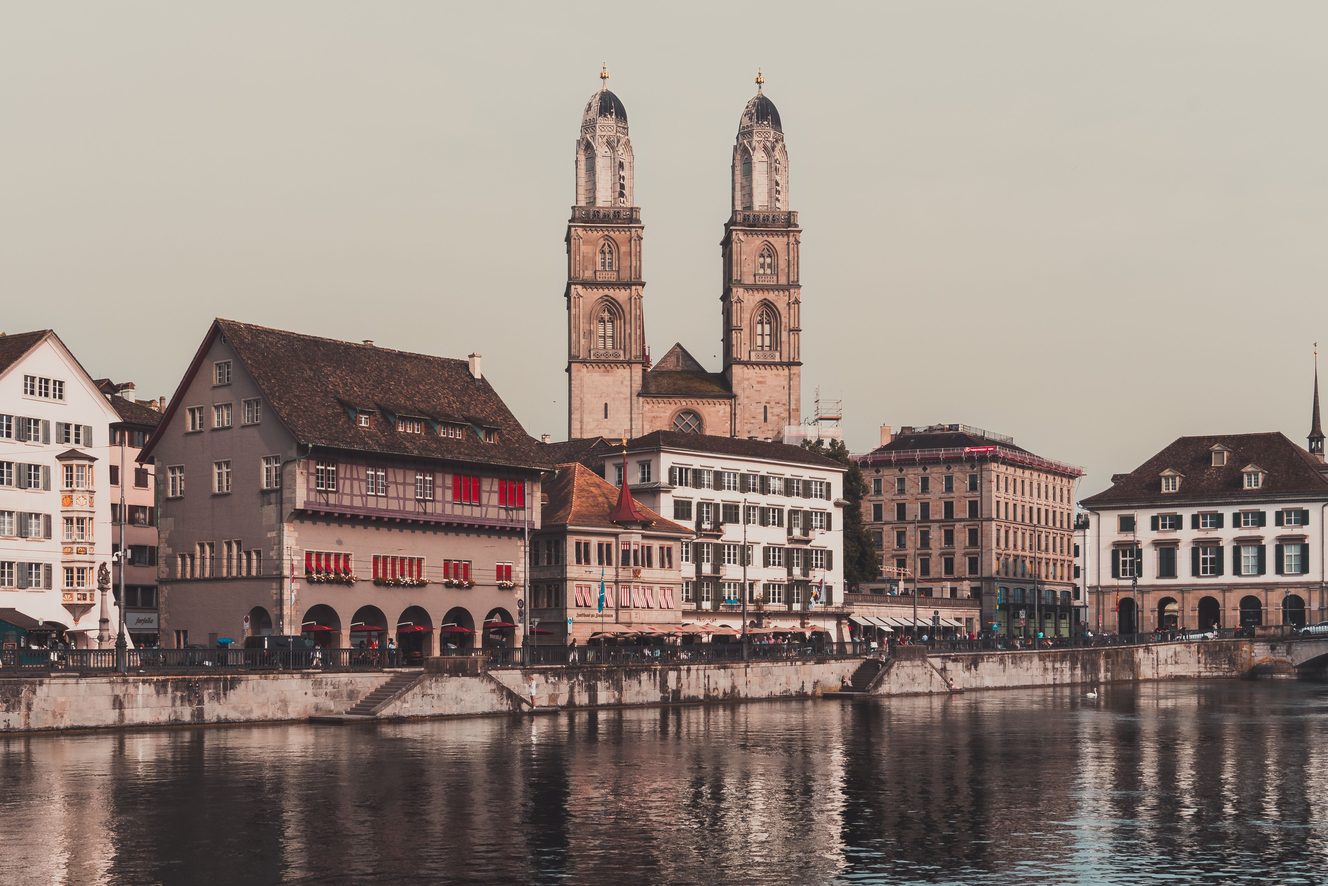
The twin towers of the Grossmünster are the emblem of Zurich, and the plain Romanesque church beneath them is where the Swiss Reformation began: Huldrych Zwingli first preached here on New Year’s Day 1519. Today it offers a bare and beautiful interior, a crypt with the original statue of Charlemagne, a Romanesque cloister and a tower to climb. The church is free; until autumn 2027 its outside is under scaffolding.

Scaffolding until 2027
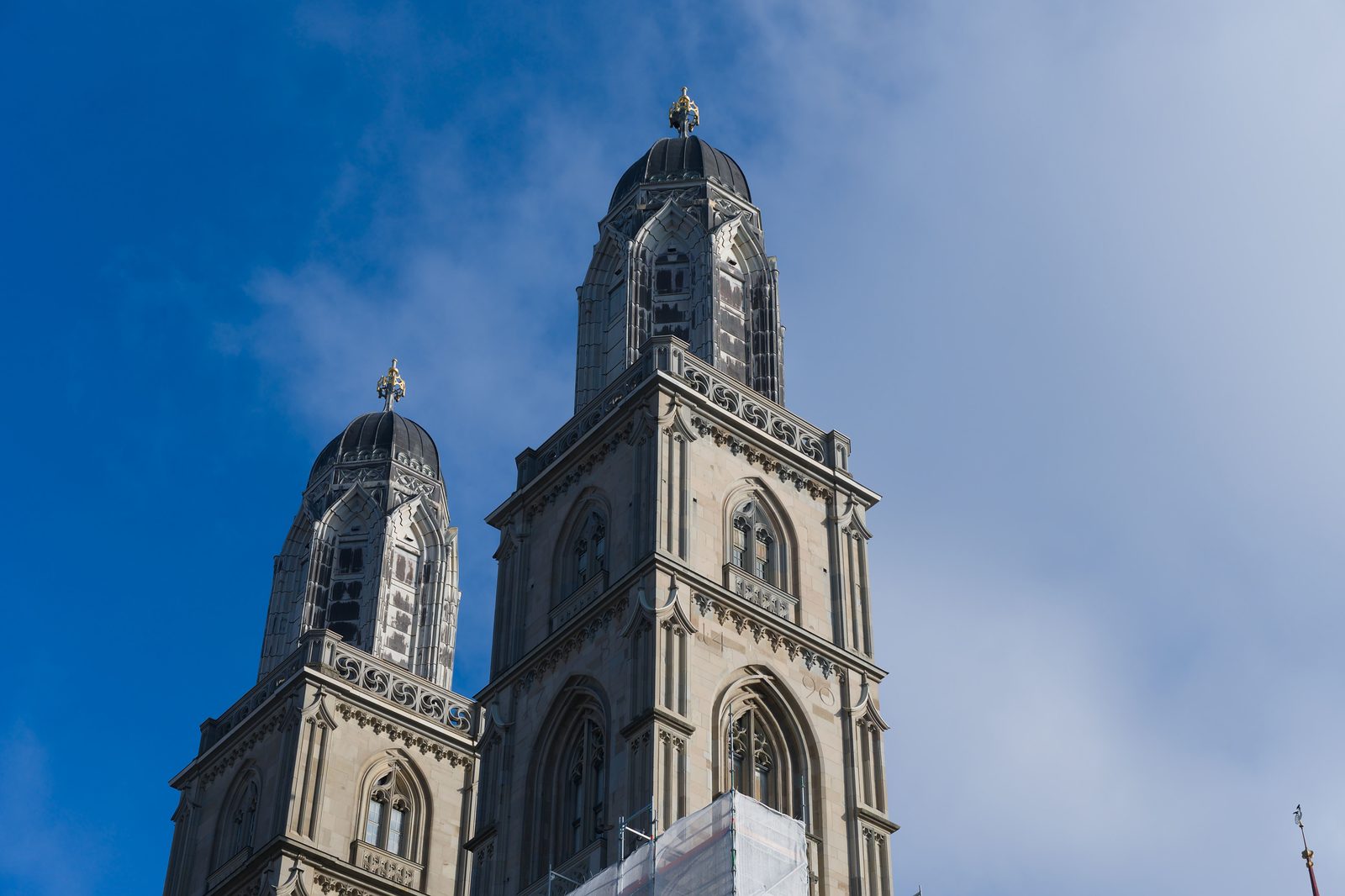
The canton of Zurich, which owns the church, is restoring the exterior, and in 2026 and 2027 the whole building, towers included, is scaffolded. The scaffolding is largely wrapped in a photographic artwork by Shirana Shahbazi. Most of the covering is due to come down in autumn 2027, when the towers will be visible again, and the works as a whole run on for some years after that. The church and the Karlsturm stay open throughout. Our photographs show the church as it looks without scaffolding.
From Charlemagne to Zwingli
Legend says that Felix and Regula, the patron saints of Zurich, were beheaded by the Romans beside the Limmat, picked up their heads and walked up the hill to the place where they wished to be buried. Centuries later, the story goes, Charlemagne’s horse fell to its knees on the spot, and the emperor founded a church over the graves. The legend cannot be proved, but a chapter of canons was here by the ninth century.
The present church was begun about 1100 and completed about 1220. In December 1518 its canons elected Huldrych Zwingli as people’s priest. His preaching, and the public disputations of 1523, led the city council to adopt the Reformation; from 1524 the images and altars were removed from the church, and the organ followed within a few years. Zwingli was killed in battle at Kappel in 1531, and his successor Heinrich Bullinger led the Zurich church from here for more than forty years.

The visitor’s cheat sheet
| Where | Zwingliplatz 7, 8001 Zürich, in the old town on the east bank of the Limmat |
|---|---|
| Opening hours | March–October: Mon and Wed–Sat 10am–6pm, Sun noon–6pm. November–February: to 5pm. Closed Tuesdays. Last entry 5 minutes before closing |
| Admission | Free (church and crypt) |
| Tower | Karlsturm: CHF 5 adults, CHF 2 students and ages 6–16, under-6s free. Fri–Sun only until further notice, with shorter hours than the church; 187 steps, no lift; tickets at the tower desk |
| Combined ticket | Karlsturm and the Fraumünster: CHF 8 |
| Cloister | Daily 10am–5.30pm in summer, to 4.30pm in winter |
| Services | Sunday service at 10am |
| Photography | For private use only, without flash or tripod, and not during services |
| Getting there | About 10 minutes on foot from the main station; tram stop Helmhaus |
| How long | 45 minutes; an hour and a half with the tower and cloister |
Hours and admission checked against the official site in November 2026. They change; the official site is always the last word.
What to see
The towers
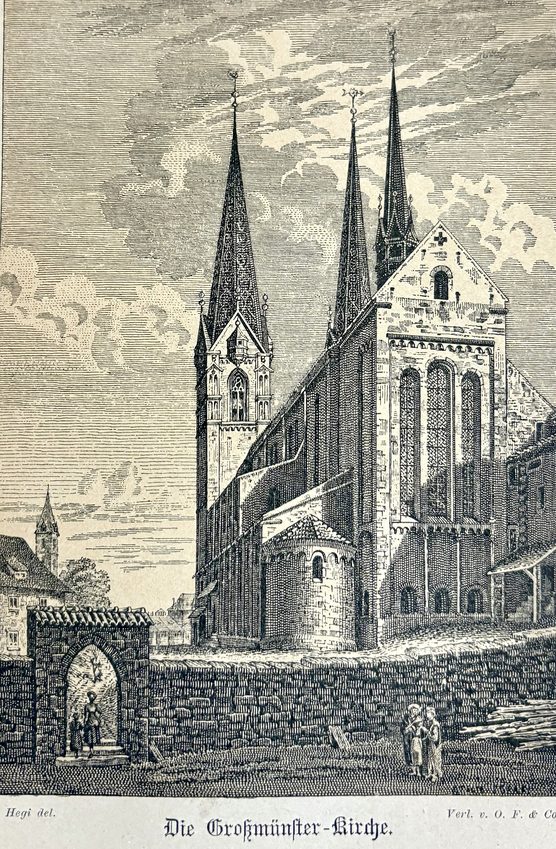
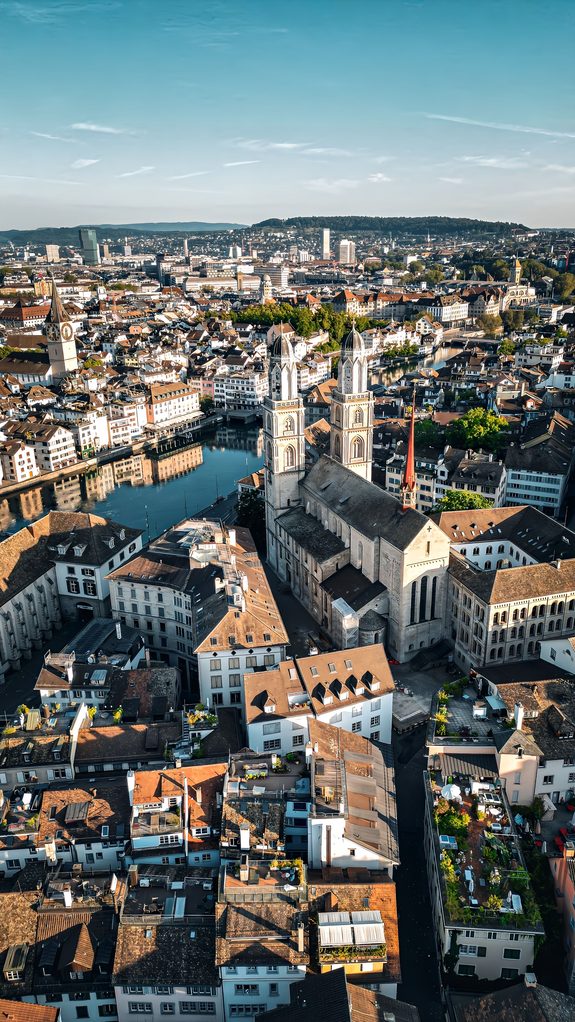
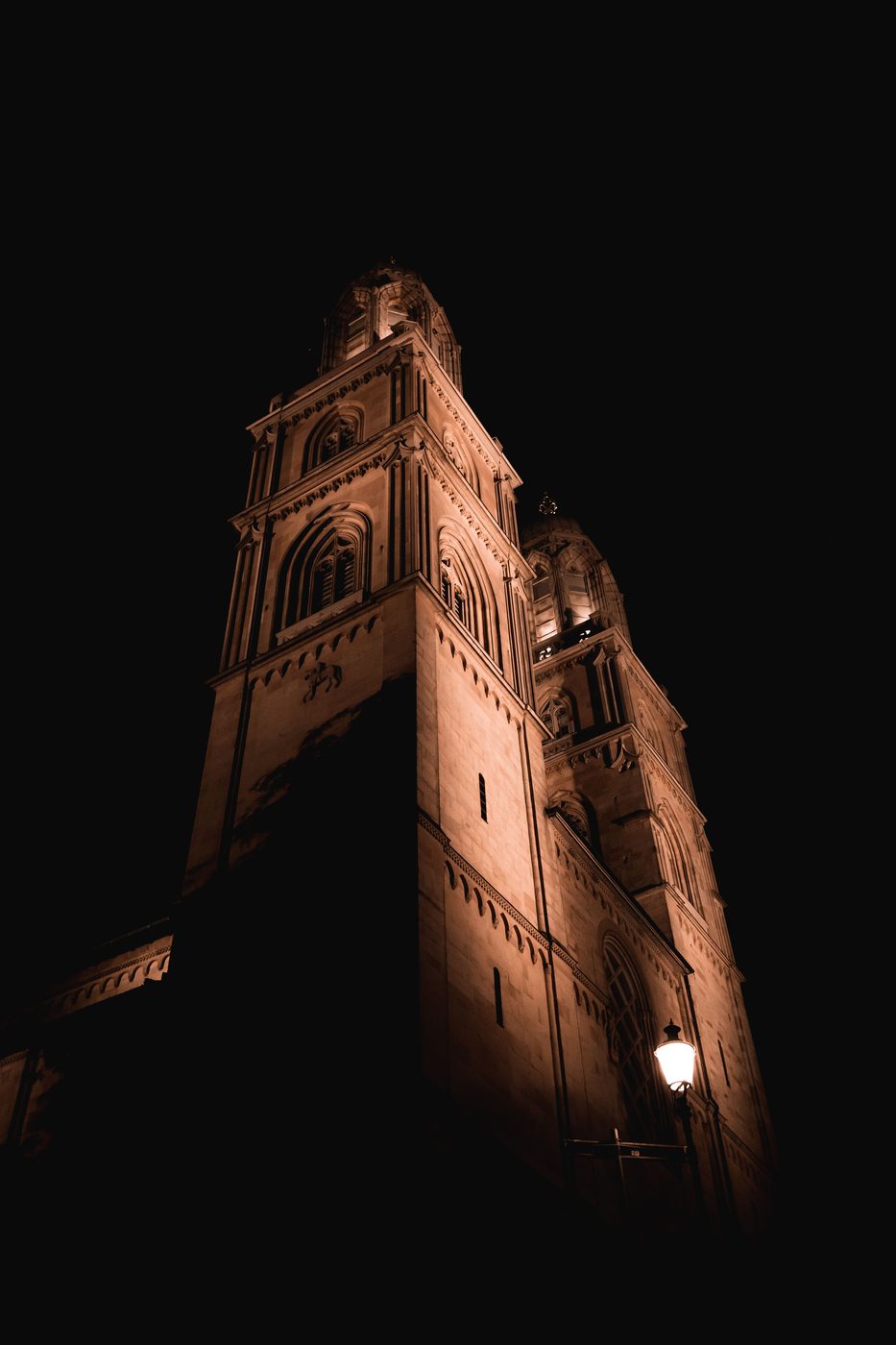
The two towers were brought to an equal height in the late fifteenth century and given tall pointed spires. A fire started by lightning in 1763 destroyed the spire of the north tower; both towers lost their pointed tops, and in the 1780s the towers received their present domed tops. On the south tower, facing the river, sits a figure of Charlemagne with a sword across his knees; it is a copy, and the weathered fifteenth-century original is in the crypt.
The portals
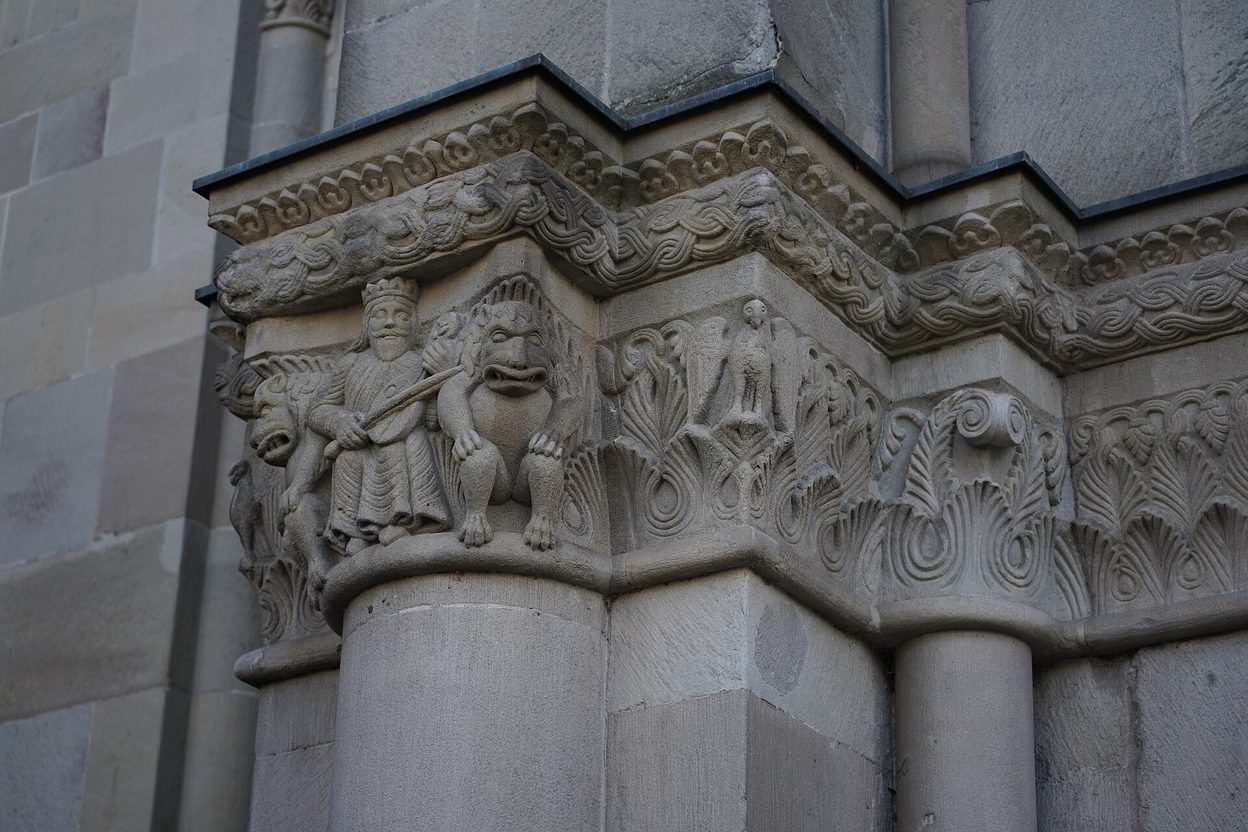
The main doorway on the north side keeps its Romanesque columns and carved capitals, with leaves, beasts and small figures. The bronze doors of the south and north portals are modern, made by Otto Münch in 1935–38 and 1950, with scenes from the Bible and from the history of the Reformation.

Inside: a Reformed church
The interior is Romanesque and almost bare, as the Reformers left it: heavy piers, galleries, a raised choir and no images. Look for the carved capitals in the nave, one of which shows Charlemagne’s horse kneeling at the saints’ graves. The colour comes from the windows. The three choir windows are by Augusto Giacometti, from the early 1930s, and the twelve windows in the nave are by the German artist Sigmar Polke, finished in 2009: seven of them are made of thin slices of agate, which glow like sections of a strange geology.
The crypt
The crypt under the choir is the oldest part of the church. It has faded wall paintings of the martyrdom of Felix and Regula, and the original seated statue of Charlemagne from the tower. It is free, and usually open when the church is, though it is closed on rainy days to protect the paintings.
The Karlsturm
One of the two towers, the Karlsturm, can be climbed by 187 steps, some of them narrow, for a view over the old town, the lake and, on a clear day, the Alps. There is no lift, large bags are not allowed, and tickets are sold only at the desk at the foot of the tower.
The cloister
Beside the church, in the building that now houses the university’s theological faculty, is a Romanesque cloister of the late twelfth century, taken down and rebuilt in 1851 when the old chapter buildings were demolished. Its arcades are carved with faces, monsters and foliage, and a small permanent exhibition explains the Zurich Reformation.
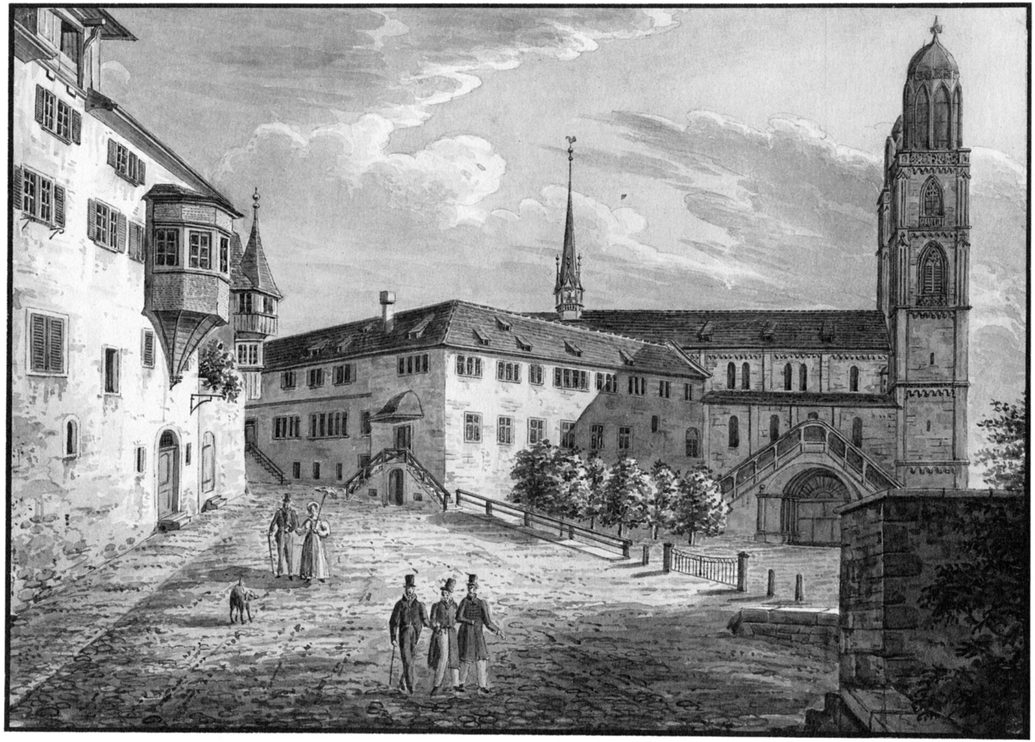
A note on our pictures. The parish allows photography inside the church for private use only, not for publication, so this page shows the outside of the church and old engravings.
Getting there
The Grossmünster stands in the old town on the east bank of the Limmat. From the main station it is a walk of about ten minutes along the river on the Limmatquai. The nearest tram stop is Helmhaus, almost at the door. The Fraumünster, with its Chagall windows, is directly across the river by the Münsterbrücke.

Tours and where to stay
The church is free and tower tickets are sold only on the spot. Walking tours of the old town usually include the Grossmünster, and hotels in the old town put it within a few minutes’ walk.
These links go to GetYourGuide and Booking.com. This site earns nothing from them at present — they are here because they are the quickest way to check what is actually available.
Don’t miss
- The agate windows Sigmar Polke’s windows of sliced stone, in the nave.
- Charlemagne in the crypt The original fifteenth-century statue from the tower.
- The view from the Karlsturm 187 steps up, Friday to Sunday.
- The cloister Romanesque carving, a few steps from the church.
Insider tips
Not on a Tuesday. The church is closed every Tuesday for organ teaching, and on Sundays it opens to visitors only at noon.
Buy the combined ticket. If you mean to climb the tower and also see the Fraumünster across the river, the CHF 8 combined ticket saves CHF 2.
Come on a dry day. The crypt is closed when it rains, and the tower can close in bad weather.
Common questions
Is the Grossmünster free to enter?
Yes: the church and the crypt are free. Climbing the Karlsturm, one of the towers, costs CHF 5 for adults and CHF 2 for students and for children aged 6 to 16.
When is the Grossmünster open?
From March to October, 10am to 6pm; from November to February, 10am to 5pm. On Sundays it opens at noon, after the service, and it is closed every Tuesday.
Can you climb the tower?
Yes, the Karlsturm, by 187 steps; there is no lift. Until further notice it is open only on Fridays, Saturdays and Sundays.
Is the Grossmünster covered in scaffolding?
Yes, at present. The whole exterior is scaffolded for restoration in 2026 and 2027, behind a printed artwork; most of the covering is due to come down in autumn 2027. The church and tower remain open.
More churches to visit
- Fraumünster — the Chagall windows, just across the river.
- Ulm Minster — the tallest church spire in the world, a couple of hours north in Germany.
- Strasbourg Cathedral — the great red sandstone cathedral of the Upper Rhine.
- Milan Cathedral — across the Alps, with its roof terraces.