
St Bride’s Church, Fleet Street
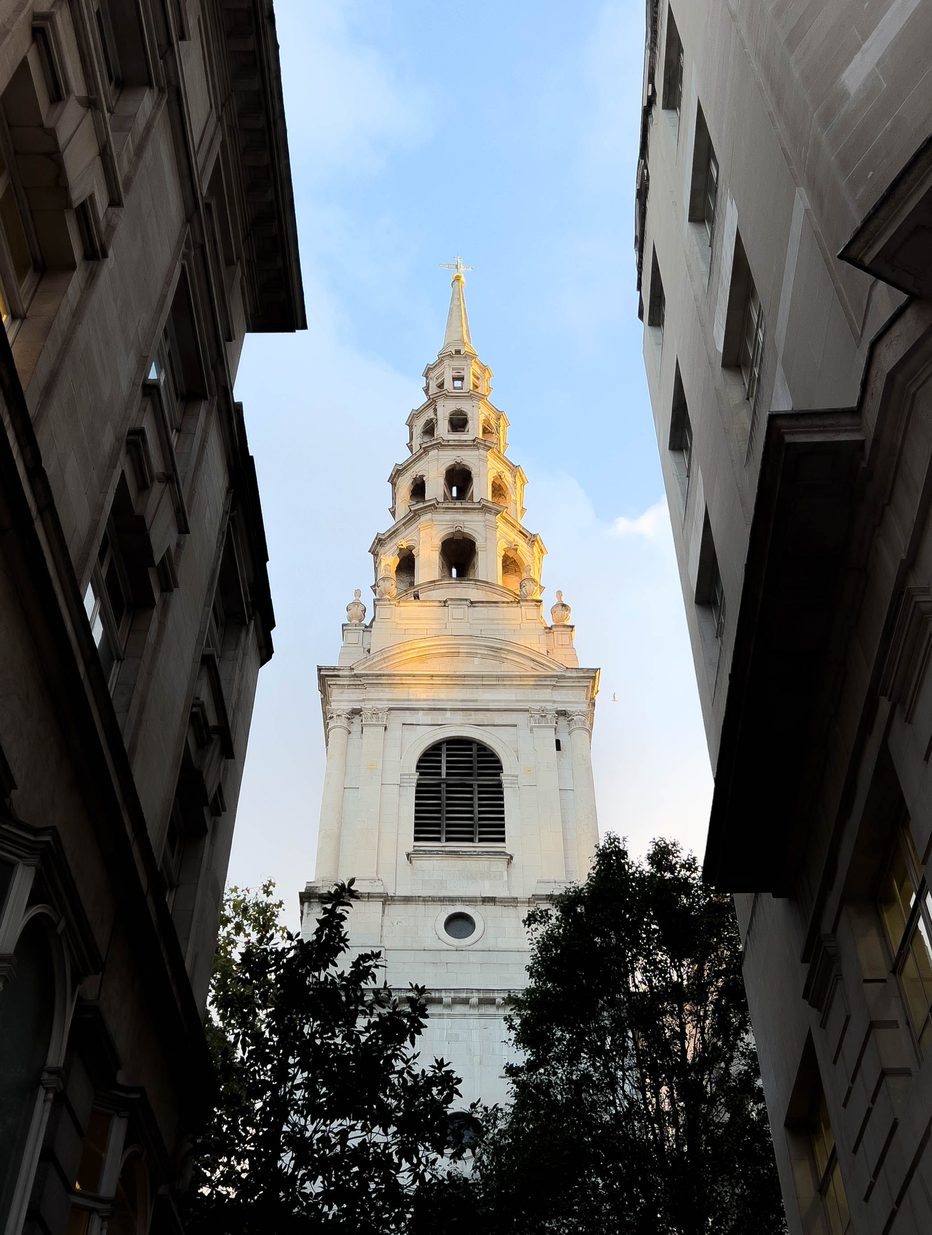
Just off Fleet Street in the City of London, St Bride’s is Sir Christopher Wren’s church with the tall tiered steeple, long linked with printers and journalists. Gutted in the Blitz and rebuilt in the 1950s, it has a crypt museum that reaches back through Saxon walls to a Roman pavement.
A church of the printers
The site is very old. Under the east end, excavators found part of a Roman building with a plain tessellated floor, which the church dates to about AD 180. Tradition says Irish missionaries founded a church here in the sixth century and dedicated it to St Brigid of Kildare, or Bride; the first church that can be traced is a small Saxon building of before the mid-eleventh century. A Norman church followed, rebuilt in the fifteenth century. The present building is usually counted as the seventh or eighth church on the site.
In 1500 Wynkyn de Worde, who had worked with William Caxton, set up his press beside the church, beginning a link with printing that lasted for centuries. Samuel Pepys was baptised here in 1633. In 1665 the Great Plague killed 238 parishioners in a single week, and in 1666 the Great Fire destroyed the medieval church.
Wren’s church and its steeple
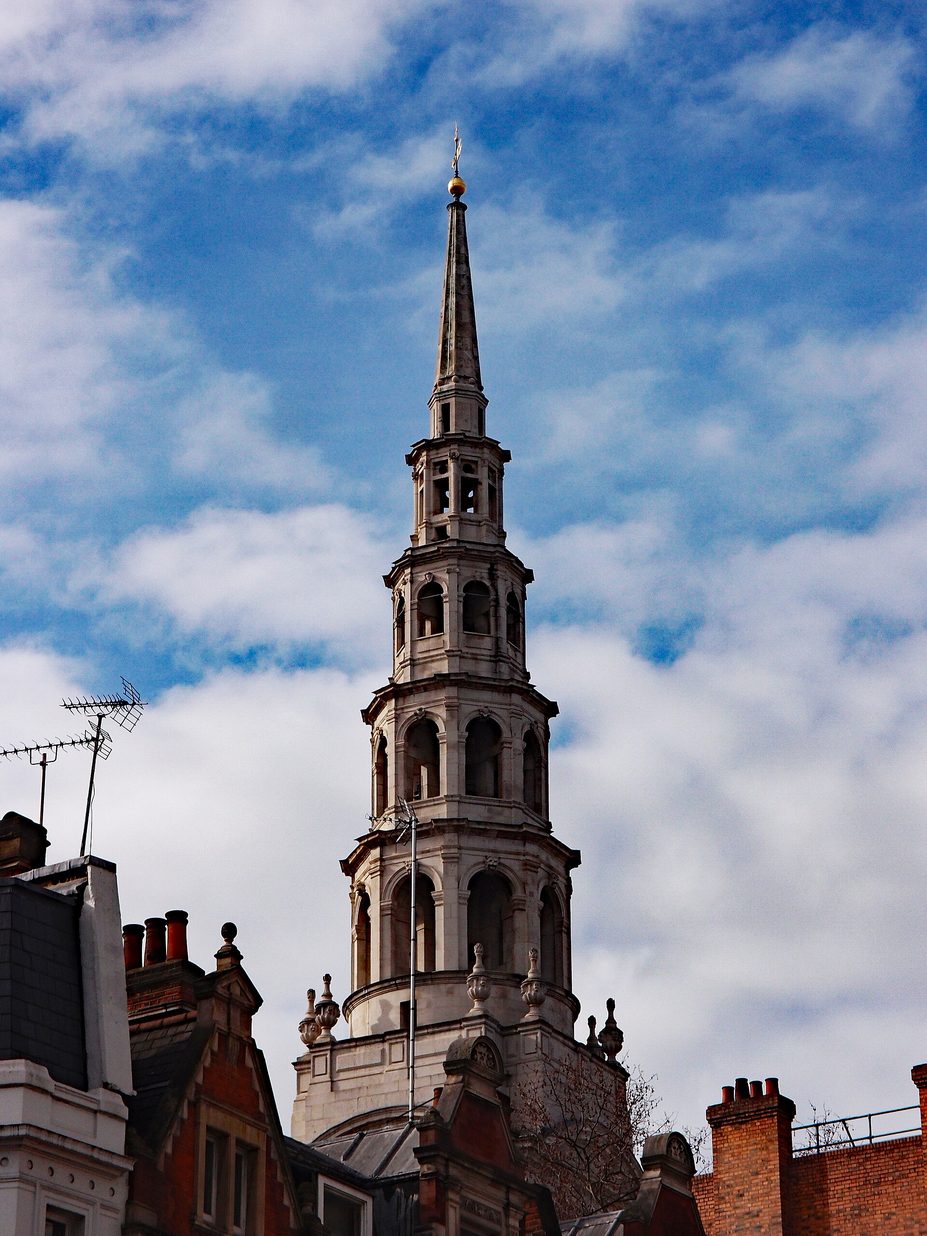
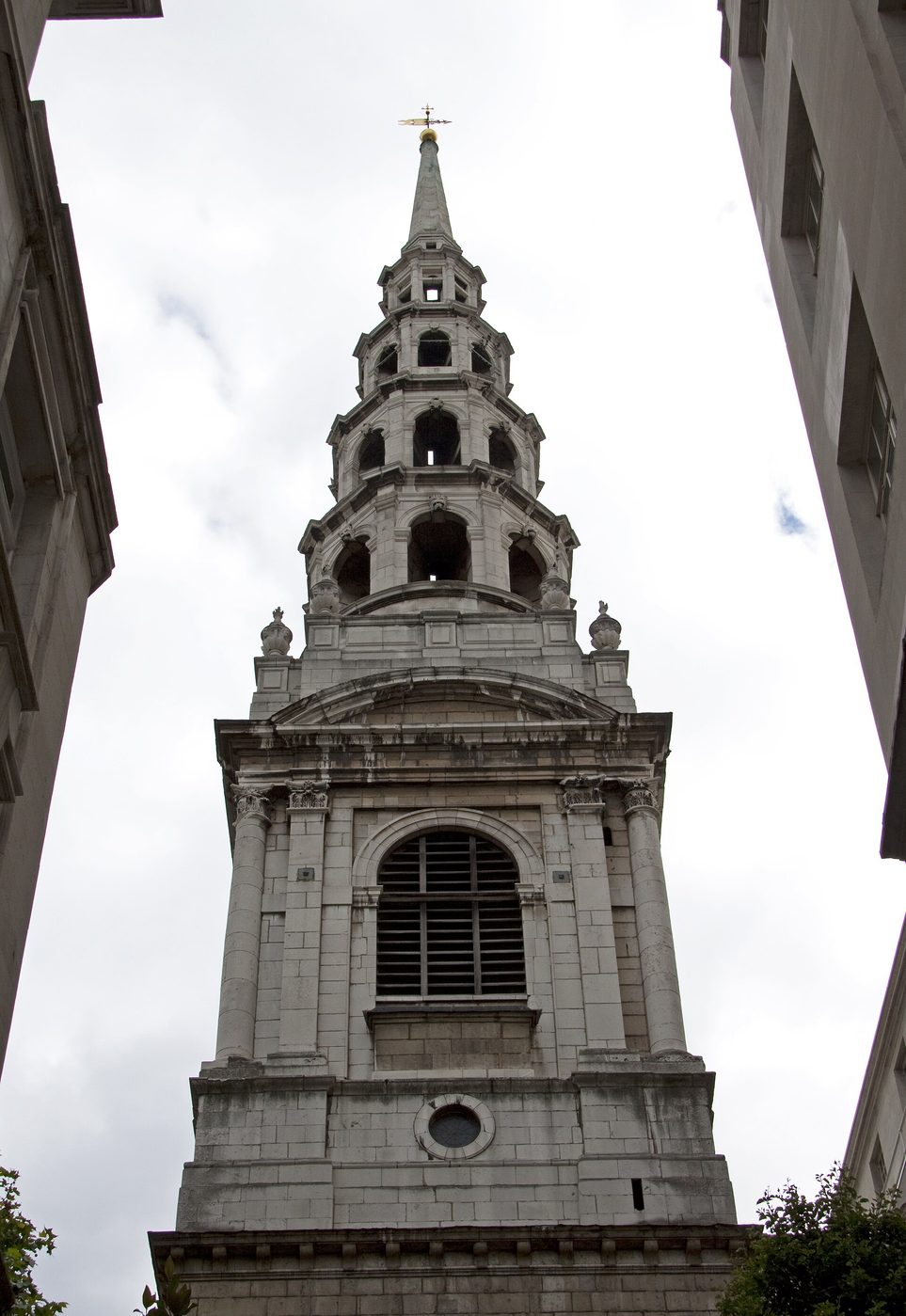
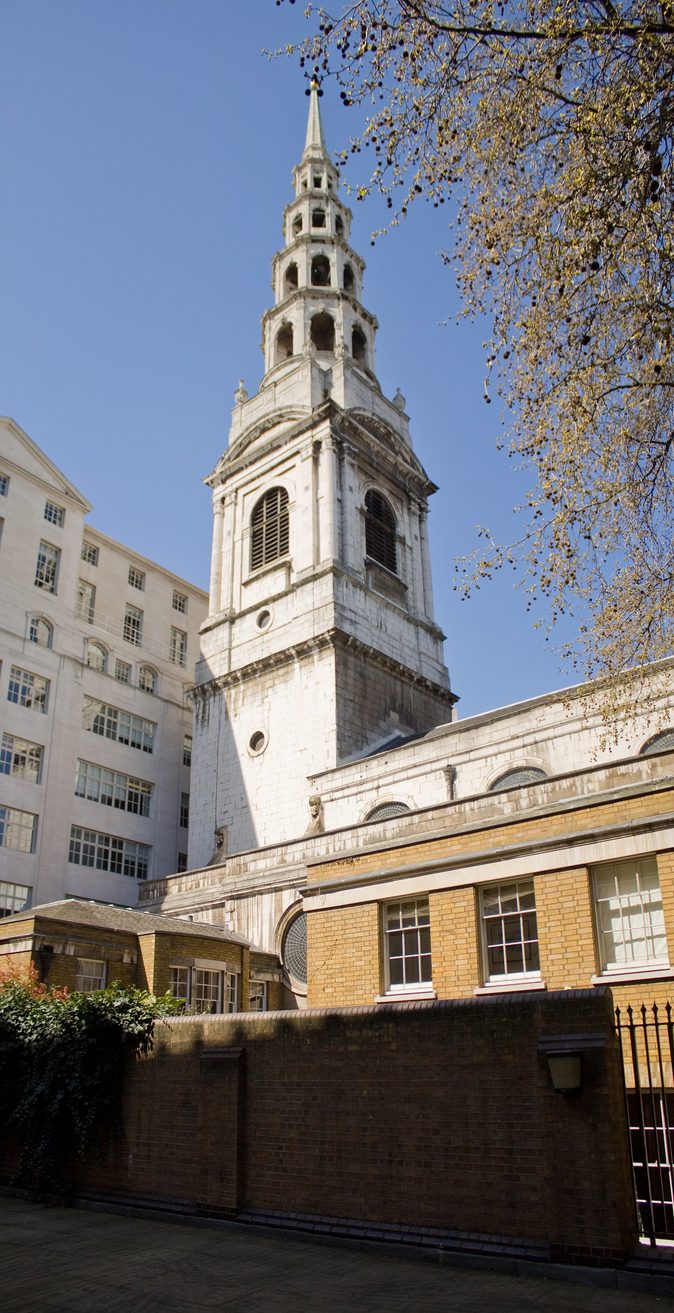
Sir Christopher Wren designed the new church in the 1670s, and it reopened for worship in December 1675. The steeple came later, in 1701–1703; some writers credit Nicholas Hawksmoor with a hand in its design. It rises in stages of open arches to a slender spire. Its height is usually given as about 69 metres (226 feet); some sources give 234 feet for its original height, before the top was shortened after a lightning strike in 1764. It is often described as the tallest of Wren’s steeples apart from St Paul’s, though sources word this differently.
By tradition the steeple inspired the tiered wedding cake: a baker’s apprentice near Ludgate is said to have copied it for a wedding. Accounts disagree on whether he was Thomas or William Rich, so treat it as a good story rather than history. In 1702 the first daily English newspaper, the Daily Courant, was printed nearby, and St Bride’s became known as the journalists’ church.

The Blitz and the rebuilding
On the night of 29 December 1940 firebombs gutted the church, though Wren’s steeple survived. The fire cleared the way for archaeology: from 1952 W. F. Grimes led excavations that uncovered the Roman floor, earlier churches and a medieval charnel house. Between 1955 and 1957 the architect W. Godfrey Allen rebuilt the church to Wren’s design, largely paid for by newspaper owners and journalists, and the Queen and the Duke of Edinburgh attended its rededication on 19 December 1957. It is listed Grade I. The newspapers have long since left Fleet Street, but the church keeps the link, with an annual service for journalists in November.
The visitor’s cheat sheet
| Where | Fleet Street, London EC4Y 8AU; the entrances are off St Bride’s Avenue |
|---|---|
| Opening hours | Monday–Friday 8am–5pm; Saturday 10am–3.30pm; Sunday 10am–6.30pm. Closed Monday bank holidays and some days around Christmas, New Year and Easter: check before you go |
| Admission | Free (crypt museum also free, normally open during church hours); donations welcome |
| Services | Sunday Choral Eucharist 11am and Choral Evensong 5.30pm; weekday Morning Prayer 8.15am |
| Concerts | Free lunchtime recitals most Tuesdays and Fridays, 1.15pm–1.55pm |
| Tours | For groups of five to fifteen, on request |
| Access | Step-free entry by a side door off St Bride’s Avenue (check with the office); hearing loop; the crypt is down about twenty steps with no step-free access |
| Toilets | Accessible toilets during services only; the church’s website lists City of London community toilets nearby |
| How long | Forty-five minutes to an hour, with the crypt |
Hours and admission checked against the official site in November 2026. They change; the official site is always the last word.
What to see
The steeple and the churchyard
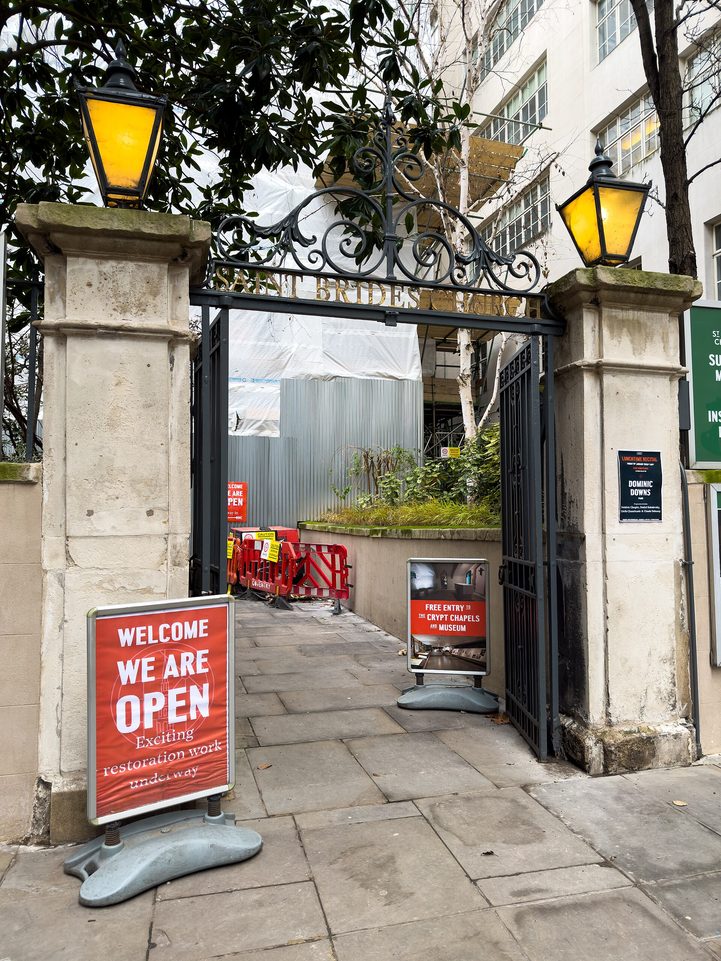
Start on Fleet Street and look up: the steeple shows best from the street and from the lane of St Bride’s Avenue. Walk through the gateway into the small churchyard garden, where the tower rises straight above you. The Old Bell Tavern nearby is reputedly where Wren’s workmen lodged.
The west end
Inside the west door, look for the memorial to Polly Nichols, who was born and raised in the parish and married here in 1864; she is the first known victim attributed to Jack the Ripper. Two stone figures of charity children come from a former parish school. The organ, by the John Compton Organ Company, was ready for the 1957 rededication and has four manuals and about 4,000 pipes.
The nave
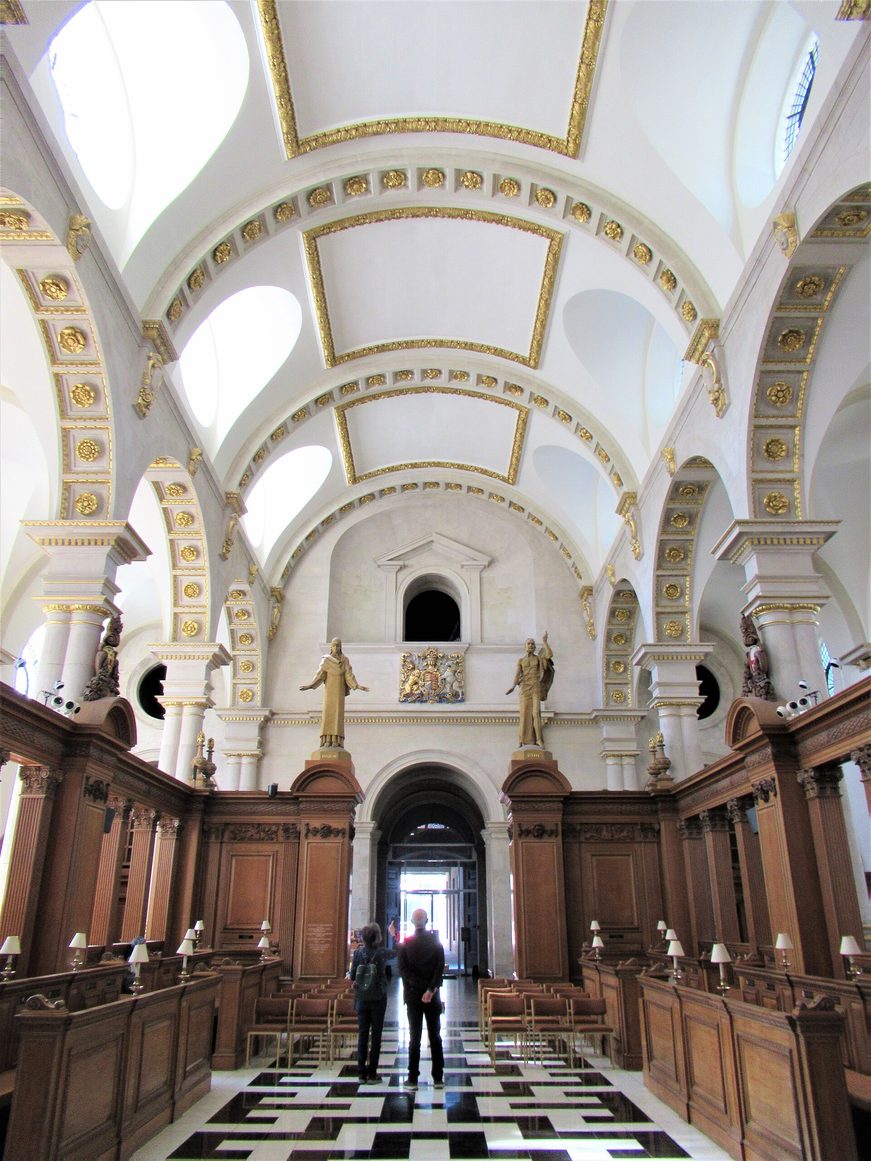
Godfrey Allen kept Wren’s coupled columns and plaster barrel vault but arranged the seating in collegiate style, with pews facing each other across a black-and-white floor. Historic England notes that no old fittings survive, and that the new woodwork obscures what was one of Wren’s finest interiors. Near the font, a modern bust of Virginia Dare, the first English child born in America, recalls her parents’ link with the parish in the 1580s; it replaced a marble monument stolen in 1999.
The east end and the Journalists’ Altar
The oak reredos was unveiled at the 1957 rededication and is dedicated to Edward Winslow and the passengers of the Mayflower. Behind the altar, a trompe-l’oeil painting, also made for 1957, extends the church in painted perspective. In the north-east corner is the Journalists’ Altar. It was once called the Hostage Altar, when candles were kept lit for John McCarthy during his captivity in Beirut from 1986 to 1991, and it is now a place to remember journalists and support staff who have died in recent conflicts.
The crypt
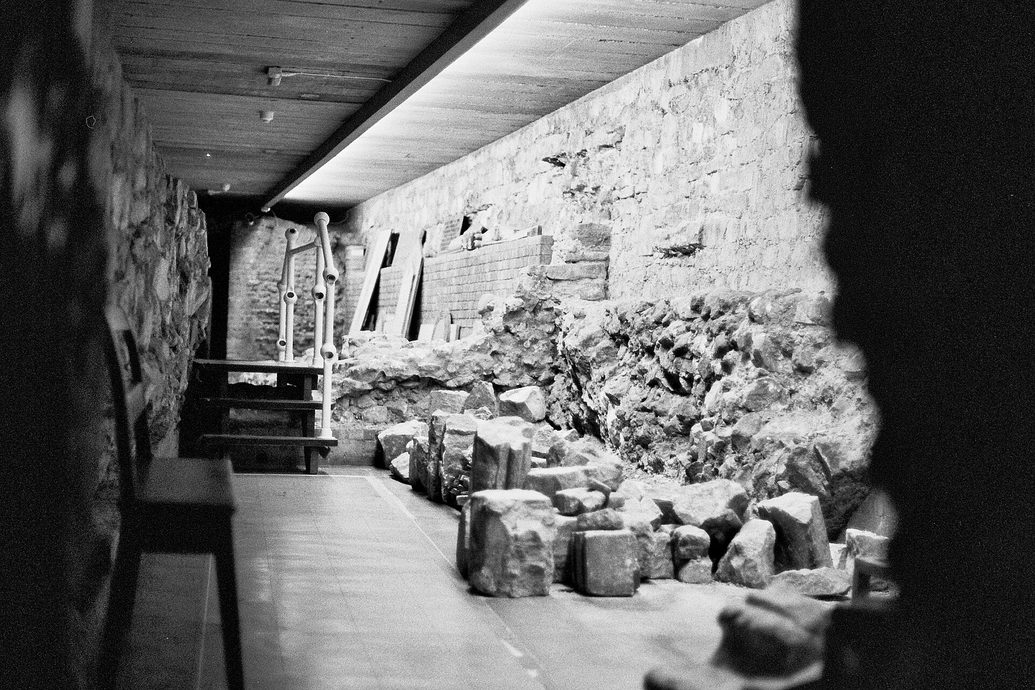
About twenty steps lead down to the crypt museum. Sections of wall are labelled by period, Roman, Saxon and later, and the Roman pavement can be seen behind the altar of the crypt chapel, partly by mirrors. Look for an iron coffin made to defeat body-snatchers, fragments of bells from the Great Fire and the Blitz, Samuel Richardson’s coffin plate and displays on Fleet Street and the print trade. The medieval chapel was restored in 2002 as a memorial to the Harmsworth family and Associated Newspapers staff killed in the two world wars. The charnel house, found in 1953, is not routinely open. Photography is reported not to be allowed in the crypt; ask at the church.
A note on our pictures
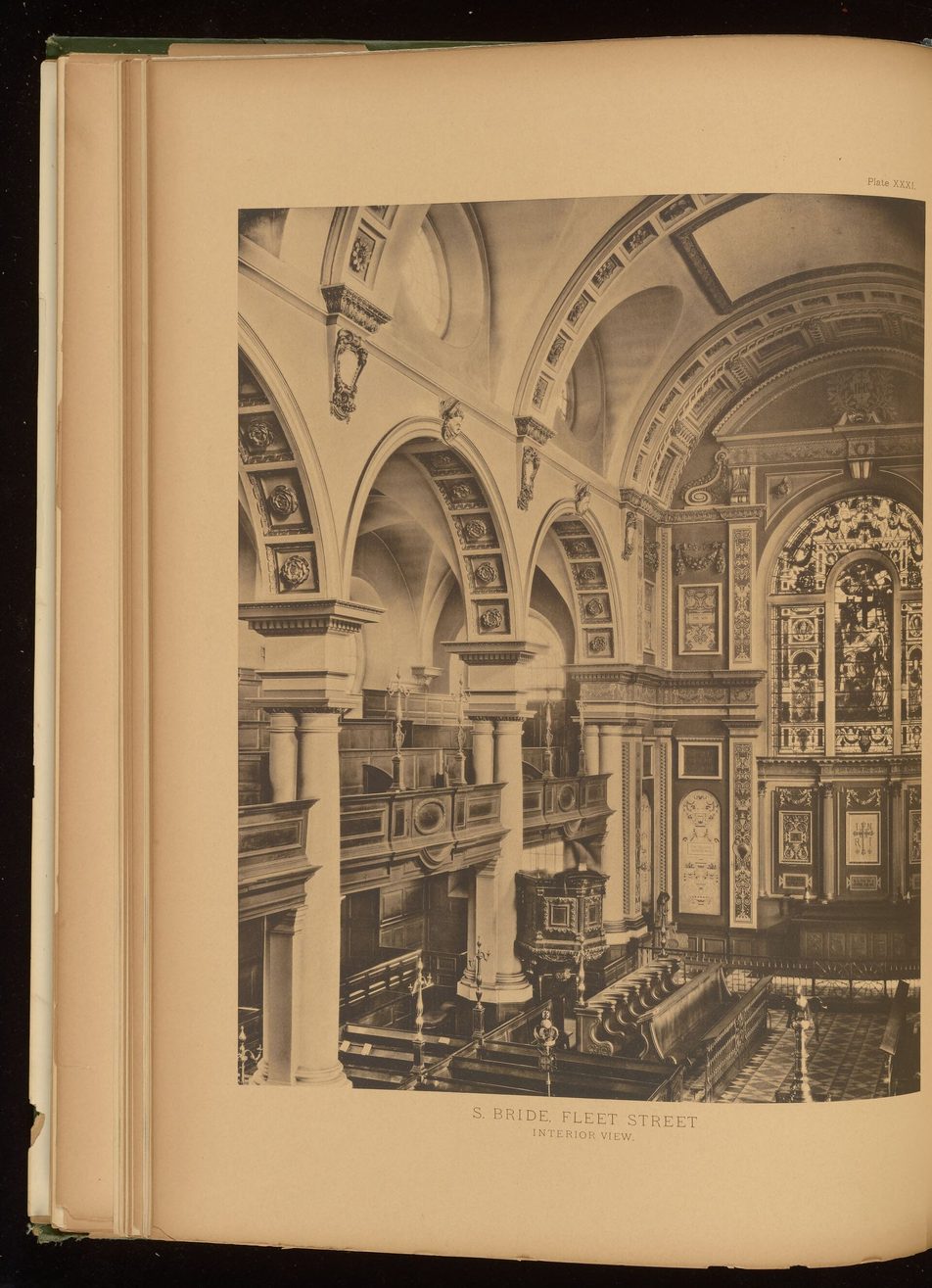
We do not show the trompe-l’oeil painting at the east end. The church names the painter as Glyn Jones, very probably the muralist Glyn Jones (1906–1984), and the painting is still in copyright. For the same reason we do not show the modern bust of Virginia Dare or the recent memorials. Our black-and-white photograph is of the interior before the 1940 fire; the colour view of the nave is of the rebuilt church.
Getting there
St Bride’s is on the south side of Fleet Street, just west of Ludgate Circus. City Thameslink is a few minutes’ walk, as is Blackfriars (National Rail and the District and Circle lines); St Paul’s on the Central line is about ten minutes’ walk, down Ludgate Hill. Buses 11, 15, 26, 76 and 341 run along Fleet Street. There is no parking at the church; there are Blue Badge bays on Dorset Rise and Tudor Street. St Paul’s Cathedral and the Temple Church are both close by.
Where to stay
London has every kind of place to stay; the City and the South Bank are within walking distance.
This link goes to Booking.com. This site earns nothing from it at present — it is here because it is the quickest way to check what is actually available.
Don’t miss
- The steeple Wren’s tiers, best seen from Fleet Street.
- The crypt museum Roman, Saxon and medieval remains.
- The Journalists’ Altar In the north-east corner.
- A lunchtime recital Free, most Tuesdays and Fridays.
Insider tips
Time it for 1.15pm. On most Tuesdays and Fridays a free recital fills the lunch hour.
Christmas 2026. Advent Carols on 29 November, Nine Lessons and Carols on 20 December and Fleet Street Carols at noon and 5pm on 21 December; most services are free and ticketless.
Saturday is shorter. The church closes at 3.30pm and opens at 10am, so leave time for the crypt.
Common questions
Is St Bride’s free to visit?
Yes. The church and the crypt museum are both free; donations are welcome.
When is the church open?
The church gives Monday to Friday 8am–5pm, Saturday 10am–3.30pm and Sunday 10am–6.30pm. It is closed on Monday bank holidays and on some days after Christmas and Easter, so check the church’s What’s On calendar before you go.
Can I see the crypt?
Yes. The crypt museum is normally open during church hours (the church does not publish separate crypt times, so check at the door). It is down about twenty steps; there is no step-free access. The medieval charnel house is not routinely open and is usually seen only on special tours or events.
Is the steeple really the model for wedding cakes?
That is the tradition: a local baker’s apprentice is said to have copied its tiers for a wedding cake. Sources disagree on his name, and the story cannot be proved.
Are there concerts?
Free lunchtime recitals are held on most Tuesdays and Fridays at 1.15pm, with a retiring collection, and the choir sings at the Sunday services. There are breaks around Easter, in August and in December.
Are there guided tours?
The church offers tours on request for groups of five to fifteen; it does not publish a price, so ask when you book.
More English churches
- St Paul’s Cathedral — Wren’s cathedral up Ludgate Hill
- Temple Church — the round church of the Knights Templar
- St Mary-le-Bow — another Wren steeple in the City
See all the cathedrals and churches worth visiting in England →