
St Dunstan-in-the-East, City of London
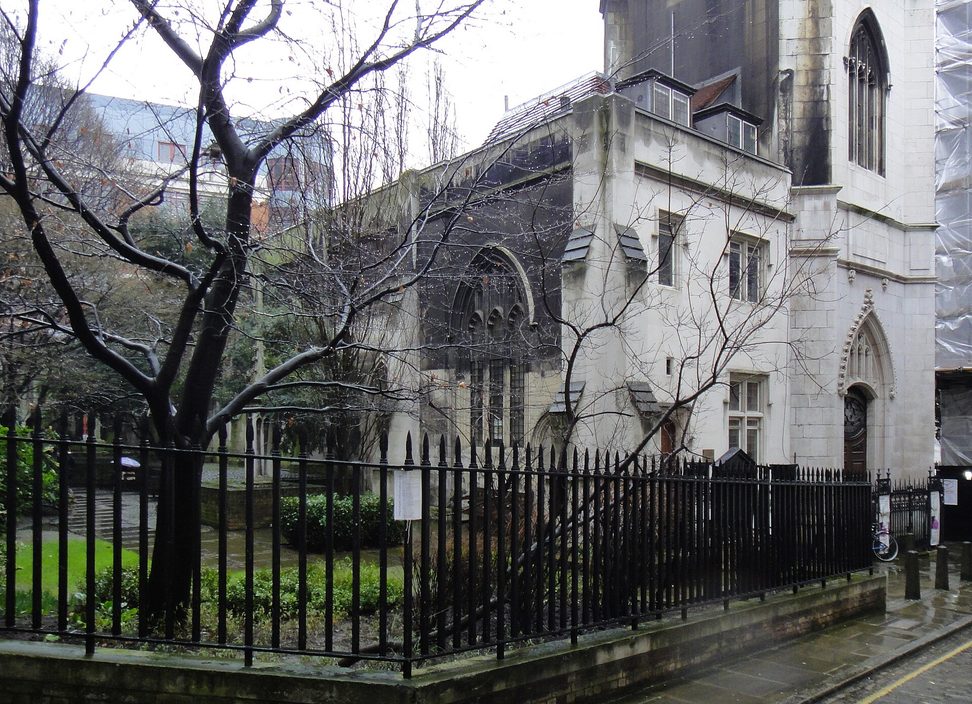
Between London Bridge and the Tower of London, the bombed shell of St Dunstan-in-the-East has been a public garden since 1971. Trees and climbers grow through the empty Gothic windows of the nineteenth-century nave, a low fountain sits on a cobbled circle where the congregation once sat, and Wren’s tower and spire still stand at the west end.
A medieval parish by the river
A church is said to have stood here from about 1100, and by the 1190s it had a large churchyard. The parish lay close to the Thames and the port, and the church grew with it. In 1366 it needed rebuilding, and the Archbishop had to compel the parishioners to pay their share; a new south aisle followed in 1391. The church was closed for a time in 1417 after a fatal brawl, and from the 1450s it housed a school, recognised in 1466 as one of London’s grammar schools. Repairs in 1631 cost more than £2,400.
Fire, Wren and a new nave
The Great Fire of 1666 badly damaged St Dunstan’s, but it was patched rather than rebuilt, in 1668–71. Sir Christopher Wren added the tower and spire in about 1695–1701; the mason was Ephraim Beauchamp, and Nicholas Hawksmoor may have helped. By 1817 the weight of the nave roof had pushed the walls seven inches out of upright, and the body of the church was taken down. David Laing, with William Tite assisting, rebuilt it in Perpendicular Gothic: the foundation stone was laid in November 1817 and the church reopened in January 1821, at a cost of about £36,000.
From bomb site to garden
In 1941 the Blitz gutted the church. The tower, spire and the north and south walls survived, and after the war it was decided not to rebuild. The ruin was listed Grade I in 1950, and the spire was reconstructed in 1953. In 1967 the City of London Corporation took on the site and its own architects and parks staff laid out a garden in the shell, the largest the Corporation made in the City in the twentieth century. A plaque records its opening by the Lord Mayor, Sir Peter Studd, on 21 June 1971 (the City’s own page gives 1970). The tower was restored in the early 1970s. The parish is now united with All Hallows by the Tower.
The visitor’s cheat sheet
| Where | St Dunstan’s Hill, London EC3R 5DD; a second gate is on Idol Lane |
|---|---|
| Opening hours | Daily, 8am to 7pm or dusk, whichever is earlier. Closed Christmas Day, Boxing Day and New Year’s Day |
| Admission | Free |
| Services | None regularly; occasional open-air parish gatherings |
| Access | The garden is on several levels, with steps and a cobbled area; step-free access is not confirmed, so check with the City Gardens team (020 7374 4127) if you need it |
| Toilets | None listed at the garden |
| How long | 20 to 40 minutes |
Hours and admission checked against the official site in November 2026. They change; the official site is always the last word.
What to see
There is no official plan of the garden, and where you start depends on which gate you use. This walk-round begins at St Dunstan’s Hill. The garden is also stop 12 on our City of London church walk.
The gates, walls and railings
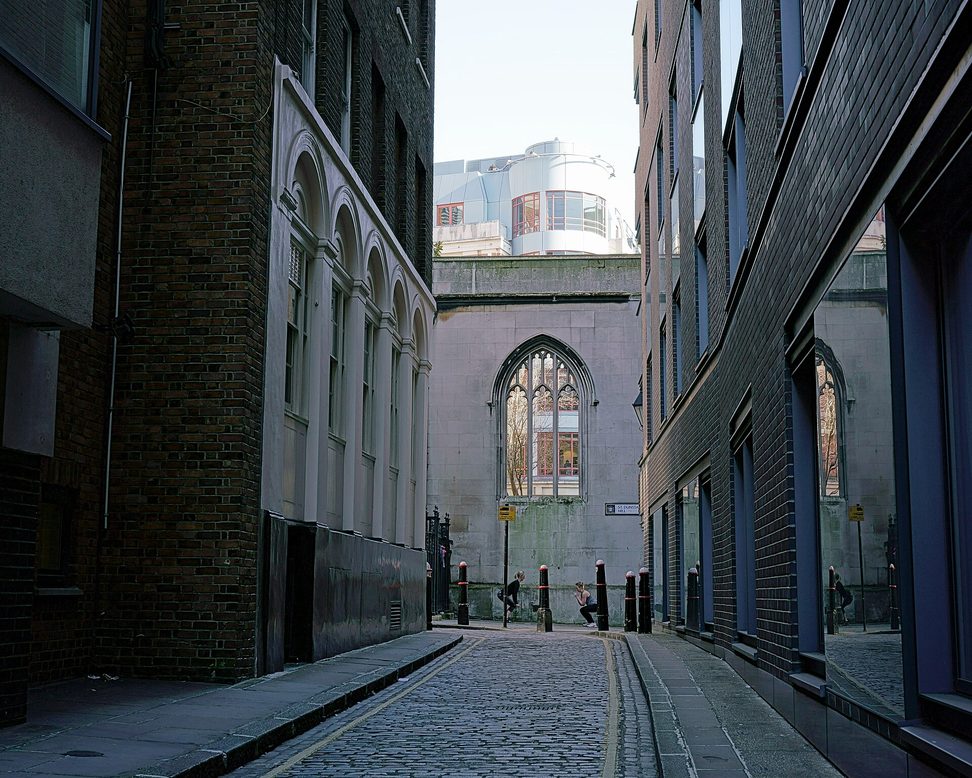
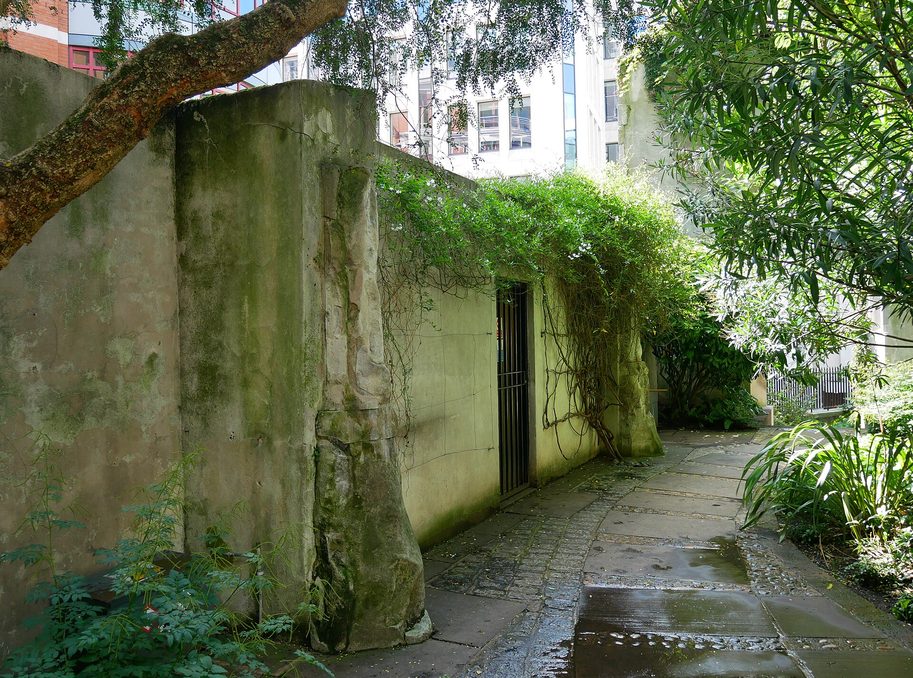
The boundary wall, gates and railings are listed in their own right, at Grade II; the brick wall is of late seventeenth-century origin, and the gates are early nineteenth-century in style. From the street you look through them into the ruin, with its tall window openings and trees, and the pale tower at the west end. The second way in, from Idol Lane, is reached along narrow City lanes.
Wren’s tower and spire
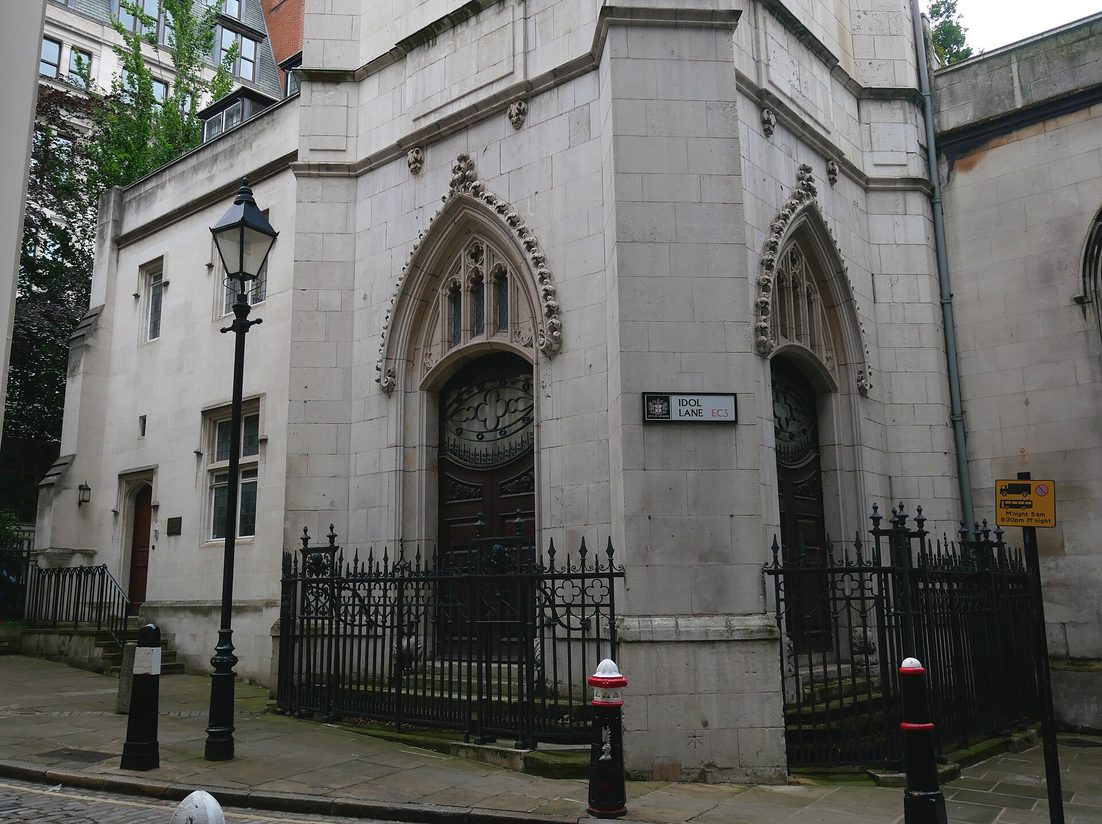
The tower is the only part of Wren’s design to survive. It rises in three stages of Portland stone, with diagonal buttresses climbing to octagonal corner turrets topped by finials. The stone spire stands on four open flying arches, a slender needle above the street; it is the 1953 reconstruction. Look at the Gothic doorways at its foot, behind railings. There is no public access to the tower.

The nave walls and windows
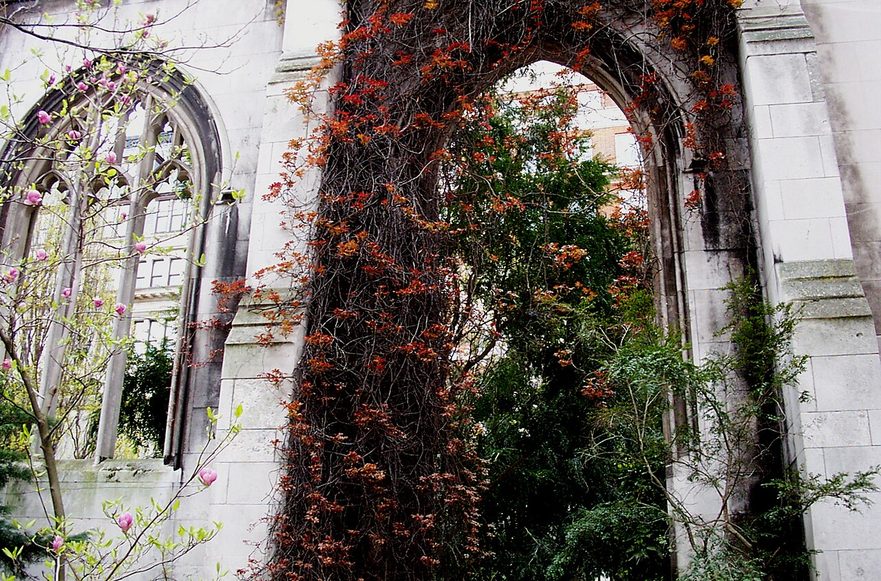
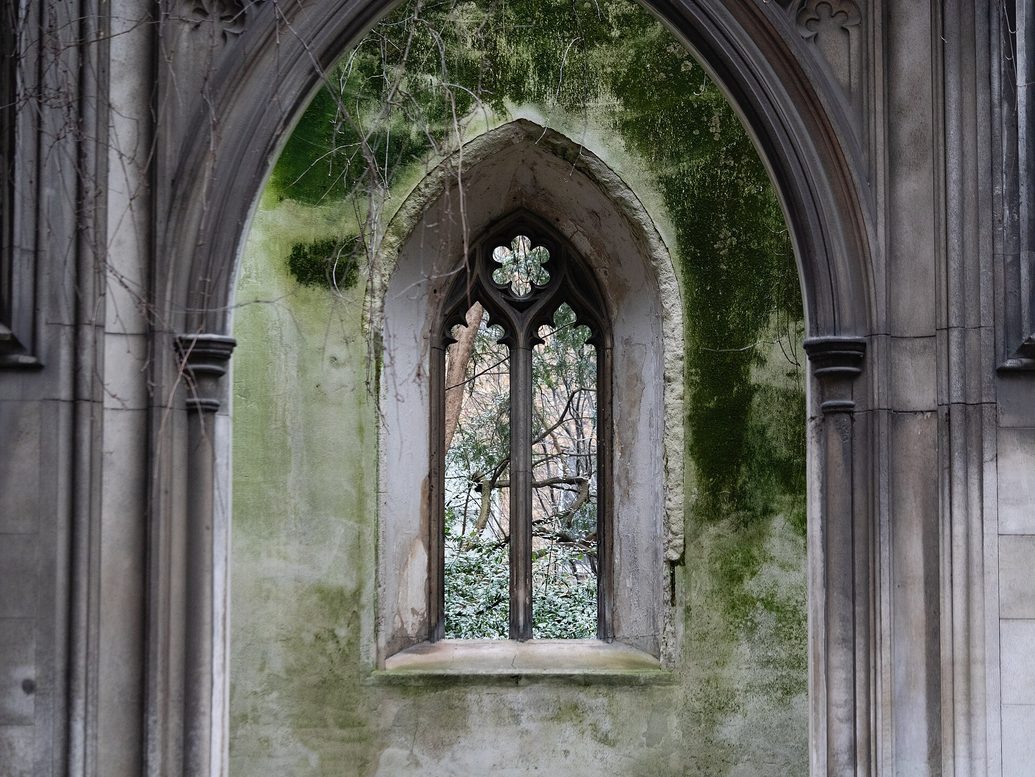
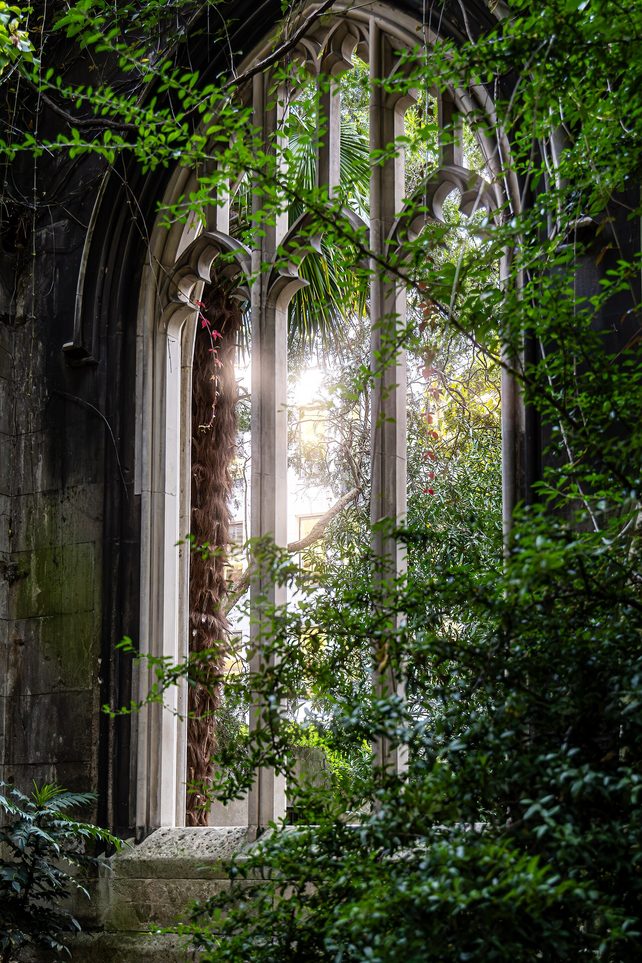
The walls around you are Laing’s of 1817–21: yellow brick faced in Portland stone, with buttresses, pinnacles and big traceried windows, now without glass. Ivy and creeper cover the stone, and trees grow through the openings, so each window frames a different tangle of leaves.
The fountain
In the middle of the old nave, set low on a circle of cobbles, is a plain fountain with benches around it. This is where most people sit, and on a weekday lunchtime the benches fill with office workers.

The planting and the levels
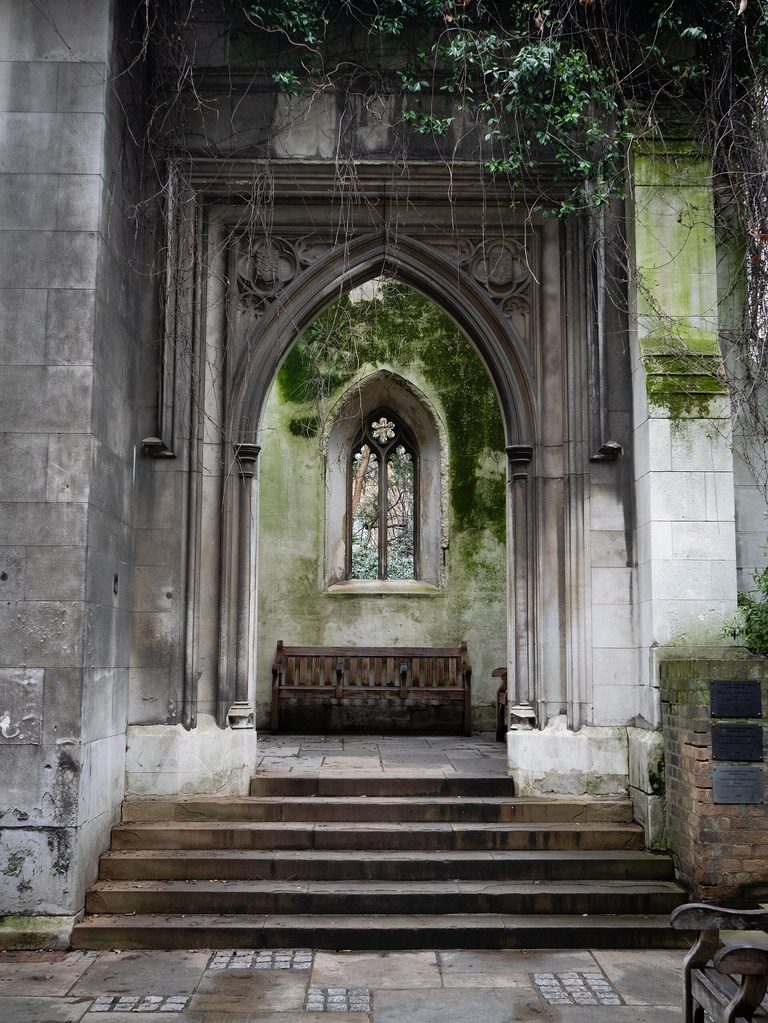
The garden is on several levels, with steps leading up through old doorways to quieter corners. Among the arches and tracery the City has planted unusual trees, shrubs, flowers and climbers, trained against the walls, including a fig tree; ferns and palms add to the green. Look out for the plaque from the 1971 opening, which records the 1971 opening.

The east end
At the east end the wall has been cut down to the level of the old window sill in the centre, and the north-east vestry still stands. Nothing of the furnished interior survived the bombing.
The view through the tracery
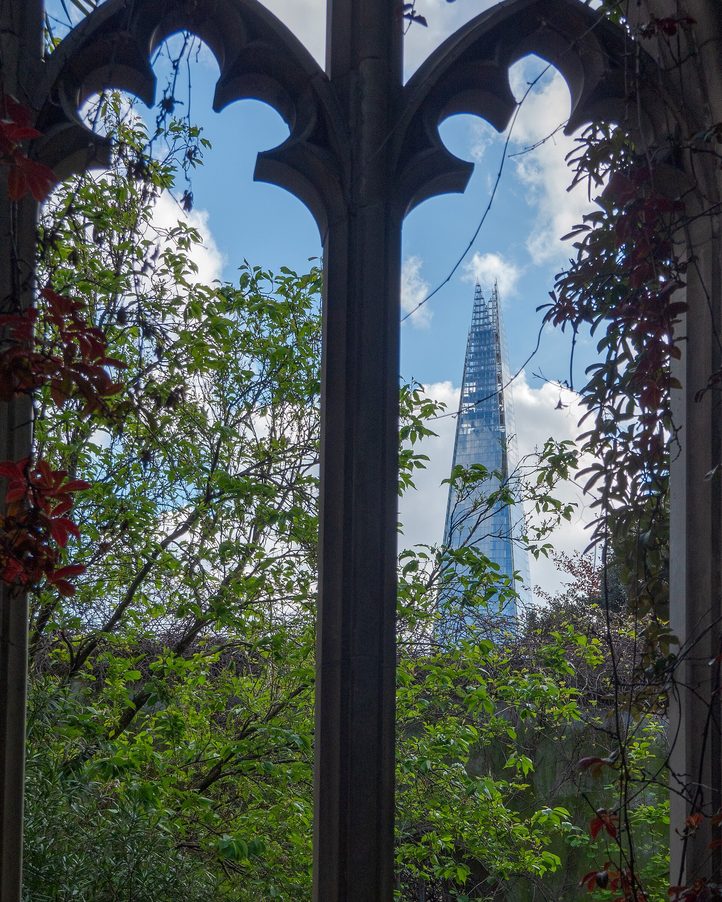
Before you leave, look south through the window openings. On clear days, especially in winter and early spring when the trees are thinner, the Shard can be glimpsed through the stone tracery.
Getting there
The garden is on St Dunstan’s Hill, just north of Lower Thames Street, between London Bridge and the Tower of London. The nearest Underground stations are Monument and Tower Hill, each a few minutes’ walk away; Bank and Cannon Street are a little further. All Hallows by the Tower, the parish church, is a short walk away, and St Mary-at-Hill and the old Custom House are close by. The garden closes at dusk, so winter afternoons are short.
Where to stay
The City and the streets around Tower Hill and London Bridge have plenty of hotels, though many are aimed at weekday business travellers.
This link goes to Booking.com. This site earns nothing from it at present — it is here because it is the quickest way to check what is actually available.
Don’t miss
- The tower and spire Wren’s Gothic tower and needle spire.
- The fountain On a cobbled circle in the old nave.
- The windows Trees and ivy through the tracery.
- The Shard Glimpsed through the arches.
Insider tips
Come early or at the weekend. The garden opens at 8am. Weekday lunchtimes are the busiest time.
Watch the clock in winter. The garden closes at dusk if that is before 7pm, so winter afternoons are short.
Planning a shoot? Casual photos are welcome, but wedding, portrait and commercial shoots need a licence from the City first.
Common questions
When is the garden open?
The City of London Corporation gives 8am to 7pm or dusk, whichever is earlier, every day except Christmas Day, Boxing Day and New Year’s Day.
Is it free?
Yes. It is a public garden with no admission charge, and no tickets or booking are needed.
Can I go inside the church or up the tower?
There is no roofed church to go into: the garden is the ruin. The tower is not part of the garden and has no public access.
Are there services here?
No regular services are held. The parish is now joined with All Hallows by the Tower, which holds occasional open-air gatherings and parish events here.
Can I take photographs?
Yes. The City welcomes visitors’ photos and videos without asking permission. Organised shoots, including wedding, engagement and portrait sessions and commercial or student work, need a licence or permit from the City first.
When is it quietest?
Early in the morning, or at the weekend, when the City’s offices are closed. Weekday lunchtimes are busy with office workers on the benches.
More English churches
- All Hallows by the Tower — the parish church, a short walk away
- St Sepulchre-without-Newgate — a large City church by Holborn Viaduct
- St Paul’s Cathedral — Wren’s great cathedral
See all the cathedrals and churches worth visiting in England →