
St Martin-in-the-Fields, Trafalgar Square
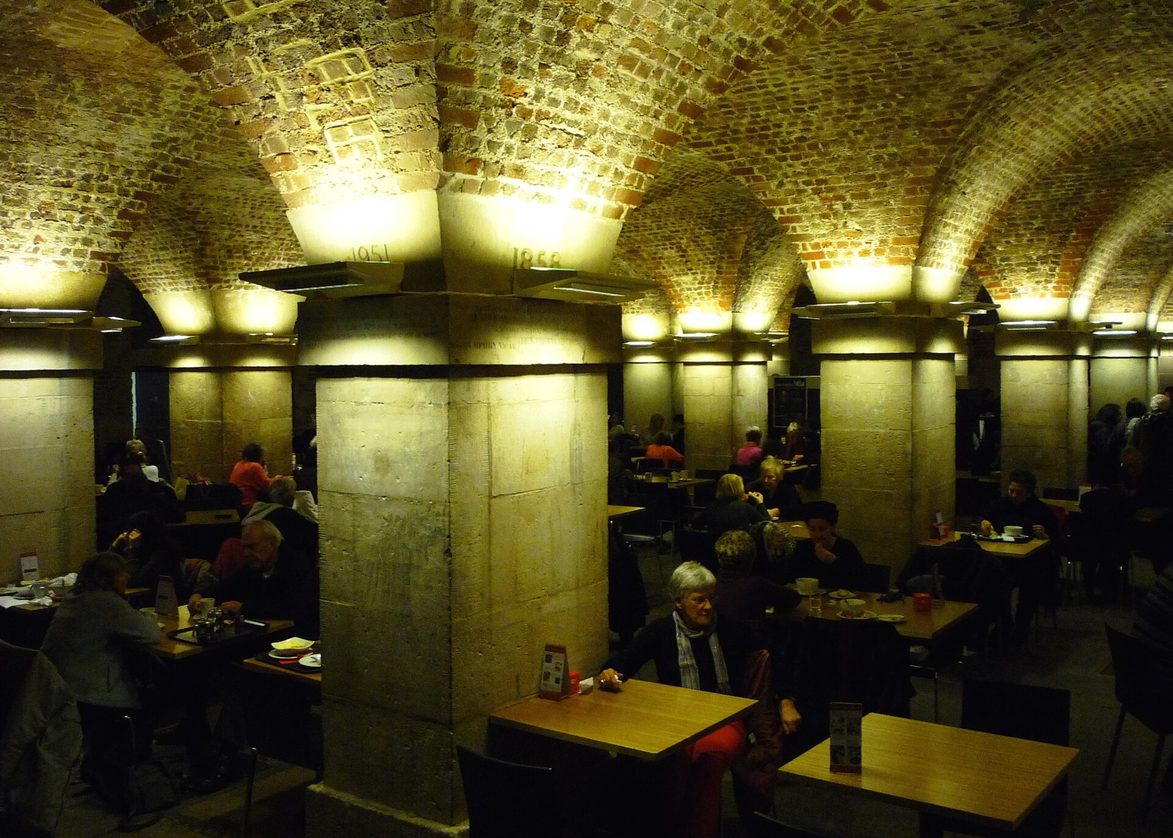
On the north-east corner of Trafalgar Square, St Martin-in-the-Fields is James Gibbs’s church of the 1720s, with a Corinthian portico and a tall steeple rising behind it – a design copied across the world. It is a working parish church with a long tradition of open doors, a café in its brick-vaulted crypt and a busy programme of concerts.
A church in the fields
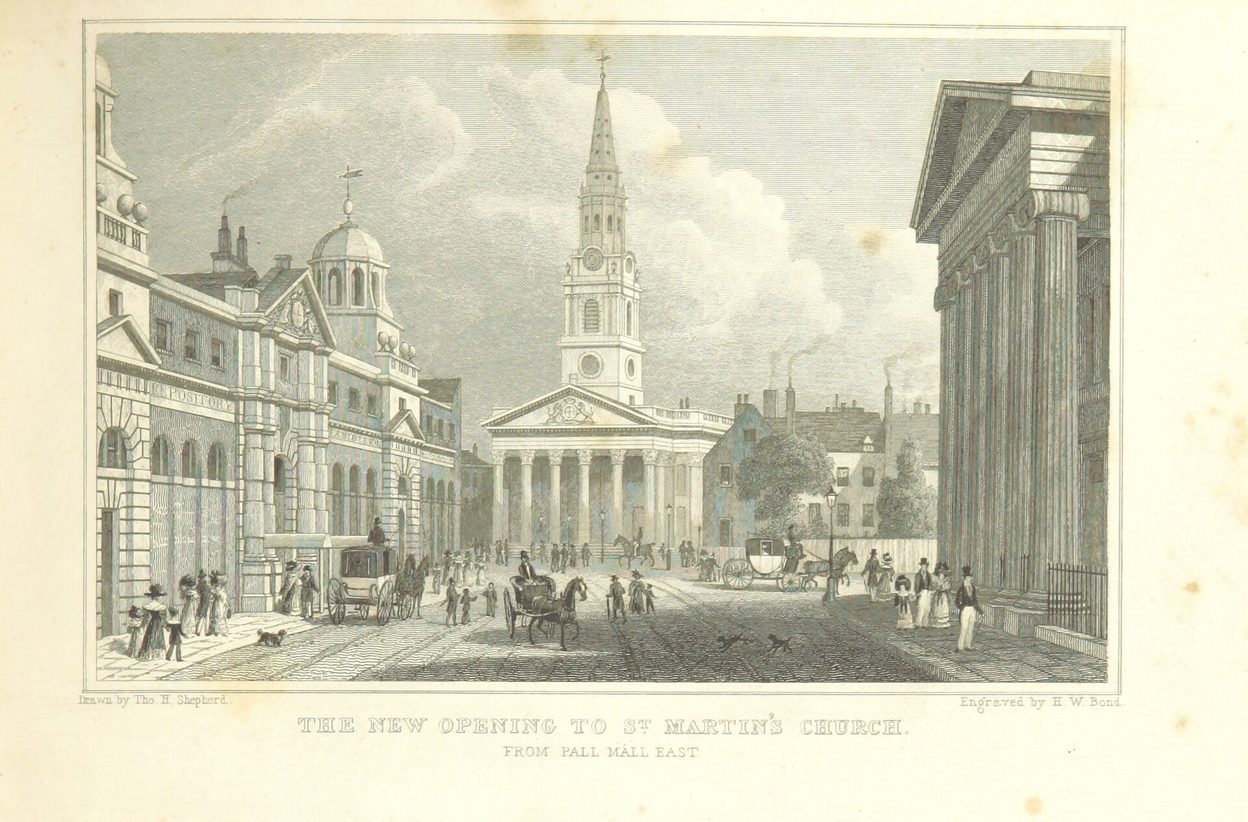
There has been a church on this site since at least the Middle Ages, when it stood in open country between Westminster and the City. Henry VIII had it rebuilt in 1542, and it was enlarged in the early seventeenth century. That older church saw the burials of the scientist Robert Boyle and of Nell Gwyn (buried 17 November 1687).
James Gibbs’s church
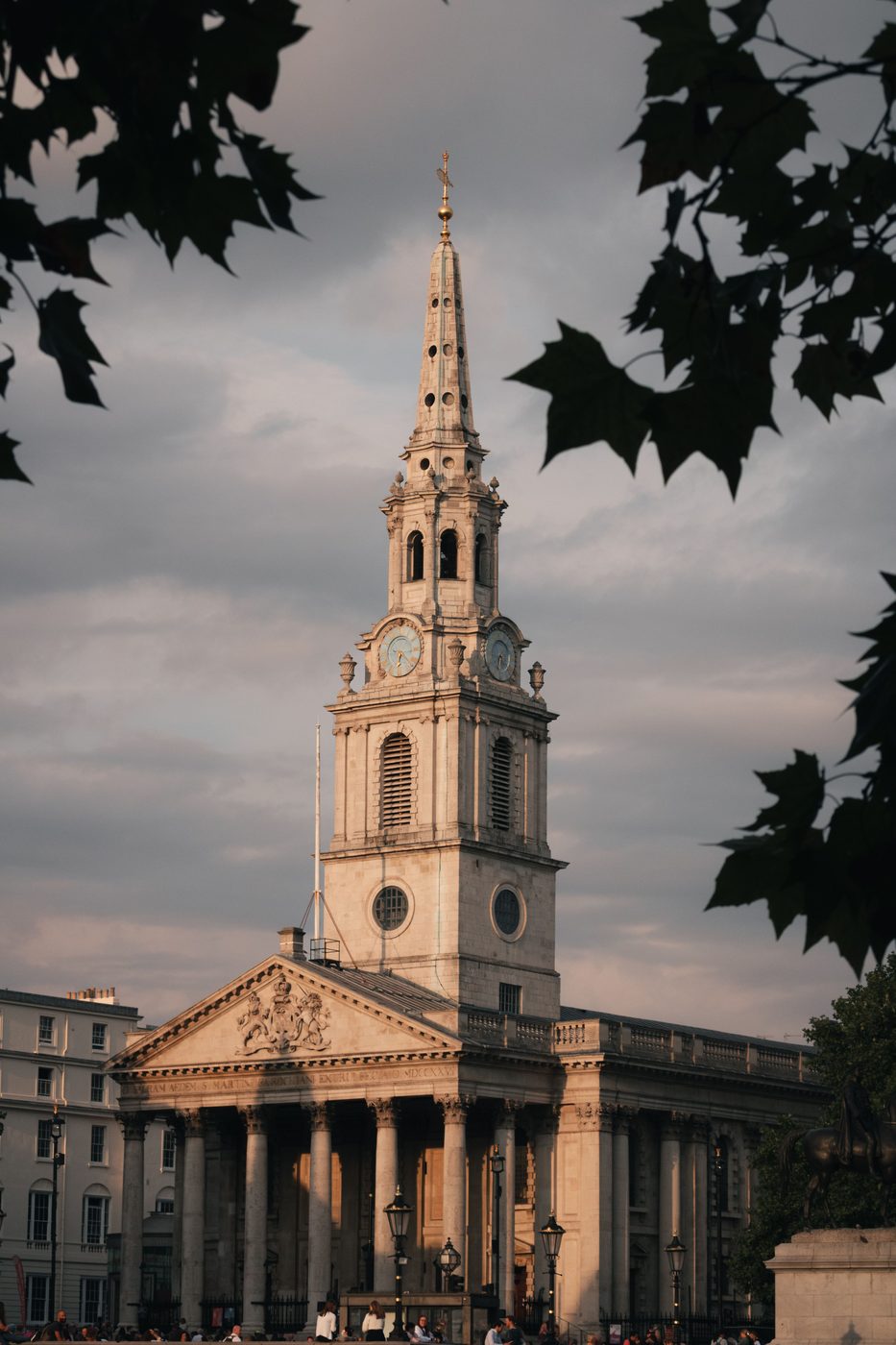
The present church was designed by James Gibbs. The foundation stone was laid on 19 March 1722, the last stone of the spire went up in December 1724, and the frieze of the portico is dated 1726. The Survey of London gives the cost, with the architect’s fees, as £33,661; George I gave the organ, at £1,500. Gibbs’s idea of a temple portico with a steeple rising from the roof behind it, 192 feet (59 metres) high, was much imitated, from St Michael’s in Charleston, South Carolina, to All Souls in Washington and St Andrew’s in Chennai. Among those buried here after 1726 were the sculptor Louis-François Roubiliac and the furniture maker Thomas Chippendale. The church is listed Grade I.
The ever open door
St Martin’s is the parish church of the royal family, with links to 10 Downing Street and the Admiralty. It is also known for its welcome to people in need. Dick Sheppard, vicar from 1914 to 1926 (some sources say 1927), called it the “Church of the Ever Open Door” and began its work with homeless people; on 6 January 1924 he led the first live church service broadcast by the BBC, from St Martin’s. In 2006–08 the whole site was renewed to a masterplan by Eric Parry Architects, at a cost of about £36 million, with a large Heritage Lottery Fund grant. The Gibbs church and crypt were conserved and new spaces built below ground.
The visitor’s cheat sheet
| Where | Trafalgar Square, London WC2N 4JJ; on the north-east corner of the square, across Duncannon Street from Charing Cross station |
|---|---|
| Opening hours | The church gives Monday, Tuesday, Thursday and Friday 9am–5pm; Wednesday 9am–7.30pm; Saturday 9am–2pm; Sunday 9am–6pm. Check, as services and concerts can close parts of the church |
| Admission | Free; concerts are ticketed, and brass rubbing costs from £6.50 |
| Services | Sundays: Sung Eucharist 10am, Choral Evensong 5pm; Wednesdays: Choral Evensong 4pm (check the church’s website, as times change by season) |
| Concerts | Lunchtime concerts on Fridays at 1pm (the church’s page currently gives £10, or £20 with lunch); candlelight concerts usually at 7pm (one Christmas 2025 concert was priced from £9 to £32). Box Office in the Crypt or 020 7766 1100 |
| Access | Ramp on the north (left) side; a lift links the church, the Crypt and the Lower Crypt |
| Toilets | Not listed in the sources we checked; ask at the church or the Café in the Crypt |
| How long | Half an hour for the church; longer with the Crypt, a concert or brass rubbing |
Hours and admission checked against the official site in November 2026. They change; the official site is always the last word.
What to see
The portico and steeple
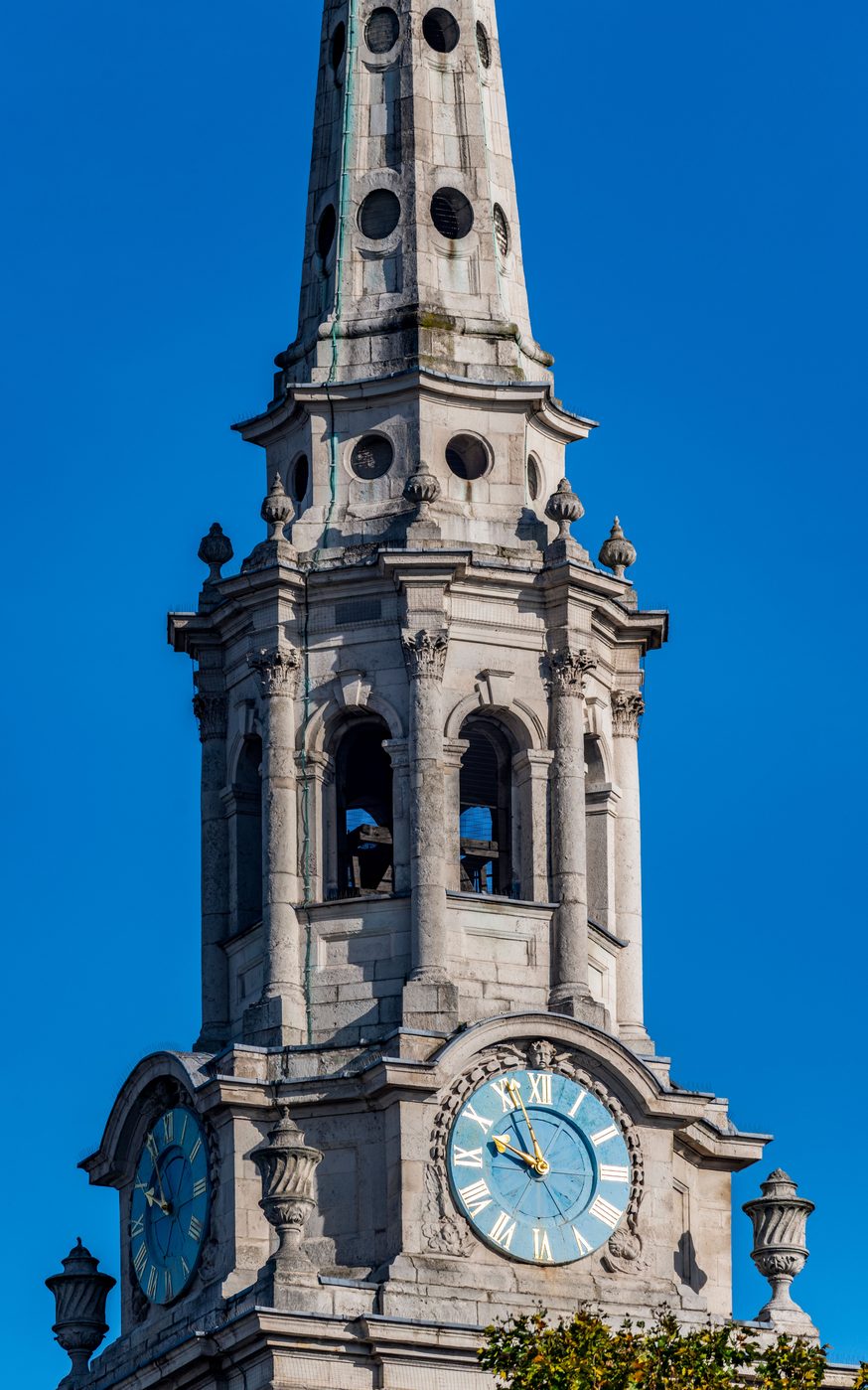
Start outside, on the steps. The portico has giant Corinthian columns carrying a pediment, with the date MDCCXXVI (1726) on the frieze, and the steeple rises in stages behind it to a clock and a slender spire. Under the portico stands Mike Chapman’s “In the Beginning”, a newborn child carved from a 4.5-tonne block of Portland stone and presented in 1999, with verses from St John’s Gospel cut into it.
Across the square
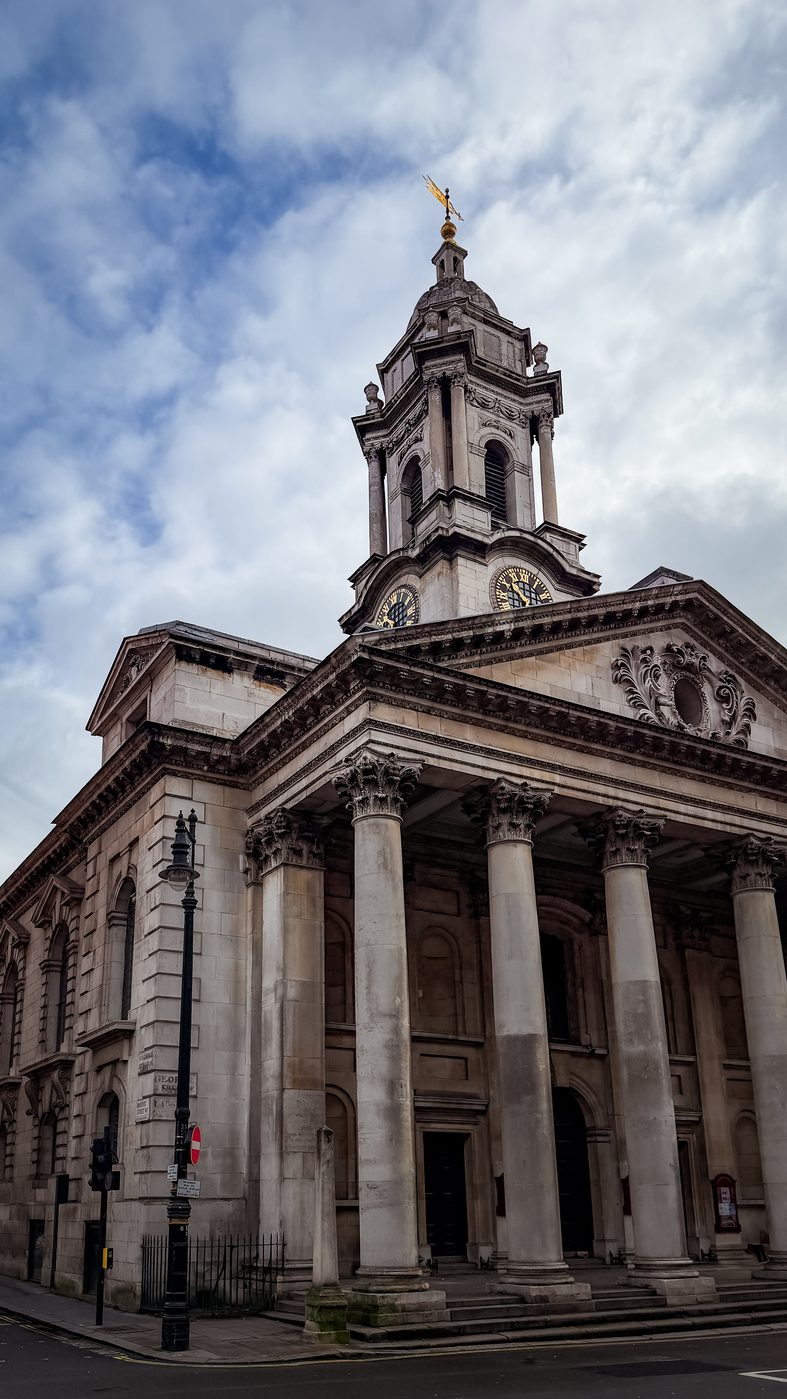
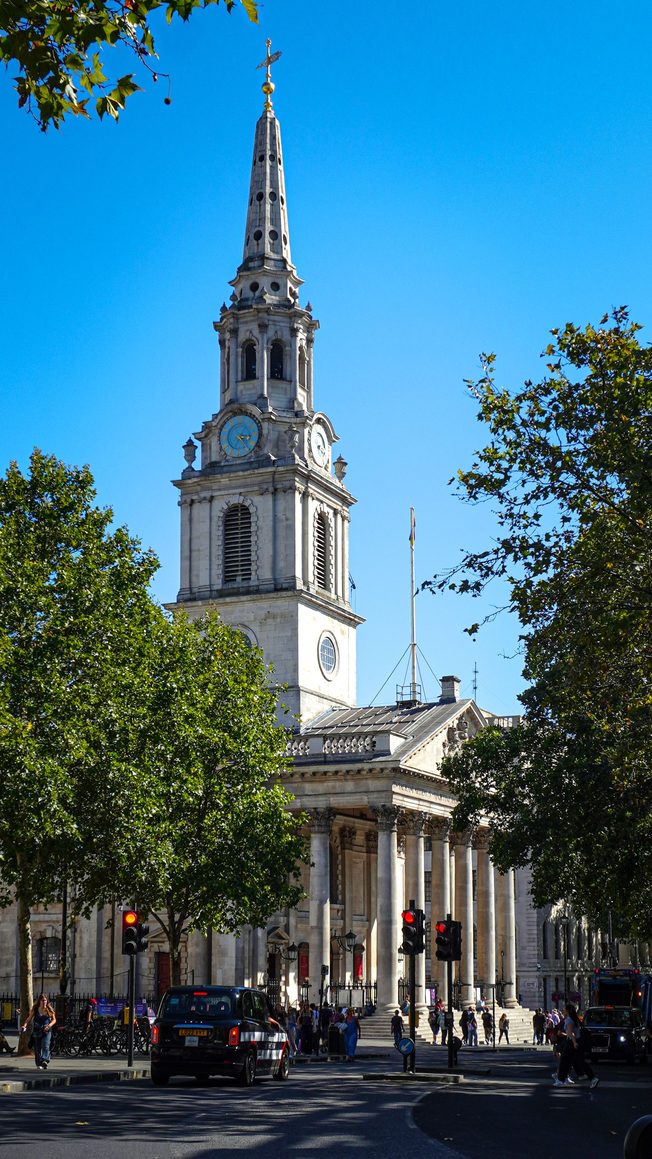
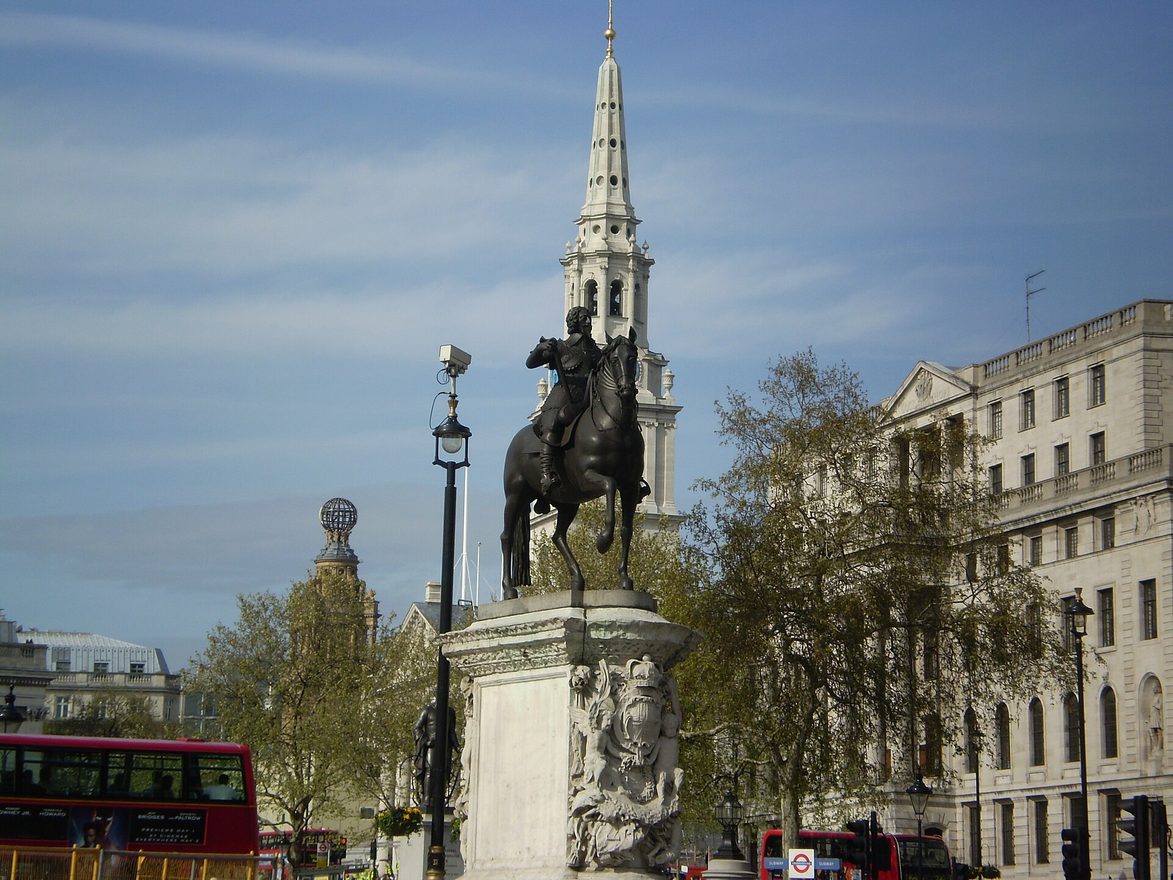
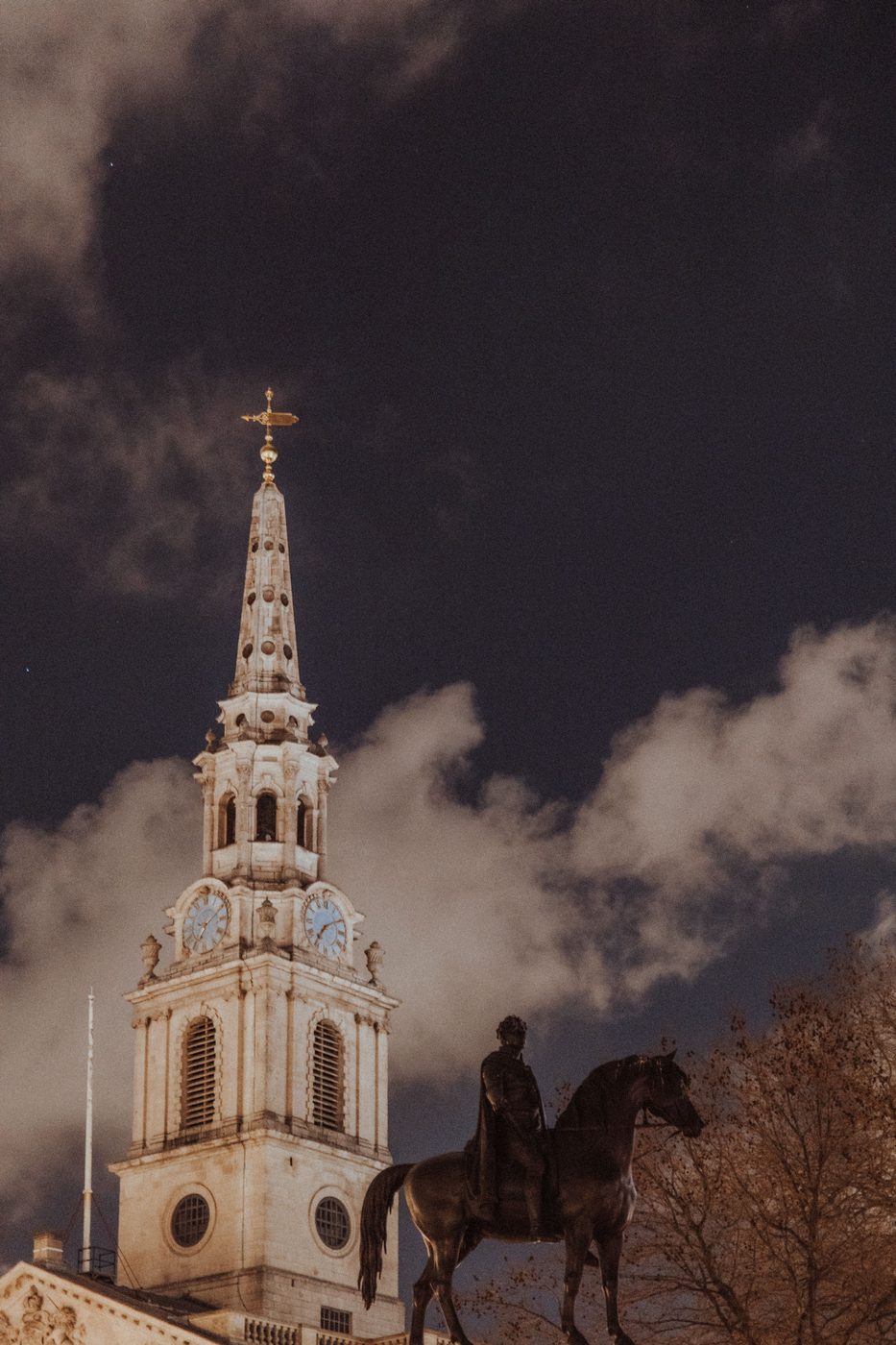
Step back across the road to see how the church closes the corner of Trafalgar Square, with the National Gallery beside it. From beside the statue of Charles I at the south end of the square you look back across the traffic to the steeple, and the lit spire makes a good view after dark.
The nave
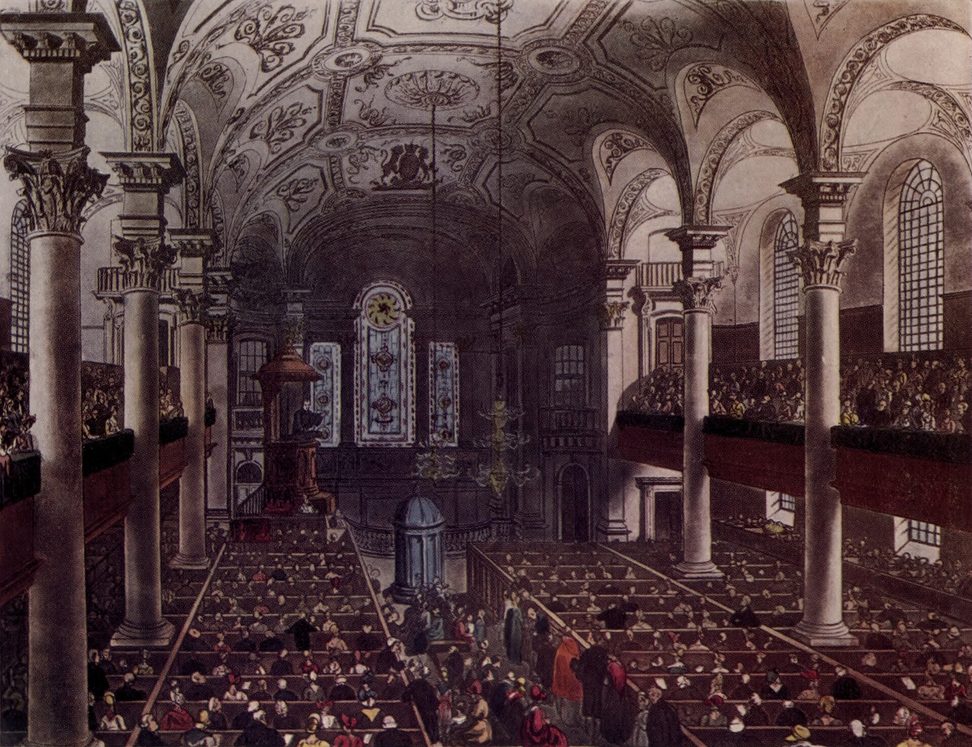
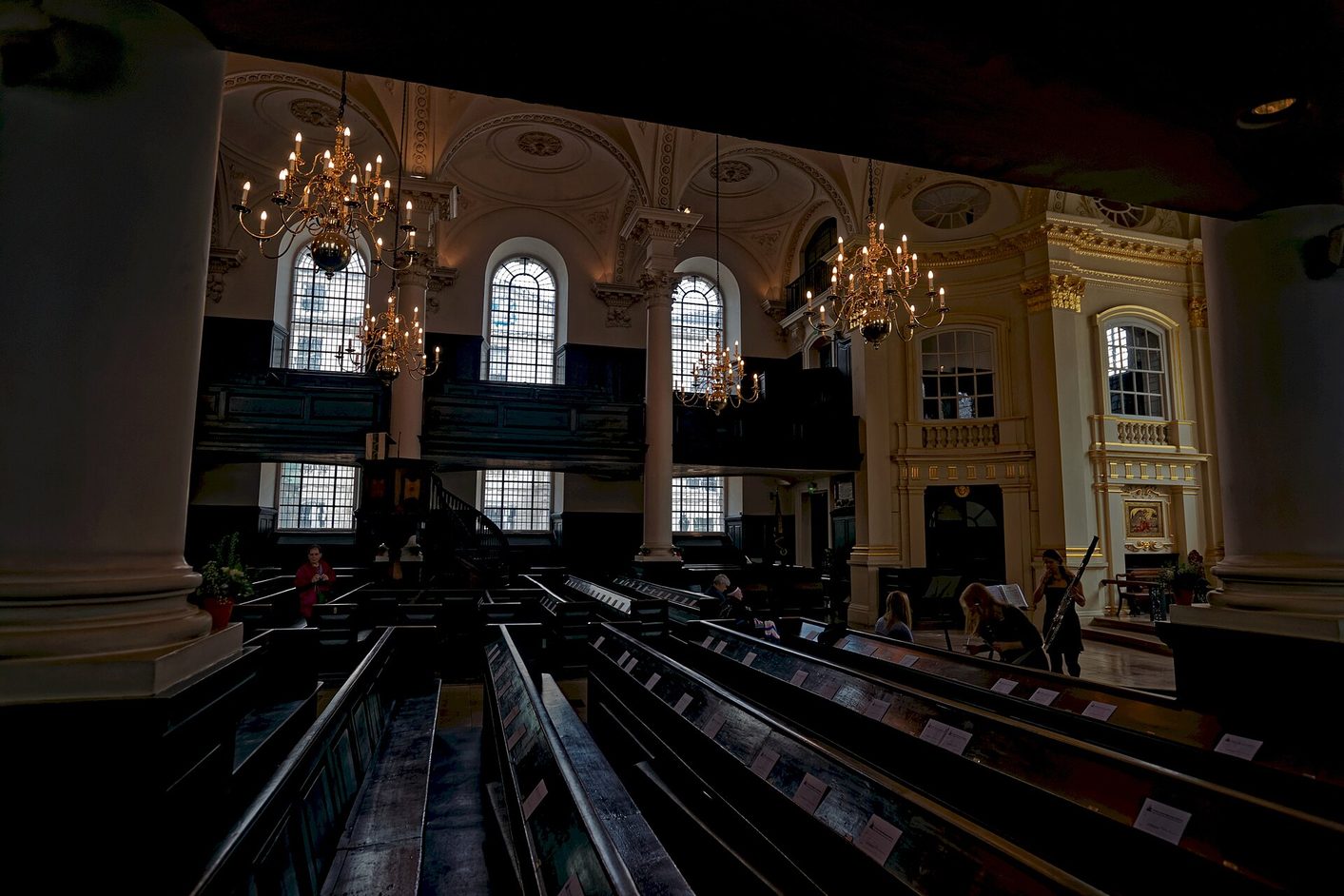
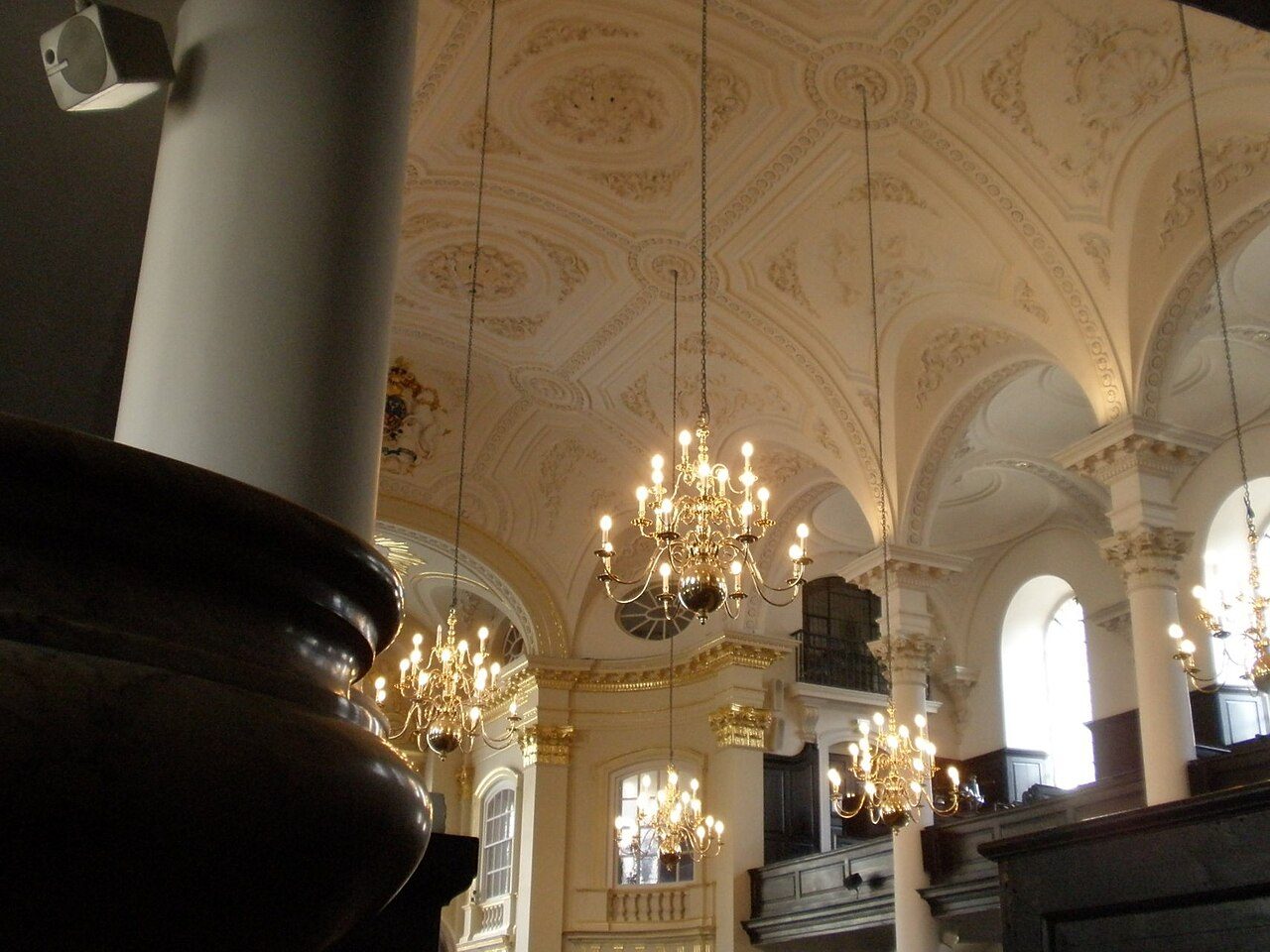
Inside, the nave is five bays long, with Corinthian columns carrying galleries on three sides. Two tiers of round-headed windows make it light. Look up at the semi-elliptical ceiling, with its plasterwork by the Italian stuccoists Giuseppe Artari and Giovanni Bagutti. At the east end, the Royal Box and the Royal Household pews flank the sanctuary. Gibbs’s east window now holds Shirazeh Houshiary’s etched glass, made with Pip Horne and installed in 2008: the frame looks warped, as if melting, and its lines suggest Christ on the Cross, with an eclipse of light at the centre. Houshiary and Horne also made the altar, dedicated in 2011, and Brian Catling made the processional cross, dedicated in 2013.
The pulpit and the font
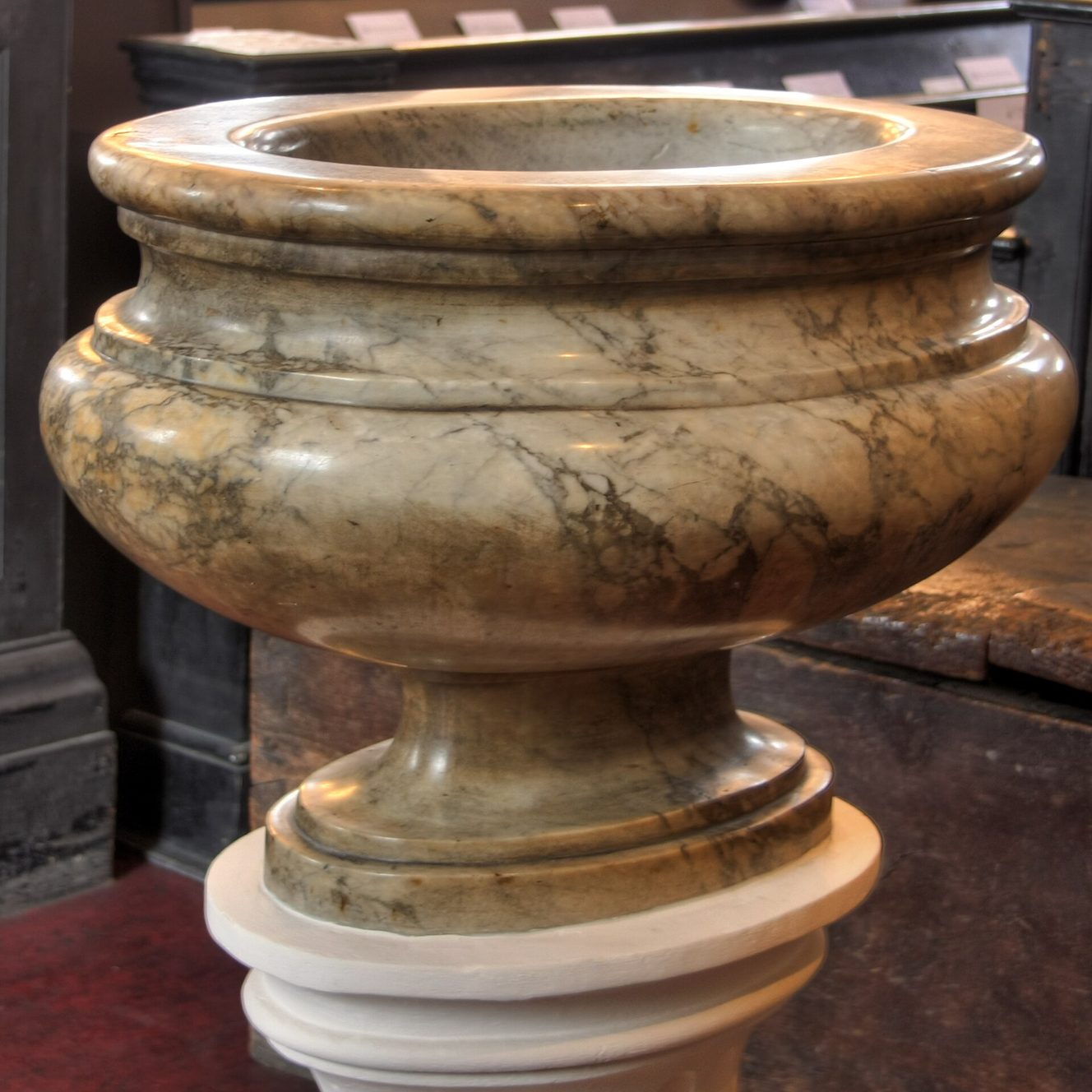
The hexagonal oak pulpit, with inlaid panels, was once part of a three-decker on the north side; in the nineteenth century it was moved to the south side without its sounding board. The font came from the earlier church: an elliptical marble basin on a fluted pedestal, with a carved oak cover, given by William Bridgeman in 1689.
The west gallery and the organ
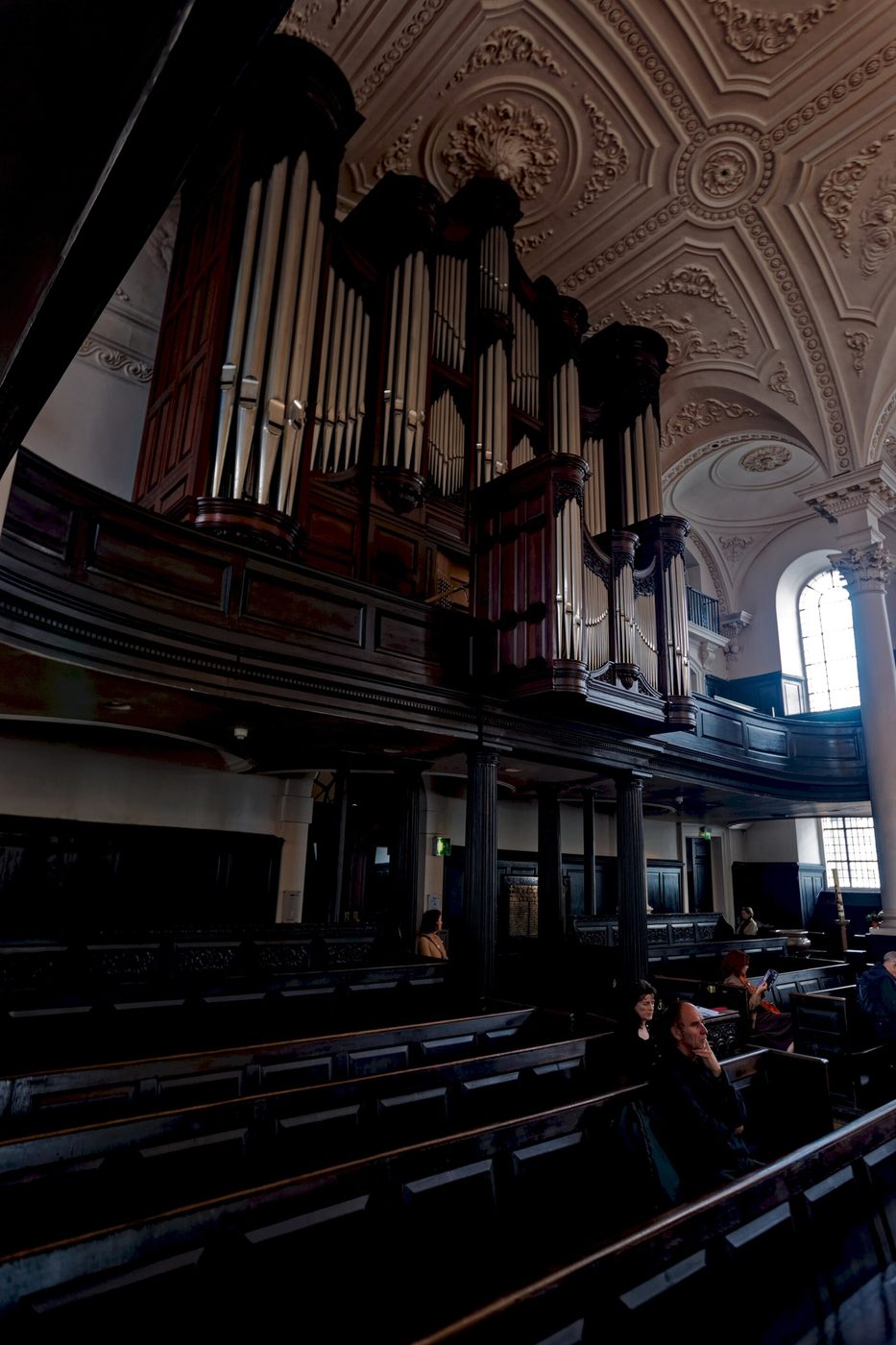
Turn to the west gallery for the organ, built by J. W. Walker & Sons in 1990. The original organ, the gift of George I, is now at Wotton-under-Edge in Gloucestershire. The church also has a Heritage edition of the St John’s Bible, given in 2009 and used in services; prints are shown in the Crypt gallery spaces.
The Crypt
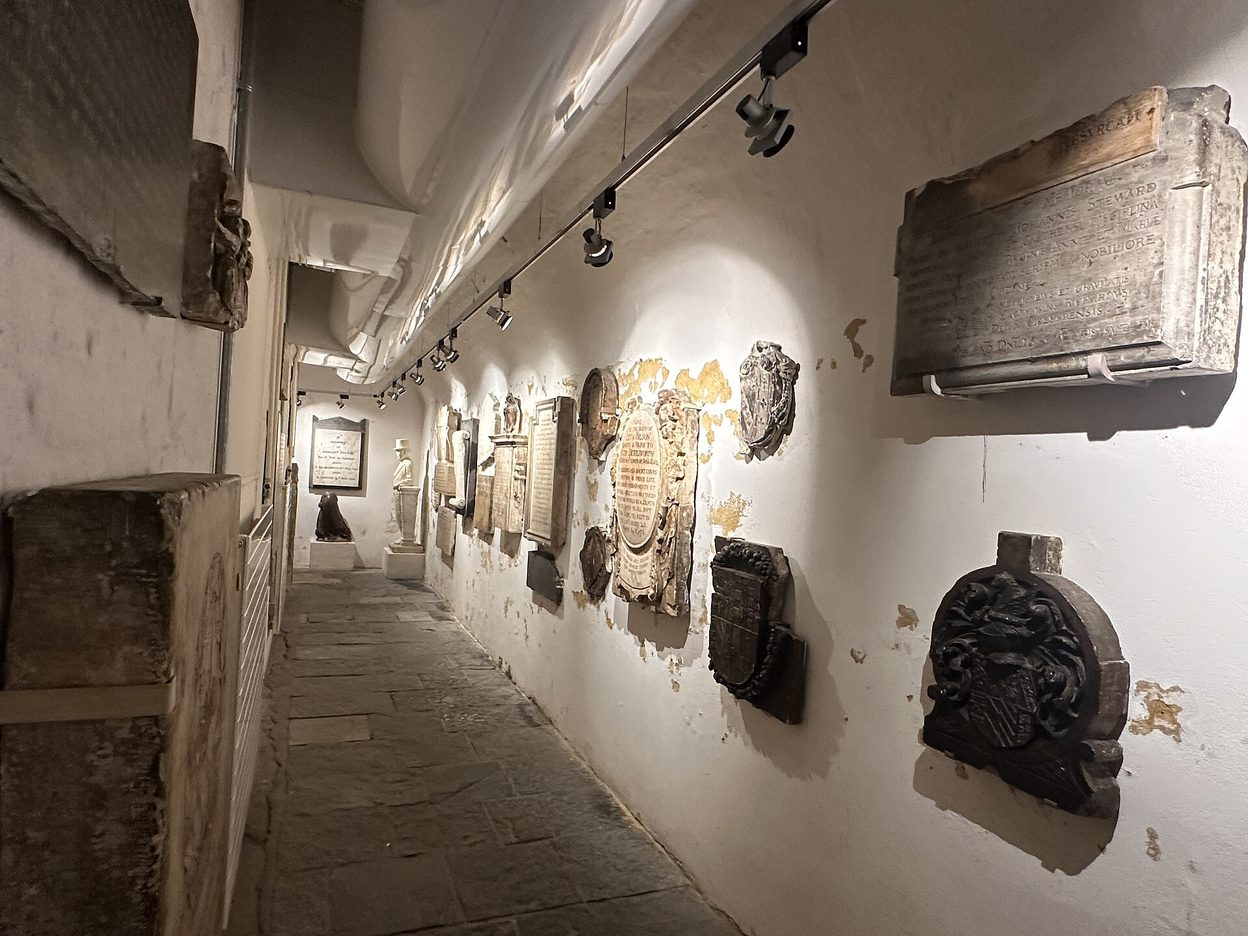
Go down by the glass pavilion on Church Path, on the north (left) side, or by the lift inside. The brick-vaulted Crypt holds the Café in the Crypt, a gift shop, gallery spaces and the London Brass Rubbing Centre, founded in 1975, where rubbing costs from £6.50 with no need to book. Memorial stones and fragments from the old church are fixed to the walls, and the statue of Henry Croft, the first Pearly King, was moved here in 2002. In the Lower Crypt is the Dick Sheppard Chapel, open for quiet prayer at some times when the church is closed; ask the staff.
A note on our pictures
We do not show Shirazeh Houshiary’s east window or the 2011 altar, Brian Catling’s cross, or Mike Chapman’s “In the Beginning” under the portico. They are recent works still in copyright, so we describe them in words instead; you can see them all for yourself on a visit.
Getting there
Charing Cross station (National Rail, Northern and Bakerloo lines) is the nearest: leave the main concourse, cross the Strand, and the church is across Duncannon Street, a couple of minutes’ walk. Leicester Square and Embankment Underground stations are a few minutes’ walk away, and Embankment is also the nearest river pier. Many day and night buses stop around Trafalgar Square. There is no parking. The National Gallery is next door, the National Portrait Gallery is just behind, and Westminster Abbey is about fifteen minutes’ walk down Whitehall.
Where to stay
Hotels of every price range are within walking distance, around Covent Garden, the Strand and Westminster.
This link goes to Booking.com. This site earns nothing from it at present — it is here because it is the quickest way to check what is actually available.
Don’t miss
- The portico and steeple Gibbs’s much-copied design.
- The plaster ceiling Italian stuccowork of the 1720s.
- The 1689 font A survivor of the earlier church.
- The Crypt Brick vaults, café and brass rubbing.
Insider tips
Avoid service times. The church closes to sightseers during services, concerts and rehearsals, so a weekday morning is usually the easiest time to look round.
Christmas. In past years the run-up to Christmas has brought candlelit carols, family carols, Handel’s Messiah and Midnight Mass; the 2026 dates were not yet published when we checked, so see the church’s What’s On.
Lunch in the Crypt. The Café in the Crypt is open to all and is run by the church, which uses the money to support its work (check the café’s own hours).
Common questions
Is it free to visit St Martin-in-the-Fields?
Yes, there is no admission charge to look round the church when it is open. Concerts are ticketed, and brass rubbing in the Crypt costs from £6.50.
When is the church open?
The church gives Monday, Tuesday, Thursday and Friday 9am–5pm, Wednesday 9am–7.30pm, Saturday 9am–2pm and Sunday 9am–6pm. Check before you go, as services, concerts and rehearsals can close parts of the church to sightseers.
Are the lunchtime concerts free?
They were long billed as free, but the church’s current concert page gives £10 a ticket, or £20 with lunch in the Crypt. Check the official website for the concert you want.
How do I book a candlelight concert?
Through the church’s own website, at the Box Office counter in the Crypt, or by phone on 020 7766 1100 (Monday to Saturday, 11am–5pm). Tickets are also sold by resellers.
Is the church step-free?
Yes, with a ramp on the north (left) side; a lift links the church with the Crypt and the Lower Crypt.
Who designed the church?
James Gibbs. It was built in 1722–26 and its portico and steeple were widely copied.
More English churches
- Westminster Abbey — a short walk down Whitehall
- St Bride’s Church — Wren’s church off Fleet Street
- St Paul’s Cathedral — Wren’s great domed cathedral
See all the cathedrals and churches worth visiting in England →