
St Michael’s Abbey, Farnborough
On a wooded hill beside the Farnborough Road in Hampshire, the Empress Eugénie built a Late French Gothic church and, beneath it, an Imperial Crypt for her husband Napoleon III and their only son. It is still a working Benedictine monastery, and the church and crypt are not a drop-in sight: the public way in is the guided tour every Saturday at 3pm (minimum donation £7) or one of the sung Latin Masses and services.
An empress in exile
After the fall of the Second Empire in 1870, Napoleon III, the Empress Eugénie and their son, the Prince Imperial, went into exile in England, at Camden Place in Chislehurst. The emperor died there on 9 January 1873 and was buried at St Mary’s, Chislehurst. Six years later the Prince Imperial was killed in the Zulu War.
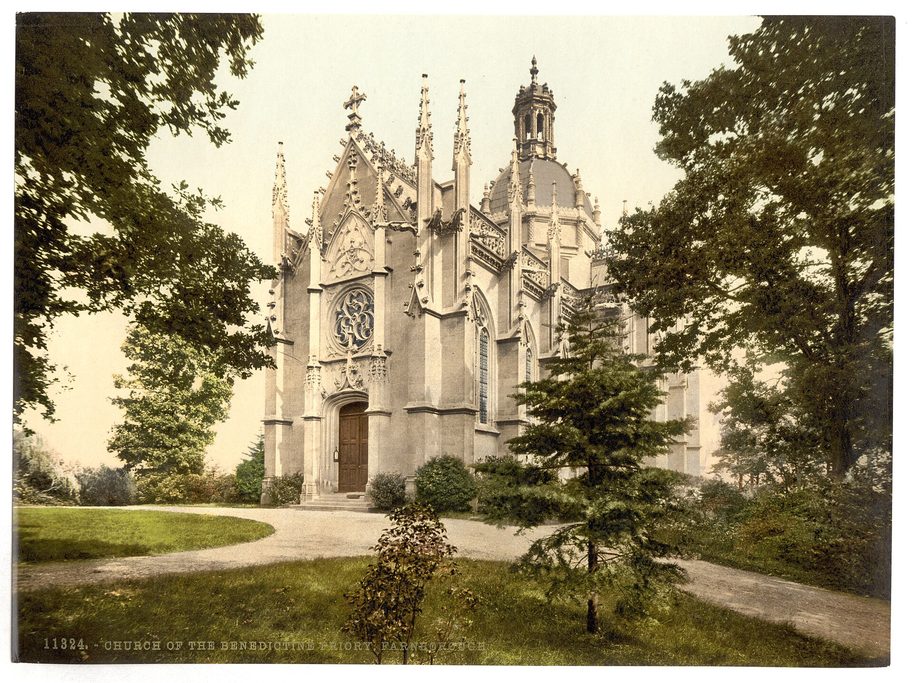
In 1880 Eugénie bought the Farnborough Hill estate in Hampshire and set about giving her husband and son a fitting resting place. Her architect was the Frenchman Gabriel-Hippolyte Destailleur, who revised his designs for a mausoleum church on a hill south of the house, across the railway line. The abbey was founded in 1881; the church was built in the 1880s (the listing description dates it 1886–87), and on 9 January 1888, fifteen years to the day after the emperor’s death, his remains and those of the Prince Imperial were placed in the crypt.
Monks from France, then England
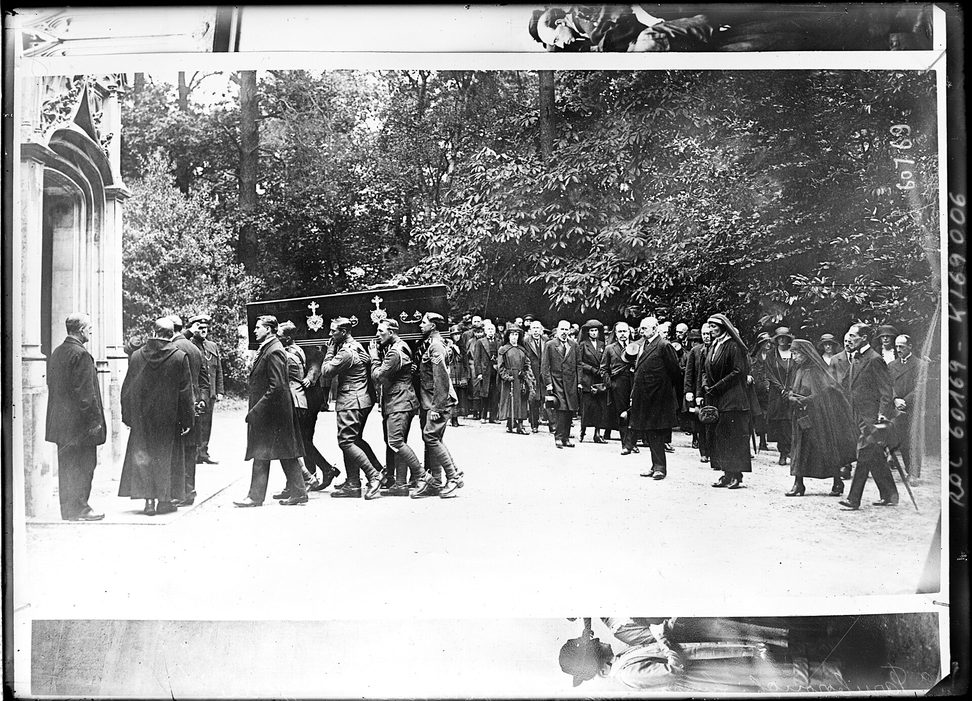
Eugénie first brought Premonstratensian canons to serve the church. In 1895 they were replaced by French Benedictines from Solesmes, and in 1903 the priory was raised to an abbey, with Dom Fernand Cabrol as abbot until 1937. Eugénie died in 1920, aged 94, and was buried beside her husband and son; King George V and Queen Mary attended her funeral on 20 July 1920.
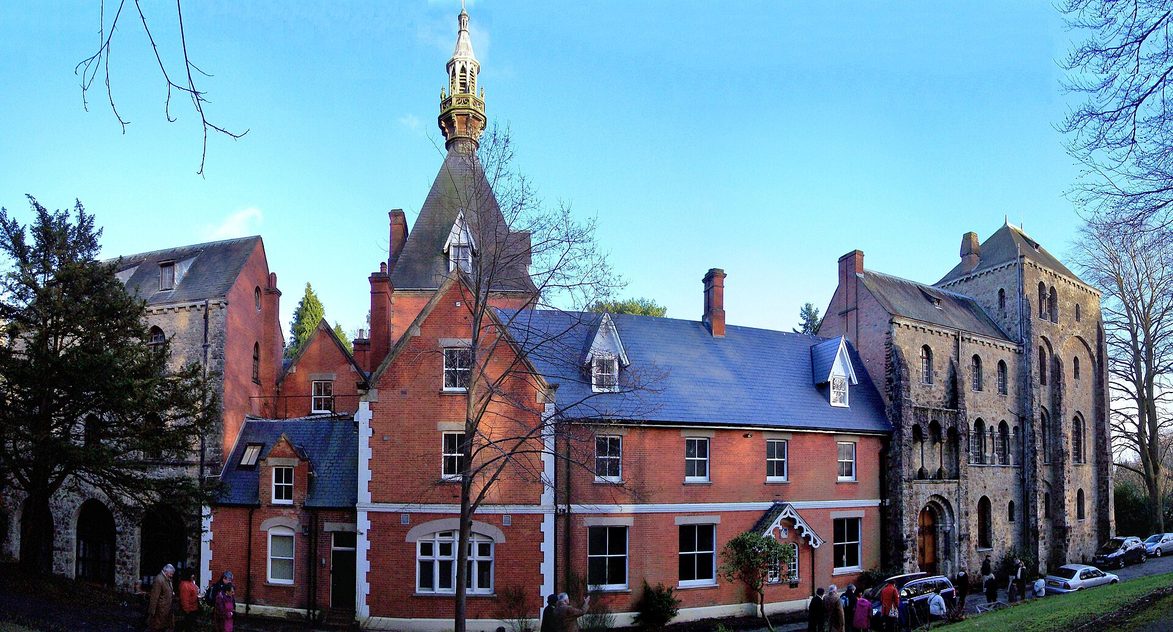
In 1947 English monks from Prinknash Abbey in Gloucestershire resettled the house, and in 2006 Dom Cuthbert Brogan became its first English abbot. The National Shrine of St Joseph was set up here in 2008, and from 2007 to 2015 the abbey housed the Catholic National Library. The church is listed Grade I. The community is an enclosed one: the monastic buildings are not open, and the monks still pray the Office through the day, with Mass and Office sung in Latin to Gregorian chant.
The visitor’s cheat sheet
| Where | 280 Farnborough Road (A325), Farnborough, Hampshire GU14 7NQ |
|---|---|
| Opening hours | Not open for casual visits. Guided tour every Saturday at 3pm (gates open 2.45pm); otherwise by arrangement, phone 01252 546105, Monday–Friday 10am–4pm. Bank-holiday tours unconfirmed: check before you go |
| Admission | Saturday tour: minimum donation £7 per person, children free. No booking needed. No charge for services |
| Services | Sunday Mass 9am; Sunday Vespers and Benediction 4.45pm; weekday Mass 8am; sung in Latin to Gregorian chant. Gates open half an hour before and close as Mass begins |
| Tours | About an hour, covering the church and the Imperial Crypt, ending in the monastery shop; groups by arrangement |
| Access | Not stated by the abbey; the crypt is reached by a flight of steps. Ask by phone |
| Toilets | Not stated; ask on arrival |
| How long | About an hour for the tour |
Hours and admission checked against the official site in November 2026. They change; the official site is always the last word.
What to see
This walk-round follows the order of the Saturday tour as it has been described; the details may vary from week to week, and the guide decides what is opened.
The gates and the drive
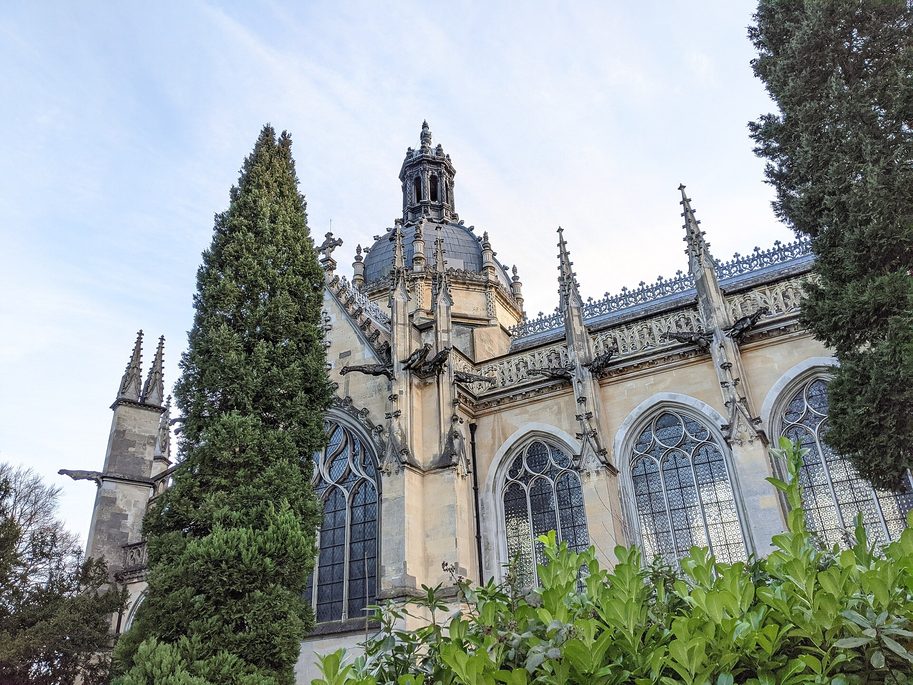
The tour gathers outside the iron gates on the Farnborough Road, which open automatically at 2.45pm. From there a winding drive climbs through woodland to the church, and the copper dome appears above the pines, a view that one architectural writer called one of England’s great unknown views.
The exterior
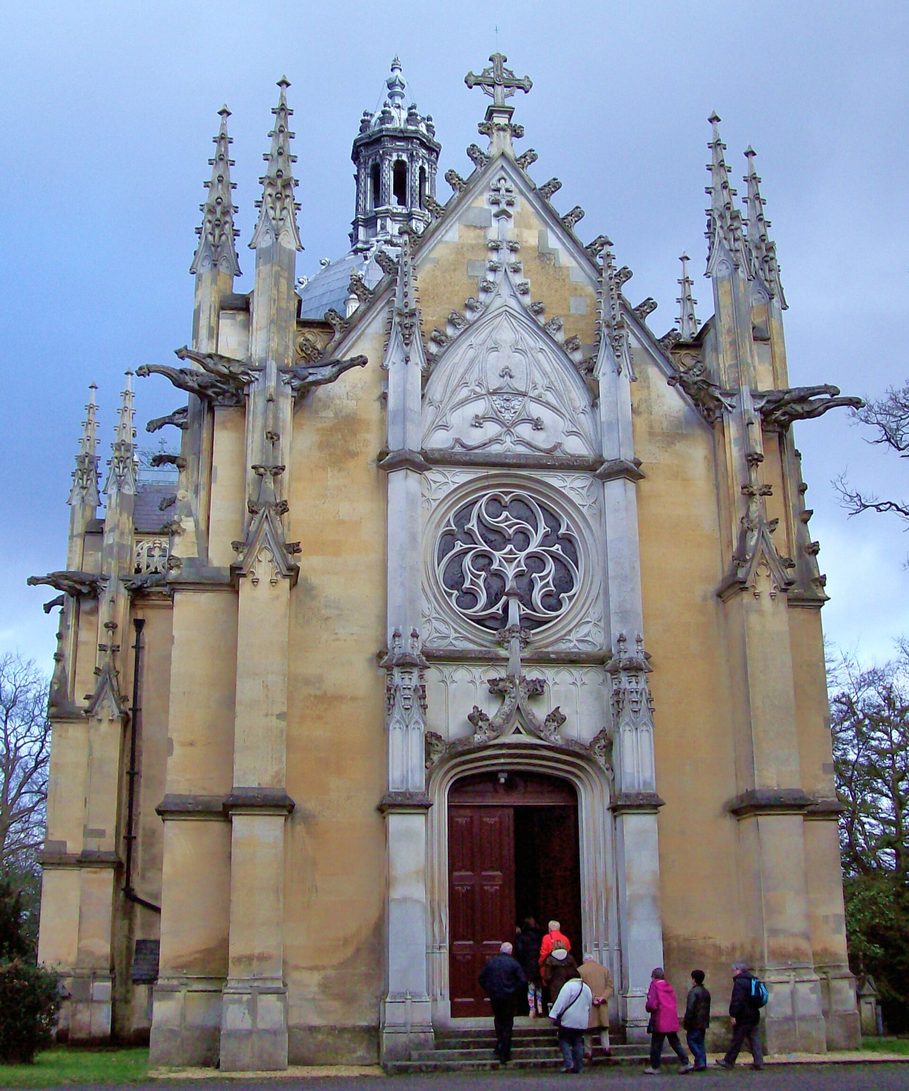
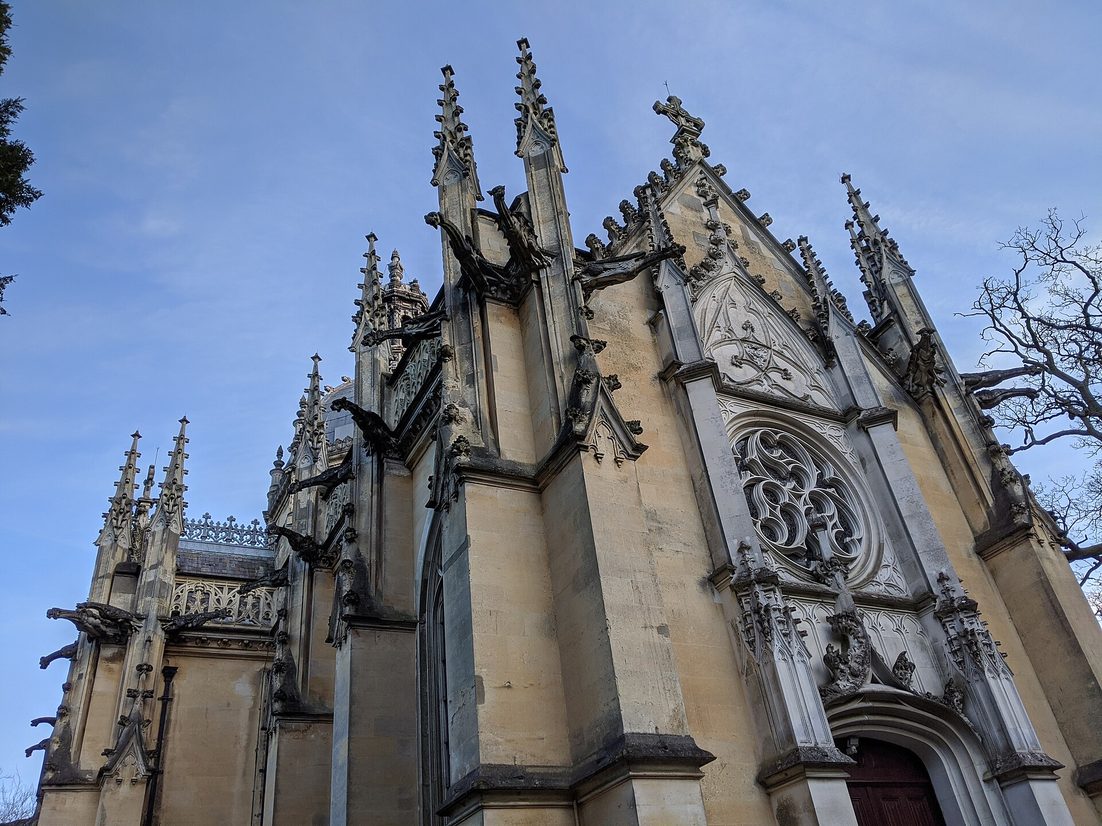
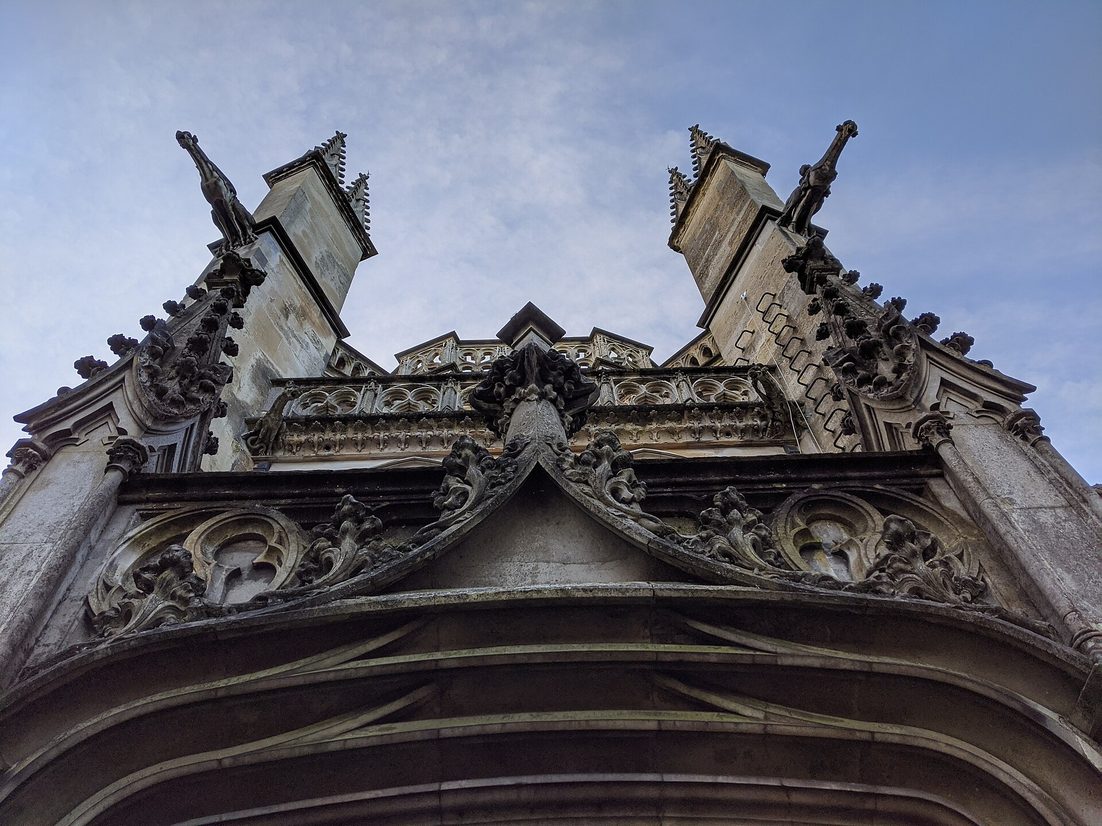
Destailleur’s church is Late French Gothic in pale ashlar: an aisleless nave with short transepts and an apsidal east end, pinnacled buttresses, a traceried parapet with gargoyles, and flying buttresses at the east end. Above the central west door is a circular Flamboyant window. Over the crossing rises an octagonal tower capped by a copper dome.
The nave
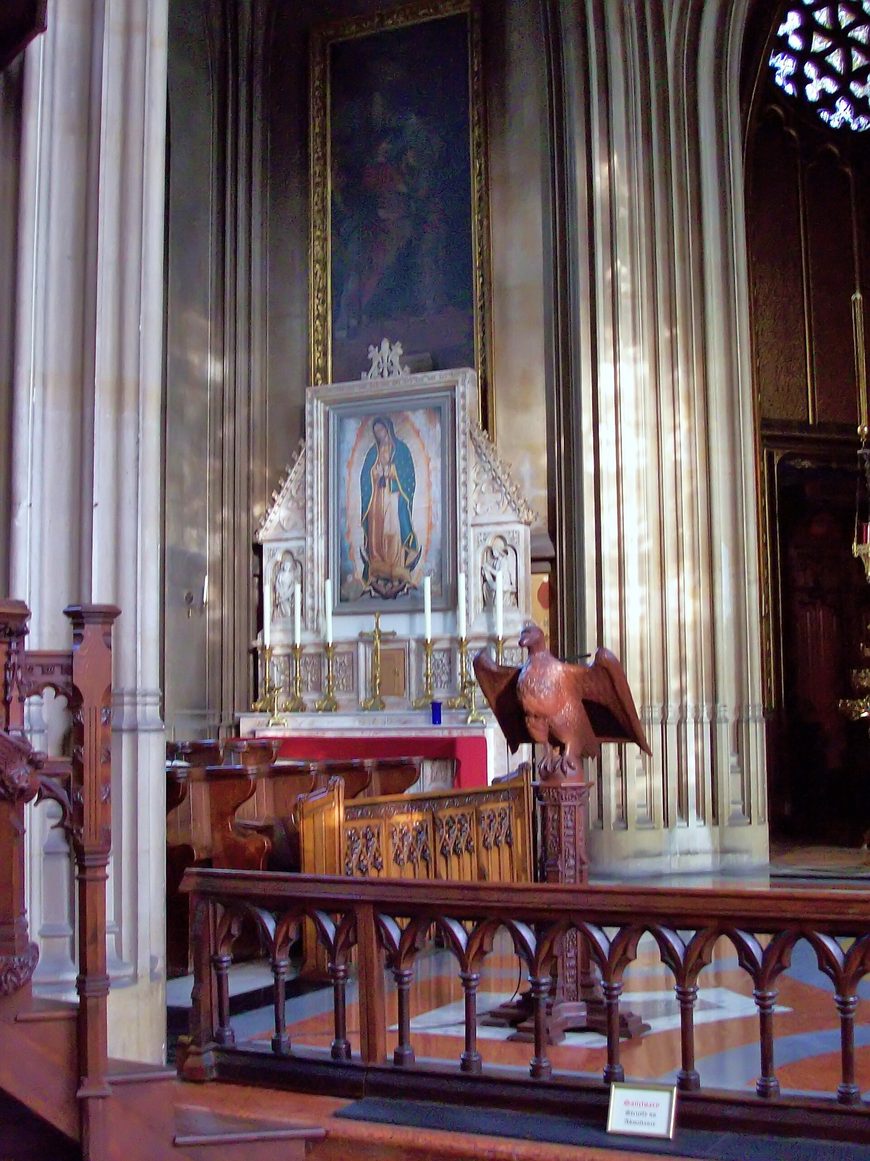
A monk unlocks the west door, and visitors sit in the pews while a local guide tells the story of the building. The nave is lit by six large windows of bottle glass rather than pictorial stained glass, and Gothic transverse arches rise into the vault. Look on the walls and pillars for the Napoleonic emblems of eagles and bees.
The crossing and the transepts
At the crossing the dome stands on high squinches decorated with Napoleon III’s heraldic arms, and is divided by sixteen ribs. The transepts hold copies of the side panels of Rubens’s Descent from the Cross in Antwerp Cathedral. The monks now sing the Office in the north transept; the choir stalls were once in the apse.
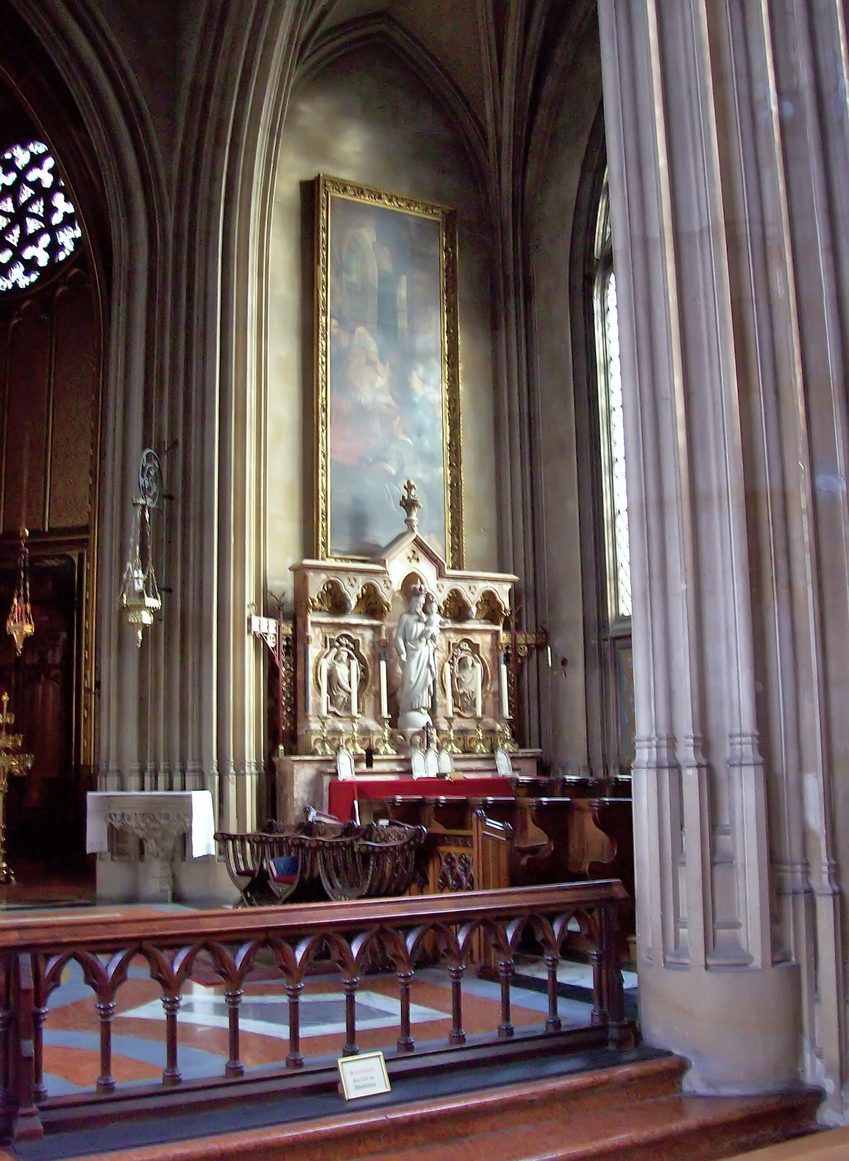
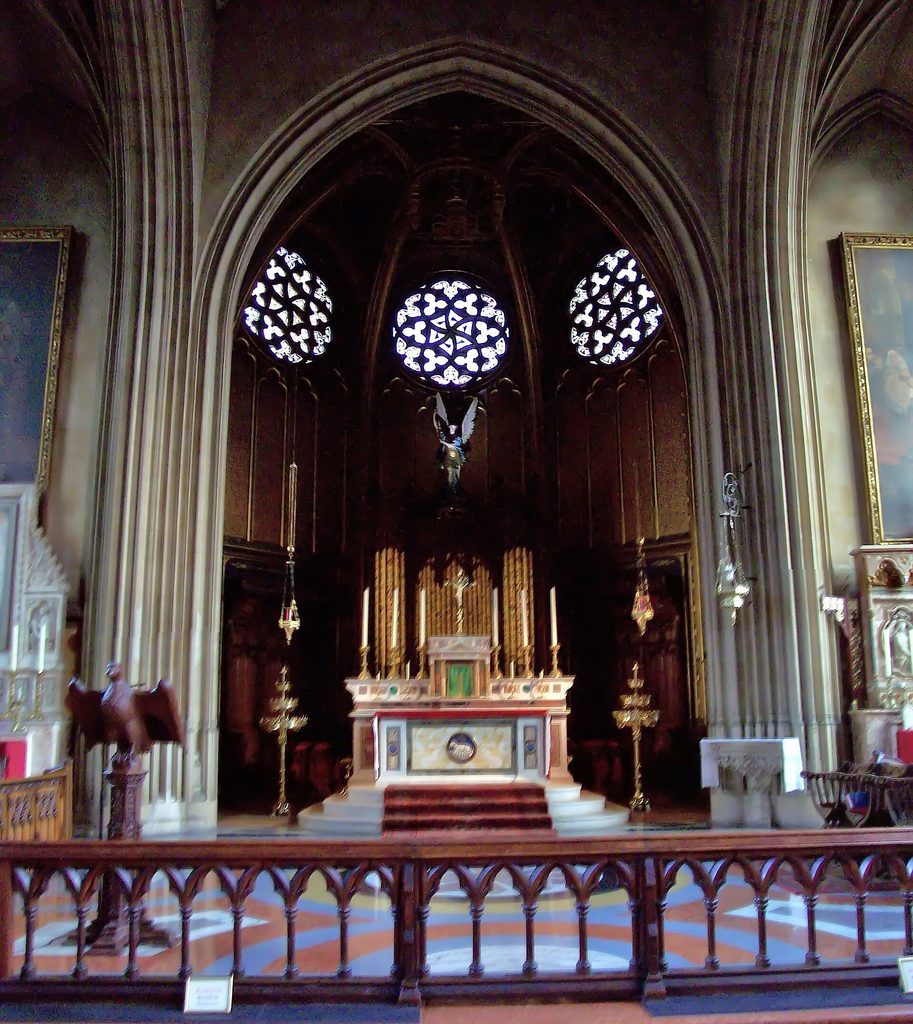
The apse and the high altar
At the east end, flying ribs converge on a suspended corona, and a flat ceiling rests on slender classical colonnettes, a design copied from the church at La Ferté-Bernard in France.
The organ, the relic and the shrine
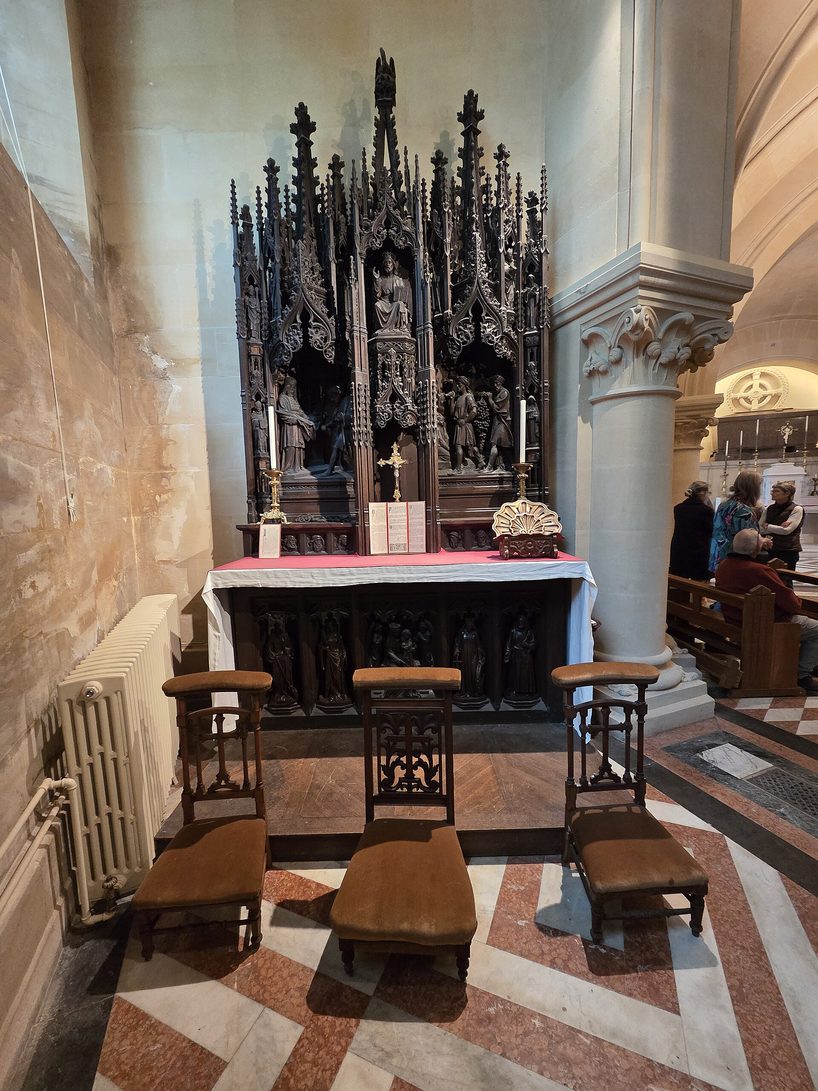
The two-manual organ was installed in 1905 by the French firm Cavaillé-Coll & Co. The abbey also keeps a relic of St Alban, part of a thigh bone, said to be the largest relic of the saint in England, and the National Shrine of St Joseph, centred on a statue of the saint that Cardinal Manning crowned in the 1870s; it came from the Mill Hill Fathers’ missionary college. No source we have says that the relic and the shrine are part of every tour, so ask the guide.
The Imperial Crypt
The climax of the tour is the crypt beneath the eastern arm, reached through a large porch at the back of the church and down a flight of steps. Accounts differ on its model: some point to the royal crypt of Saint-Denis near Paris, others to the Romanesque crypt of Saint-Eutrope at Saintes. Here lie Napoleon III, the Prince Imperial and the Empress Eugénie in three granite sarcophagi, given by Queen Victoria and said to be of Scottish granite. Eugénie is described as lying above the altar, between her husband and her son, whose tombs with their recumbent effigies stand in side chapels; the guide will show you which is which. No source names the sculptors of the tombs or effigies.
The shop
The tour ends in the monastery shop, which is also open on weekdays from 10.30am to 3.30pm.
A note on our pictures. We show no photographs of the Imperial Crypt. The abbey publishes no rules on photography inside the church or crypt, so ask the guide before you take any pictures.
Getting there
Farnborough (Main) station is very close: the abbey gates on the A325 Farnborough Road are only a short walk from the station, and trains from London Waterloo take about 40 minutes. By road, the abbey is some 30 miles from London, near junction 4 of the M3. The abbey does not say whether visitors can park; ask when you phone. The Empress’s house, Farnborough Hill, stands on the same road and is now a Catholic girls’ school; it is not normally open, though it has opened its house and grounds for Heritage Open Days in September.
Where to stay
Farnborough itself is the simplest base for the Saturday tour; it is about 40 minutes by train from London Waterloo.
This link goes to Booking.com. This site earns nothing from it at present — it is here because it is the quickest way to check what is actually available.
Don’t miss
- The Imperial Crypt The tombs of Napoleon III, Eugénie and the Prince Imperial.
- The dome Rising above the pines as you climb the drive.
- The apse Flying ribs and a suspended corona.
- The chant Mass and Vespers sung in Latin to Gregorian chant.
Insider tips
Be at the gate before 2.45pm. The gates open automatically then for the 3pm tour and there is no booking, so arrive in good time.
Never be late for Mass. The gate closes as Mass begins, and latecomers cannot get in. Sunday Vespers and Benediction at 4.45pm is a good way to hear the monks sing.
Dress modestly. This is our suggestion rather than a published rule, but it is a working monastery and the monks’ church.
Common questions
Can I just turn up and look round?
Not at most times. The church and crypt are open to the public for the guided tour every Saturday at 3pm and for Masses and services; at other times individuals and groups visit only by arrangement, by phoning the abbey (01252 546105, Monday to Friday 10am–4pm) or using the contact form on its website.
Do I need to book the Saturday tour?
No. The abbey says there is no need to book: the gates open automatically at 2.45pm and the tour starts at 3pm. It lasts about an hour and ends in the monastery shop.
How much does it cost?
The abbey asks a minimum donation of £7 per person for the tour; children are free. There is no charge to attend Mass or the other services.
Are there tours on bank holidays?
The abbey’s own site mentions Saturdays only. Some tourist listings say tours also run on bank holidays, but that is unconfirmed, so phone before travelling on one.
Who is buried in the crypt?
The Emperor Napoleon III (died 1873), his son the Prince Imperial (killed in 1879) and the Empress Eugénie (died 1920), in granite sarcophagi given by Queen Victoria.
What about Christmas 2026?
The abbey had not published Christmas service times when we checked in November 2026, so check with the abbey before you go.
More English churches
- Guildford Cathedral — a twentieth-century cathedral in Surrey
- Watts Chapel — an Arts and Crafts chapel near Guildford
- Reading Abbey — the ruins of a royal abbey in Berkshire
See all the cathedrals and churches worth visiting in England →