
St Clement Danes, Strand
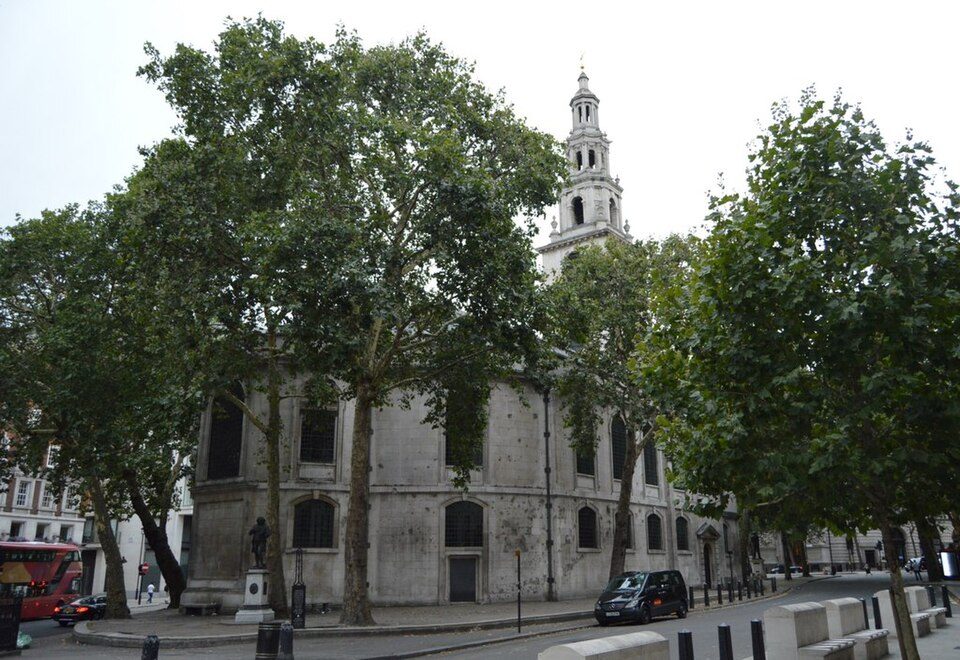
On an island in the middle of the Strand, beside the Royal Courts of Justice, St Clement Danes is a Wren church with a steeple by James Gibbs. Gutted by fire in the Blitz in 1941, it was restored in the 1950s as the Central Church of the Royal Air Force, and its floor is set with the slate badges of RAF units.
Seeing more than one church? St Clement Danes is the first stop of our City of London church walk, a route on foot of about 5 km from St Clement Danes on the Strand to All Hallows by the Tower, linking seven churches, with maps, timings and the sights in between.
Danes, saints and the Strand
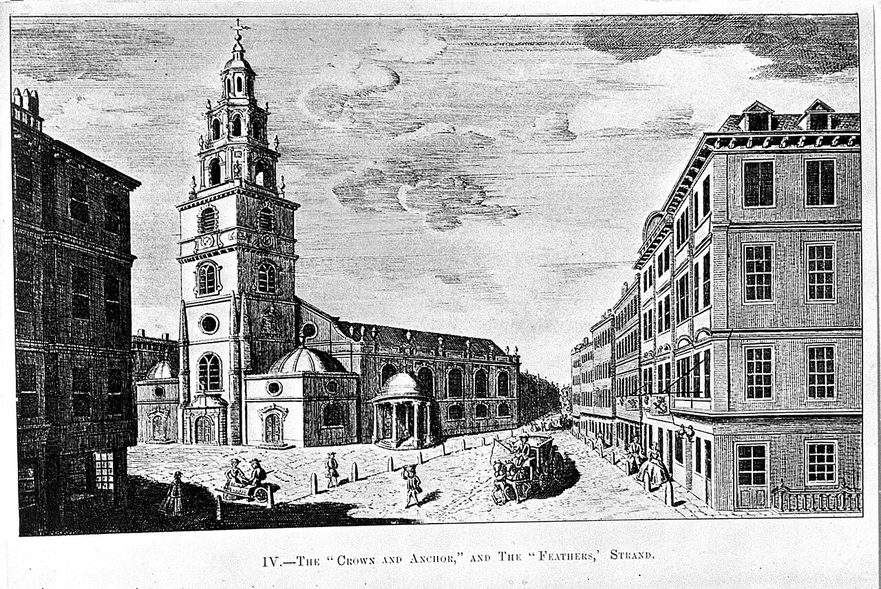
The name is old and its origin uncertain. The church’s own account follows a tradition that late in the ninth century Alfred the Great let Danish settlers married to English women live between London and Westminster, and that they built a church here. Tradition also holds that King Harold Harefoot was buried here in 1040. St Clement, the patron saint of mariners, gives the church its anchor emblem. The medieval church was rebuilt more than once.
Wren and Gibbs
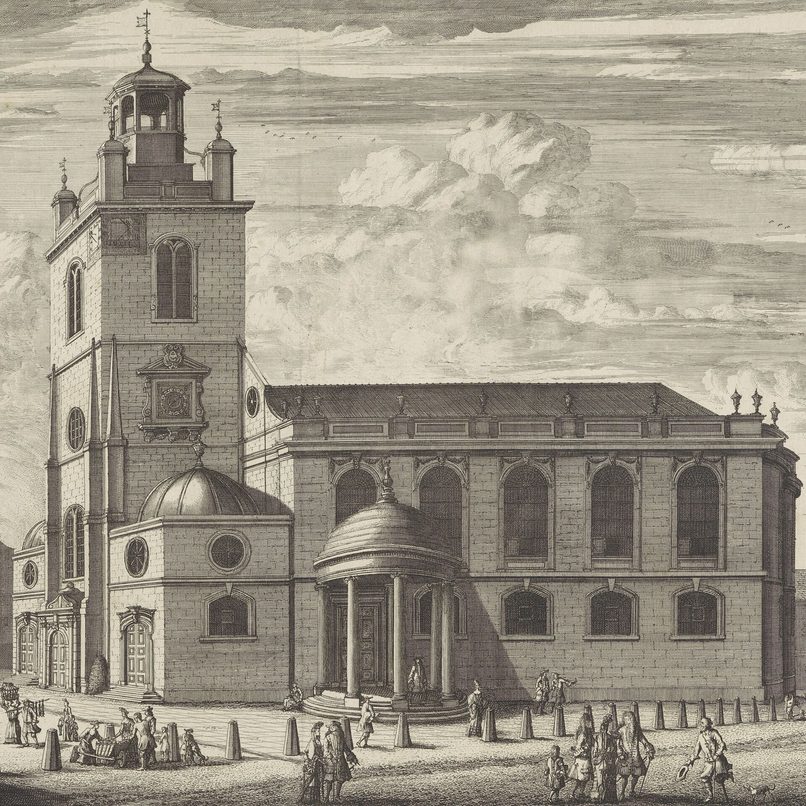
In 1680 the old body of the church was taken down, and Sir Christopher Wren rebuilt it, with Edward Pierce as carver and mason; it was finished by about 1682. The tower, rebuilt in 1669, was crowned in 1719 by James Gibbs’s steeple. Samuel Johnson, who lived nearby, worshipped here.
The Blitz and the RAF
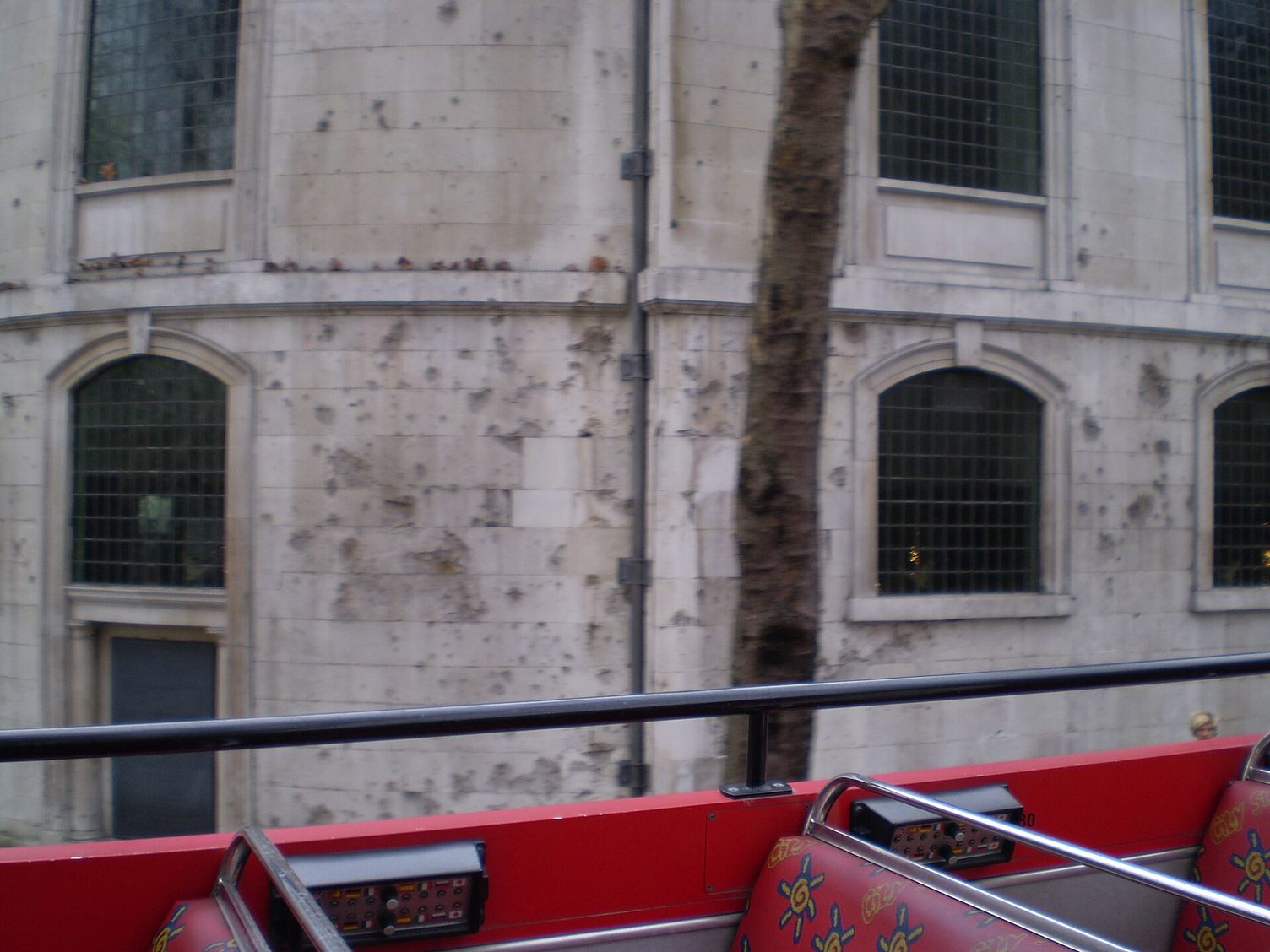
On 10 May 1941 an incendiary bomb pierced the lead roof and the church was gutted; only the outer walls, the tower and the steeple survived, the steeple acting as a chimney. The bells had already been taken down. After the war an appeal raised £125,000, and the church was restored under the architect W.A.S. “Sam” Lloyd. It became the Central Church of the Royal Air Force – the church gives 1955, other accounts 1953 – and was reconsecrated on 19 October 1958 in the presence of Queen Elizabeth II and Prince Philip.
The visitor’s cheat sheet
| Where | Strand, London WC2R 1DH, on an island in the road by the Royal Courts of Justice |
|---|---|
| Opening hours | The church’s pages differ: Wednesday–Friday 10.30am–3.30pm (home page) or Monday–Friday 10am–3.30pm (events page and RAF); weekends 10am–3pm. Usually closed on bank holidays and from after the Christmas Day service into early January; check before you go |
| Admission | No admission charge is listed; donations welcome |
| Services | Sundays at 11am (about an hour), with a professional choir |
| Tours | No guided tours listed; the church website has a virtual tour |
| Access | Step-free access to the nave: not stated by the church; step-free access to the crypt was listed for Heritage Open Days 2025 |
| Toilets | Not listed by the church |
| How long | Forty-five minutes to an hour |
Hours and admission checked against the official site in November 2026. They change; the official site is always the last word.
What to see
The Gladstone memorial and the steeple
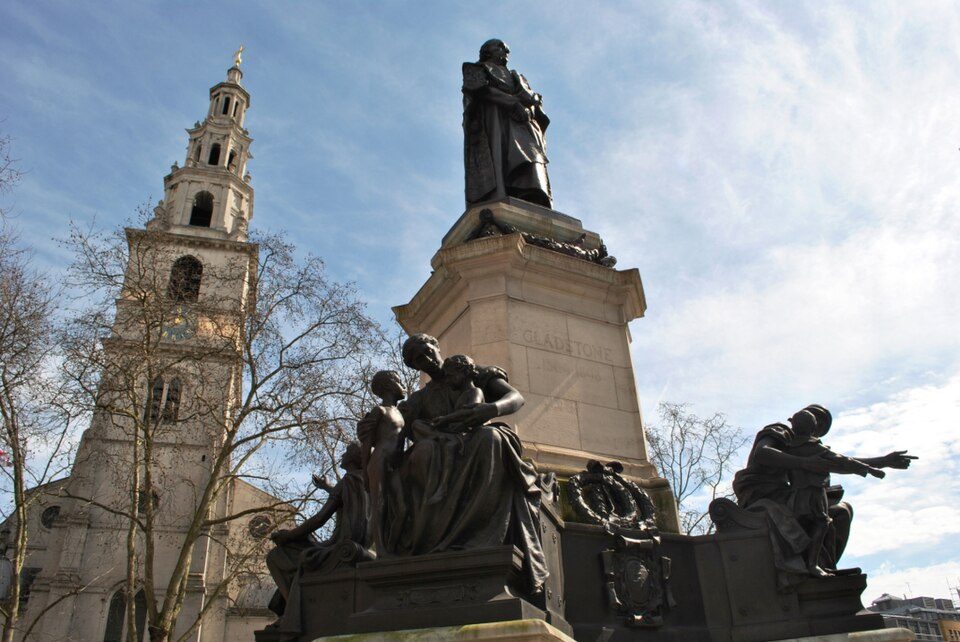
Start at the west end, where the traffic divides. Just west of the church stands Hamo Thornycroft’s bronze memorial to W.E. Gladstone, unveiled in 1906: an 11-foot figure in the robes of Chancellor of the Exchequer, with allegorical figures of Courage, Brotherhood, Education and Aspiration around the base. Behind it rises Gibbs’s steeple of 1719. Its stonework, damaged by the heat of 1941 and by rusting iron cramps, has been under restoration since 2024; the church’s last published progress report is from August 2025 and it has not announced completion, so check whether scaffolding is still up.
The west front
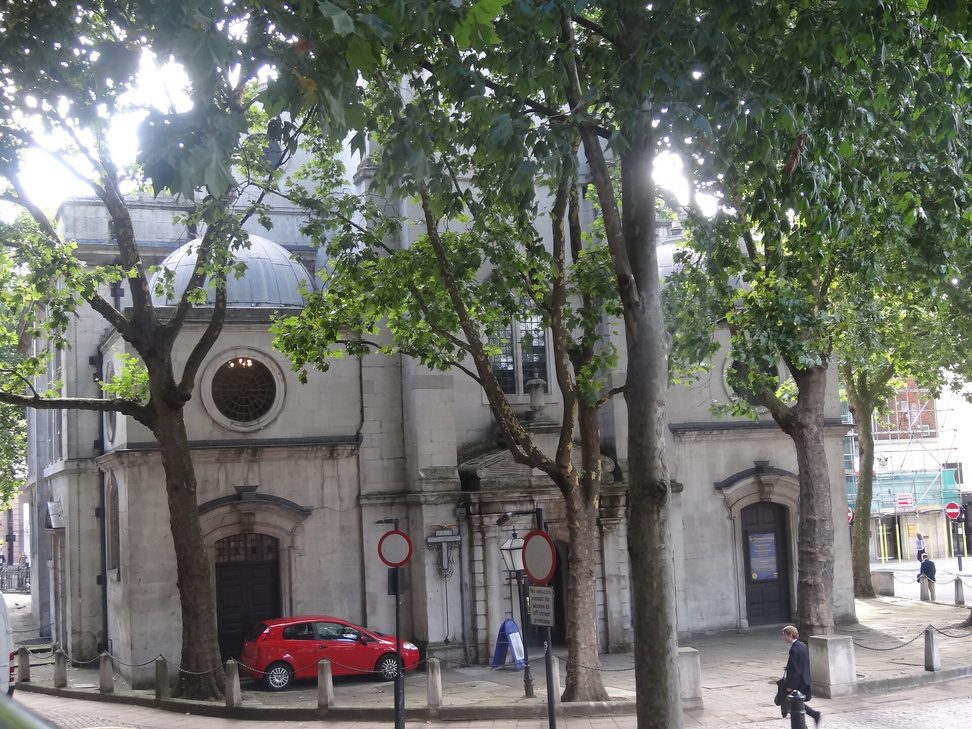
Before the west front stand two bronze statues by Faith Winter: Lord Dowding, who led Fighter Command in the Battle of Britain, unveiled in 1988, and Sir Arthur Harris of Bomber Command, unveiled in 1992. The Harris statue has been the subject of public debate because of the bombing of German cities, including Dresden; there were protests at its unveiling and it has been vandalised.
The nave and the badges
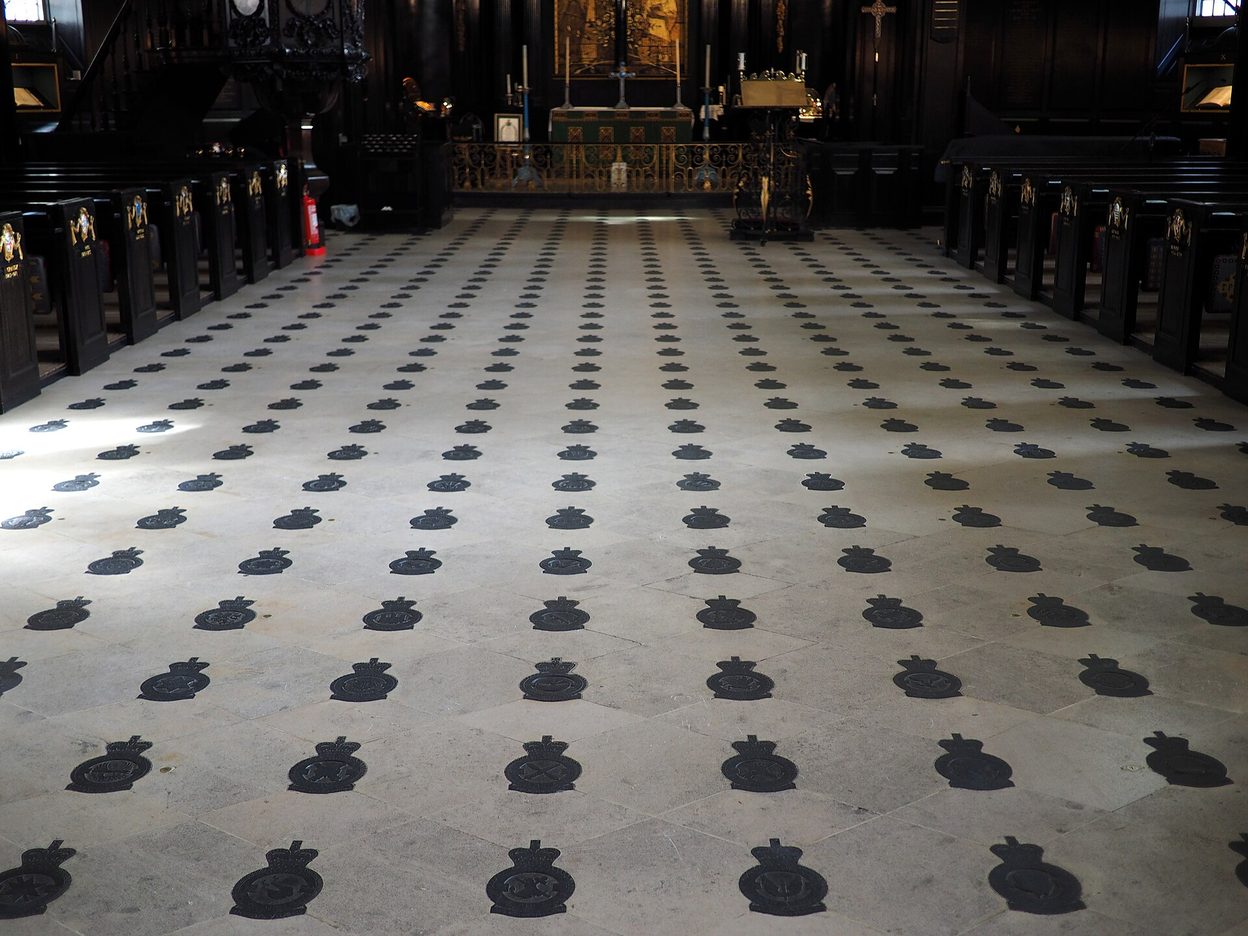
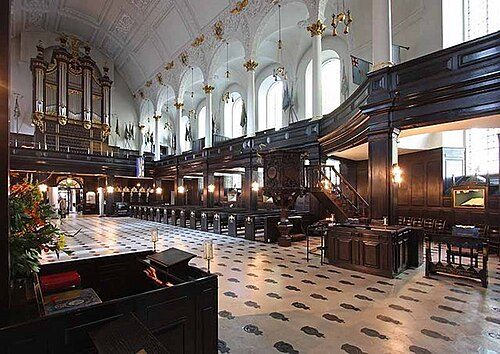
Inside, Wren’s plan returns in white and gold: galleries on three sides, Corinthian columns, a barrel vault and an apse. The floor is the church’s most remarkable feature. Set into it are hand-carved Welsh slate badges of RAF commands, groups, stations and squadrons – over 800 by one count, more than 1,000 by others – with a ring of Commonwealth air force badges around the RAF badge near the door. Pew ends carry cartouches of Chiefs of the Air Staff, and pews were given by, among others, Douglas Bader and the Guinea Pig Club. The pulpit, attributed to Grinling Gibbons, was stored in St Paul’s during the Blitz and so survived. In the north aisle floor is a memorial to the Polish airmen and squadrons who fought in the defence of Britain and the liberation of Europe.
The organ and the galleries
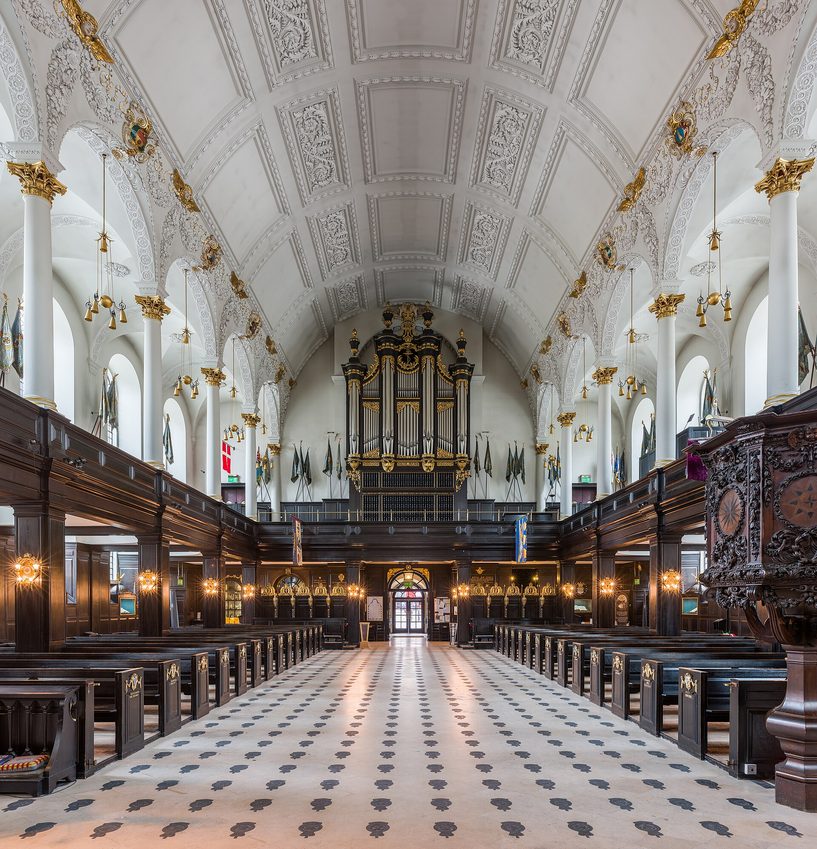
Turn west to the organ, built by Harrison & Harrison in 1958 as a gift from the United States Air Force and their families and friends. In the galleries hang retired colours and squadron standards. Records say that in 1851 parishioners placed a brass plate on the pew in the north gallery where Dr Johnson “for many years attended divine service”.
The Books of Remembrance and the sanctuary
In glass cases along the walls are the Books of Remembrance, recording more than 150,000 names of RAF men and women who died in service, with American airmen based in Britain who died in the Second World War. Plaques near the altar list holders of the Victoria Cross and George Cross from the RAF, its forerunners and the Commonwealth. The reredos, an Annunciation, was designed by Ruskin Spear, and the glass is by Carl Edwards. The ashes of the surgeon Sir Archibald McIndoe and of Lord Tedder and Lord Douglas of Kirtleside are buried in the church.
The crypt
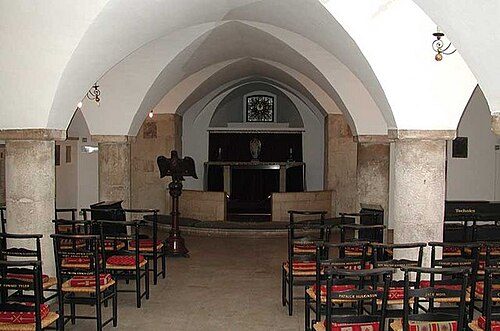
The crypt chapel is not always open (see the FAQ). When it is, you will find a bright chapel whose font was given by the Royal Norwegian Air Force. Old coffin plates and memorial tablets are fixed to its walls.

Dr Johnson at the east end
Leave and walk round to the east end, where Percy Fitzgerald’s bronze statue of Samuel Johnson (1910) shows him in a full-bottomed wig with a book in his hand; Boswell appears in relief on the plinth. Johnson’s house in Gough Square is close by.
A note on our pictures. We do not show Faith Winter’s statues of Dowding and Harris, Ruskin Spear’s reredos, Carl Edwards’s glass or the Polish Air Force memorial, because these are recent works still in copyright (or, for the memorial, by a maker we could not identify).
Getting there
The church stands in the middle of the Strand at Aldwych, opposite the Royal Courts of Justice; there is no parking. The nearest Underground station is Temple (Circle and District lines), a few minutes’ walk away, but it is closed on Sundays; Holborn (Central and Piccadilly) and Embankment are the alternatives. Buses 11, 23, 26, 76 and 172 stop at Royal Courts of Justice. Charing Cross, Blackfriars and Waterloo are the most convenient main-line stations to walk from.
Where to stay
The Strand is in the middle of central London, so hotels around Covent Garden, Aldwych and the South Bank are well placed.
This link goes to Booking.com. This site earns nothing from it at present — it is here because it is the quickest way to check what is actually available.
Don’t miss
- The slate badges Hundreds of RAF units in the nave floor.
- The Books of Remembrance More than 150,000 names.
- The Gibbs steeple Above Wren’s tower, by the Gladstone memorial.
- Dr Johnson His statue at the east end.
Insider tips
Check the day. The church’s own pages disagree about Monday and Tuesday opening, so confirm before you come early in the week.
Sunday music. The 11am service has a professional choir, and the church has advertised free recitals on the second Sunday of the month at 1.30pm; check the calendar.
Look at the stonework. The pitted steeple stone is damage the church ties to the 1941 fire and to rusting iron cramps.
Common questions
When is St Clement Danes open?
The church’s own pages differ: its home page gives Wednesday to Friday 10.30am–3.30pm and weekends 10am–3pm, while its events page and the RAF give 10am–3.30pm Monday to Friday and 10am–3pm at weekends. It is usually closed on bank holidays and over Christmas and New Year, and sometimes at short notice: check before you go.
Is there a charge to visit?
There is no admission charge listed, and no booking is needed for a casual visit; donations are welcome.
Is this the church of “Oranges and Lemons”?
It may be. Its bells play the tune and it holds a children’s service at which oranges and lemons are handed out, but St Clement Eastcheap in the City is also a candidate and the question is not settled.
Will I hear the bells?
Perhaps not. In 2025 the church said bell ringing was paused during the steeple works and that the bells were undergoing maintenance. Check whether they have resumed.
Can I see the crypt?
The crypt chapel has been opened to visitors during Heritage Open Days; the church does not say whether it is open at other times, so ask on arrival.
More English churches
- Temple Church — a medieval round church nearby
- St Paul’s, Covent Garden — the actors’ church, near the Strand
- St Paul’s Cathedral — Wren’s masterpiece in the City
See all the cathedrals and churches worth visiting in England →