
Deerhurst: St Mary’s Priory Church and Odda’s Chapel
Deerhurst is a hamlet in the flat meadows beside the River Severn, and it holds two Anglo-Saxon buildings a few hundred yards apart. St Mary’s Priory Church, begun in the eighth century, is one of the most important Saxon churches in England, full of carvings and puzzles. Odda’s Chapel, consecrated in 1056, spent centuries disguised as part of a farmhouse.
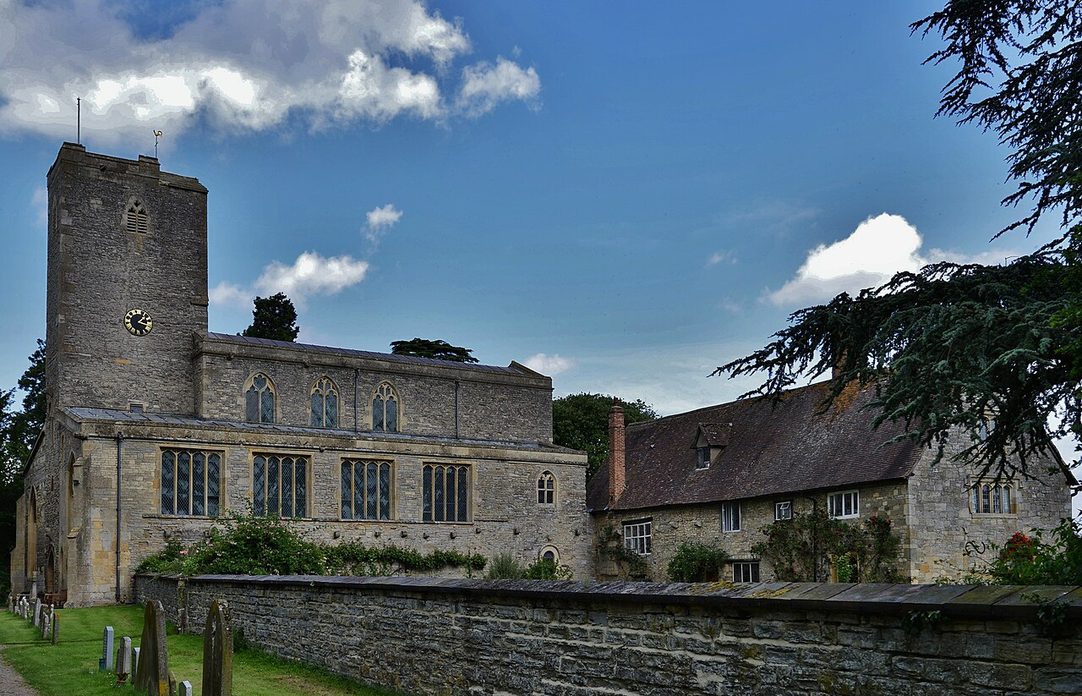
A Mercian minster
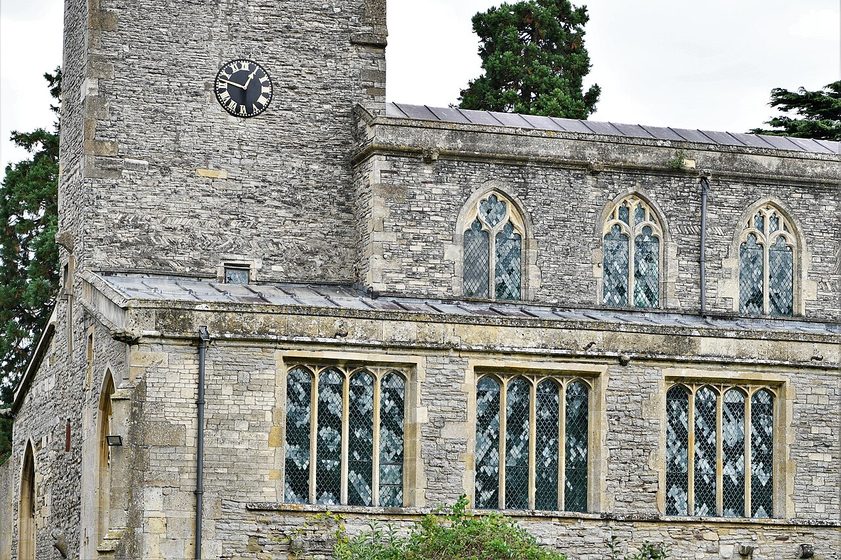
St Mary’s was built in the eighth century, when Deerhurst lay in the Anglo-Saxon kingdom of Mercia, and by 804 it was the church of a monastery. The nave is tall and narrow, in the manner of the earliest English churches, and the building grew outwards in stages: a two-storey west porch, side chapels, and then extra storeys that turned the porch into a tower. After the Viking raids the church was restored in the tenth century.
In about 1060 Edward the Confessor gave the priory to the Abbey of St Denis near Paris. It later passed to Tewkesbury Abbey and was dissolved in 1540, after which St Mary’s carried on as the parish church.
The visitor's cheat sheet
| Where | Deerhurst, near Tewkesbury, Gloucestershire, GL19 4BX |
|---|---|
| Getting there | About 3 miles south-west of Tewkesbury off the A38; charged car park opposite Odda’s Chapel; nearest station Ashchurch for Tewkesbury |
| Opening hours | St Mary’s: 9am–6pm (April–September), 10am–4pm (October–March). Odda’s Chapel: daily 10am–6pm (April–October), 10am–4pm (November–March) |
| Admission | Free to both; donations welcome |
| How long | An hour for both buildings |
| Best time | A dry day; the village lies on the Severn flood plain |
| Dress code | No rule; respectful dress in the working church |
| Tours | Self-guided; toilet in the churchyard of St Mary’s |
Hours and admission checked against the official site in October 2026. They change; the official site is always the last word.
The stone that gave the game away. In 1675 a stone was found near Deerhurst with a Latin inscription recording that Earl Odda had built a “royal hall” in honour of the Holy Trinity for the soul of his brother Ælfric, dedicated in 1056. The chapel itself was not recognised until the nineteenth century. The original stone is in the Ashmolean Museum in Oxford; a replica is in the chapel.
What to see, in the order you meet it
St Mary’s: the west porch and the nave
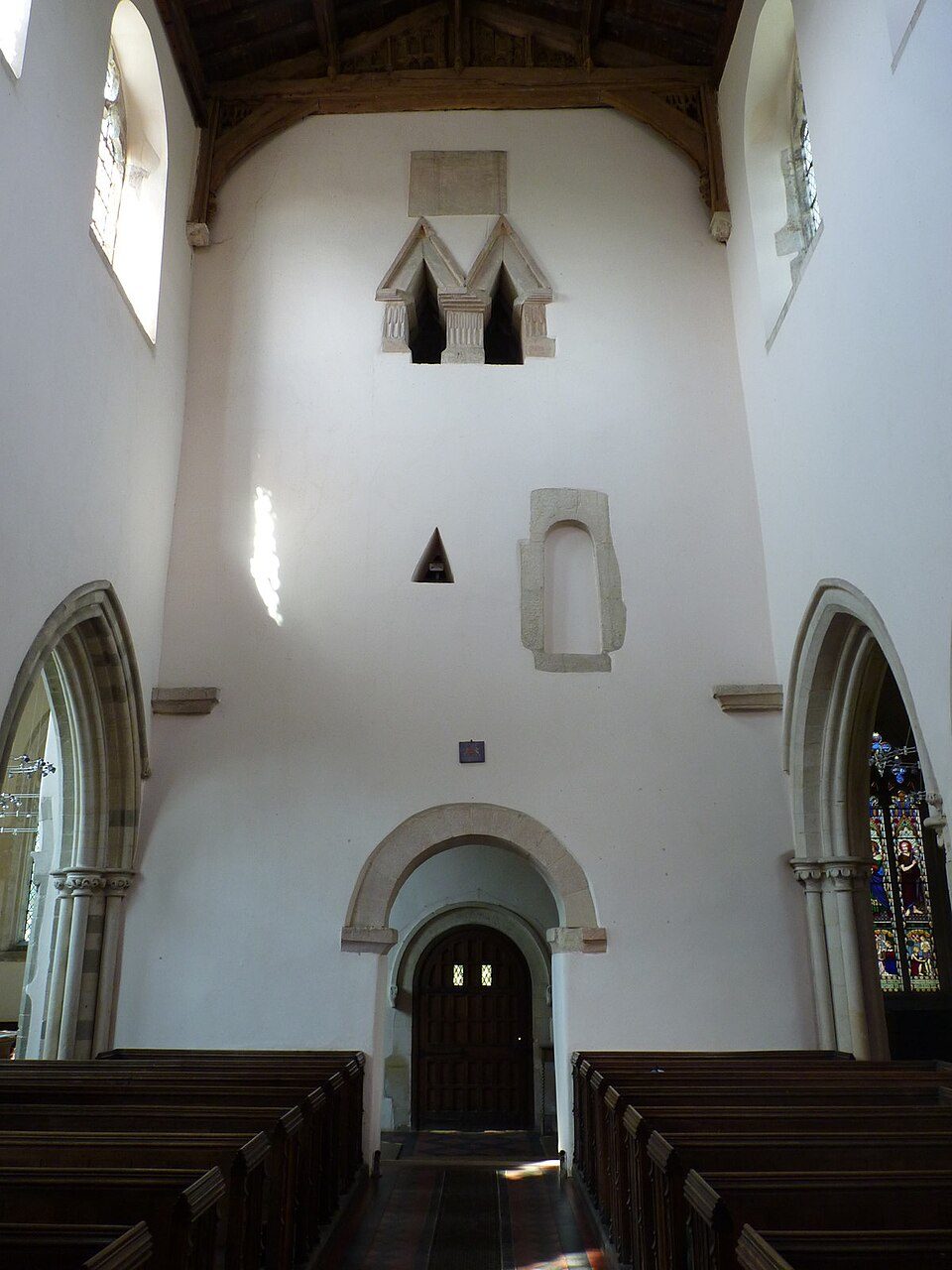
You enter through the base of the west tower. Above the doorways are Anglo-Saxon animal heads, and over the inner door is an eighth-century relief of the Virgin and Child. In the nave, look up at the west wall: high up is a double window with triangular heads and fluted pilasters, which once opened from an upper chapel or gallery in the tower.
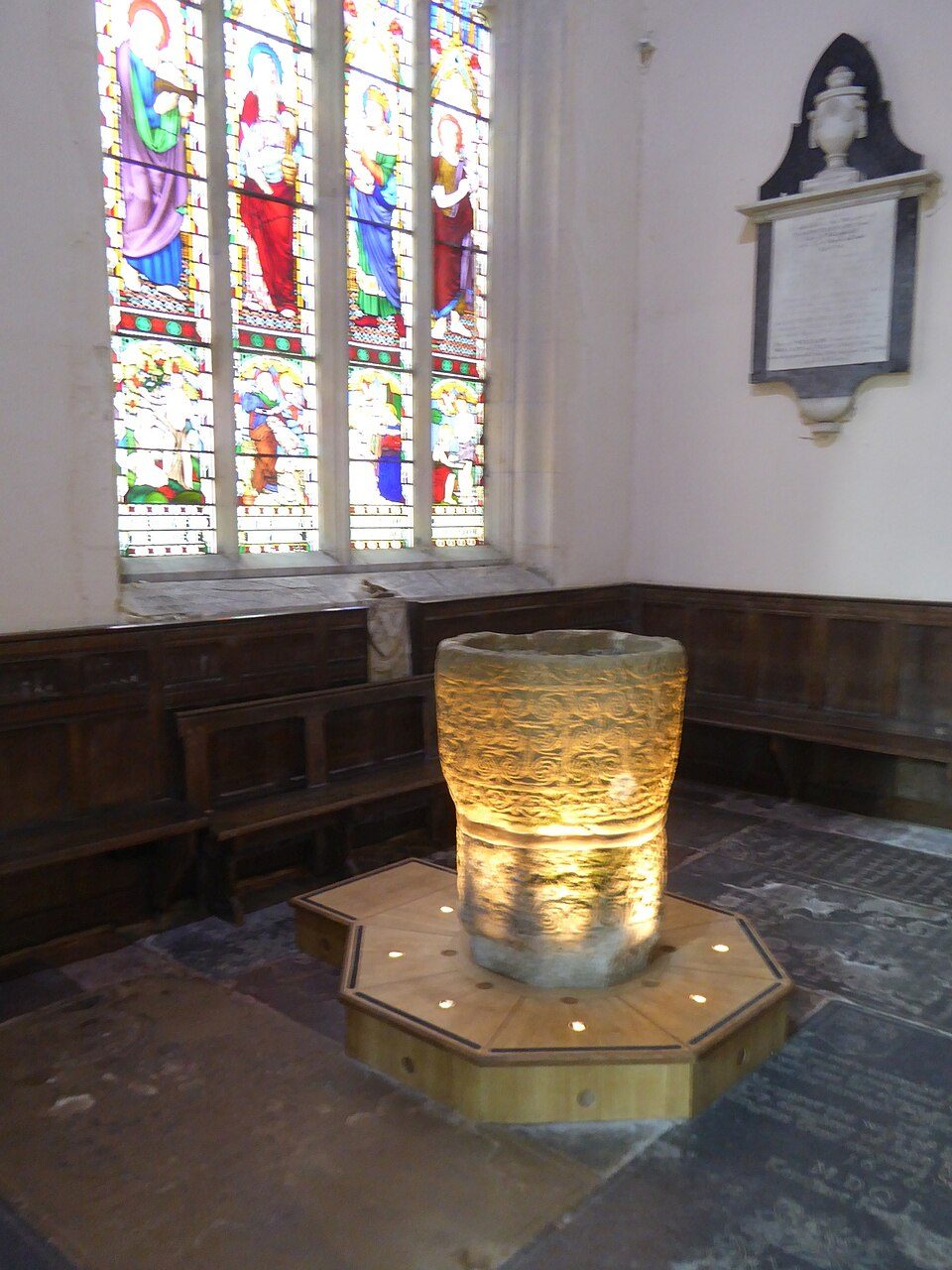
The font
In the north aisle is the font, carved with a band of double spirals between bands of vine scroll. It has been dated to the ninth century and is one of the oldest in England. It was rescued from use as a wash tub on a local farm.
The angel and the apse
Go outside to the east end, where the ruined walls of the apse survive. High on one wall is the Deerhurst angel, a ninth- or tenth-century relief showing Byzantine influence. Inside, look for the medieval glass of St Catherine and St Alphege, who began his life as a monk at Deerhurst, and the brasses of Sir John Cassey and his wife.
Odda’s Chapel
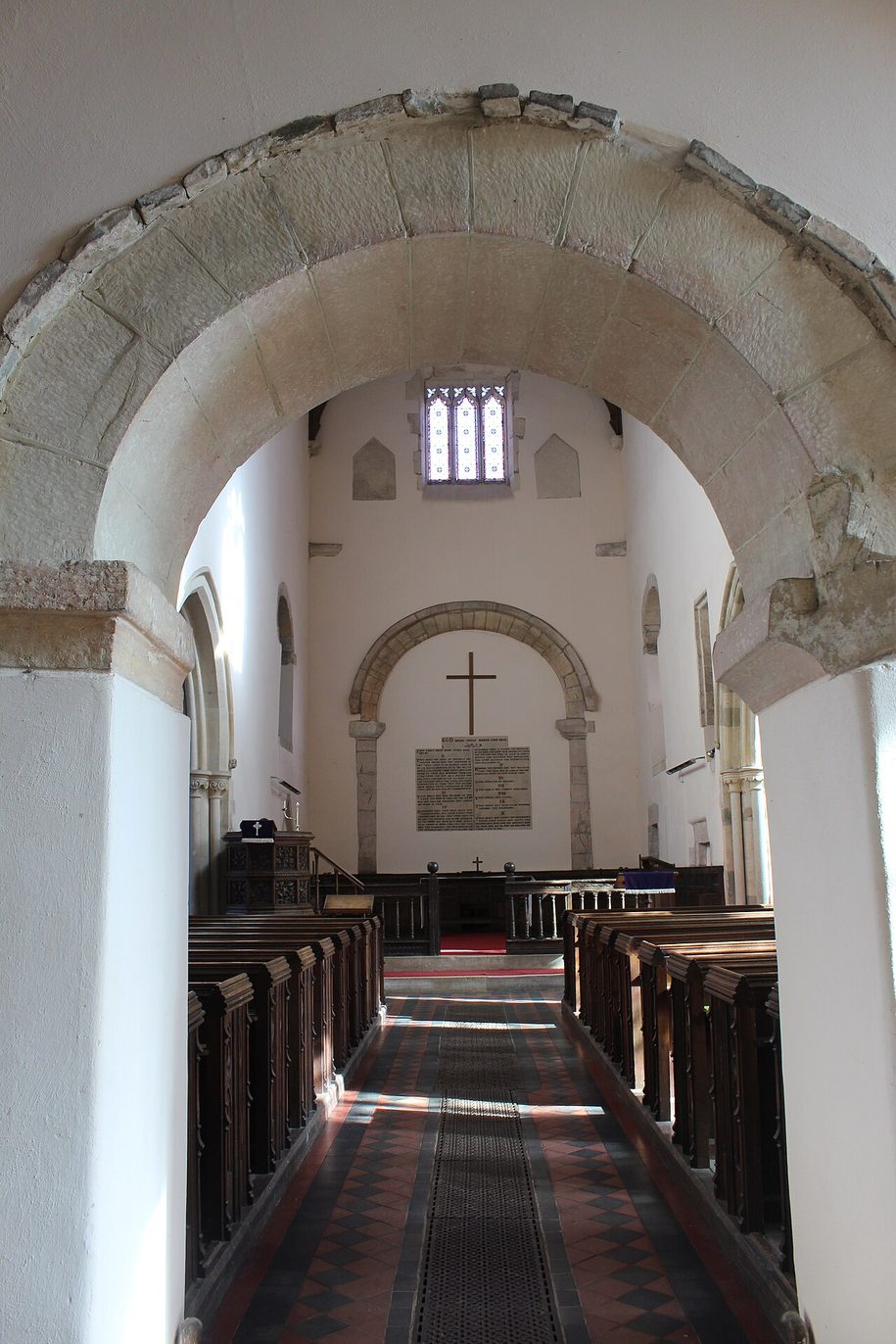
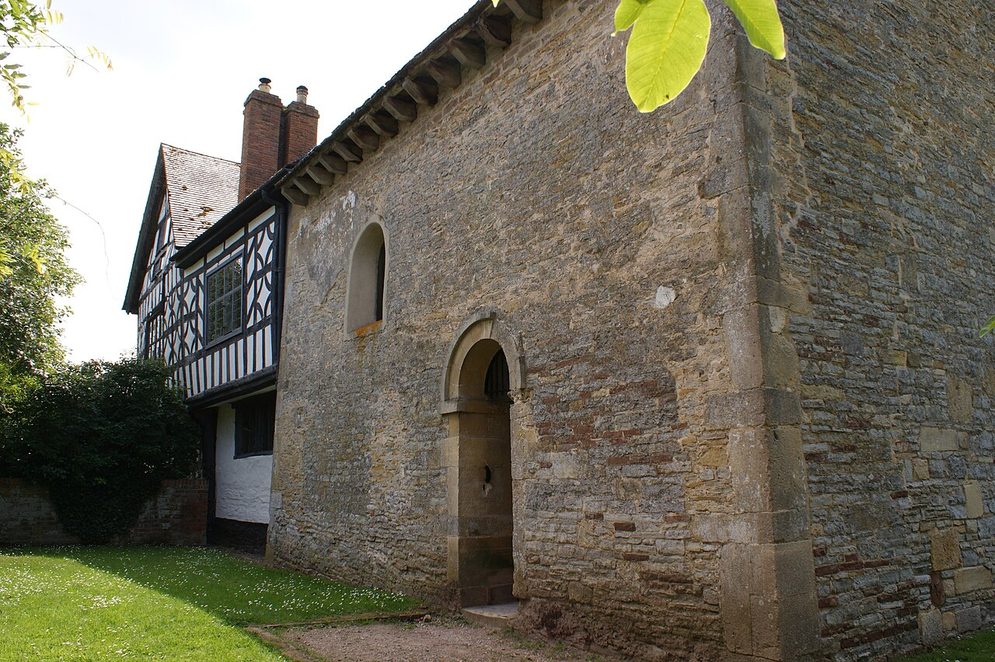
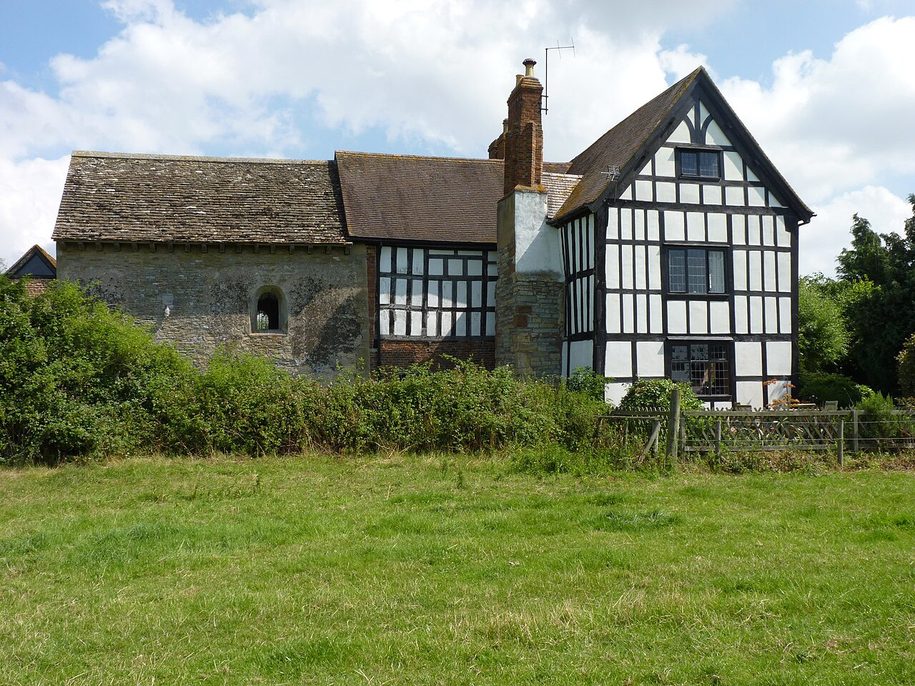
A short walk south-west, past the farm, is Odda’s Chapel: a small stone nave and chancel joined by a round arch, still attached to the timber-framed farmhouse of Abbot’s Court, which incorporated it after the Reformation. The nave became a kitchen and a floor was put into the chancel. It was untangled from the house and restored in the 1960s.
Visiting
Free to visit
Both buildings are free. St Mary’s is open from 9am (10am in winter), and Odda’s Chapel daily from 10am, closing at 6pm in summer and 4pm in winter.
The hotel link goes to Booking.com. This site earns nothing from it at present — it is here because it is the quickest way to check what is actually available.
Don't miss
- The triangular window High in the west wall of the nave.
- The spiral font One of the oldest in England.
- The Deerhurst angel On the ruined apse outside.
- The animal heads Guarding the doorways.
- Odda’s Chapel A Saxon chapel inside a farmhouse.
- The Severn Way The riverside path passes the village.
Insider tips
Pair it with Tewkesbury. Tewkesbury Abbey is ten minutes’ drive away, and the two make a fine day. The village is prone to flooding, and a flood gate can close the lane to Odda’s Chapel, so check before setting out after heavy rain.
Common questions
Does it cost anything to visit Deerhurst?
No. St Mary’s Priory Church is free to visit, and so is Odda’s Chapel, which is looked after by English Heritage. Donations are welcome at the church.
When are they open?
St Mary’s is open from 9am to 6pm between April and September and from 10am to 4pm between October and March. Odda’s Chapel is open daily from 10am to 6pm between April and October and from 10am to 4pm between November and March.
What is Odda’s Chapel?
A small Anglo-Saxon chapel built by Earl Odda, a kinsman of Edward the Confessor, in memory of his brother Ælfric, and consecrated on 12 April 1056. After the Reformation it became part of a farmhouse and was forgotten until its true identity was worked out in the nineteenth century.
How old is St Mary’s?
The nave and chancel were built in the eighth century, when Deerhurst was in the kingdom of Mercia, and the church was enlarged in several stages before and after the Viking raids. The aisles were added around 1200.
How do you get to Deerhurst?
Deerhurst is a small village beside the River Severn, about three miles south-west of Tewkesbury, off the A38. There is a charged car park opposite Odda’s Chapel and some parking near the church. The nearest station is Ashchurch for Tewkesbury.
Where to stay and eat nearby
There are pubs along the river nearby, and Tewkesbury and Cheltenham have hotels.
More English churches
- Tewkesbury Abbey — the Norman abbey down the road
- Hailes Abbey — the Cotswold abbey of the Holy Blood
- All Saints’, Brixworth — the largest Anglo-Saxon church
See all the cathedrals and churches worth visiting in England →