
Jedburgh Abbey, Scottish Borders
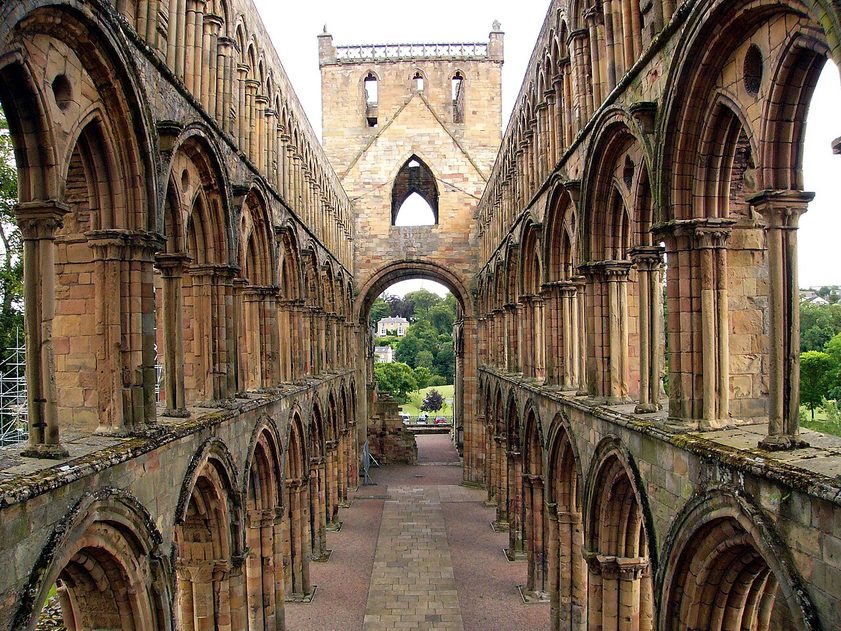
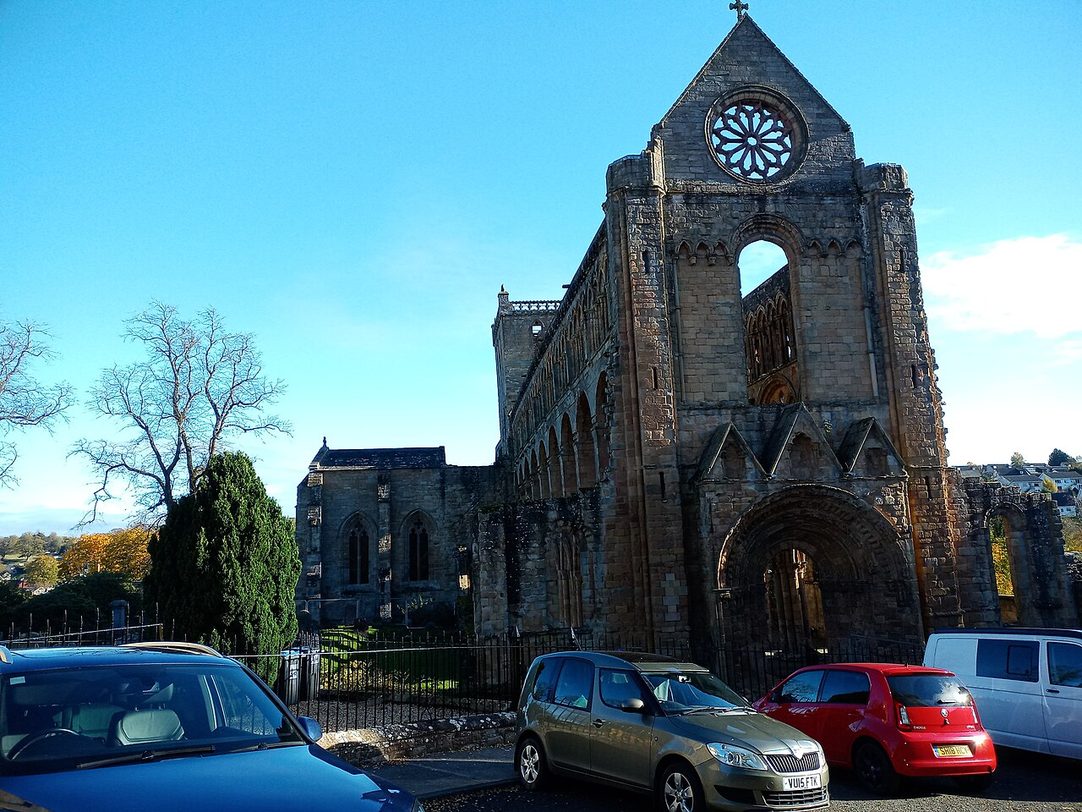
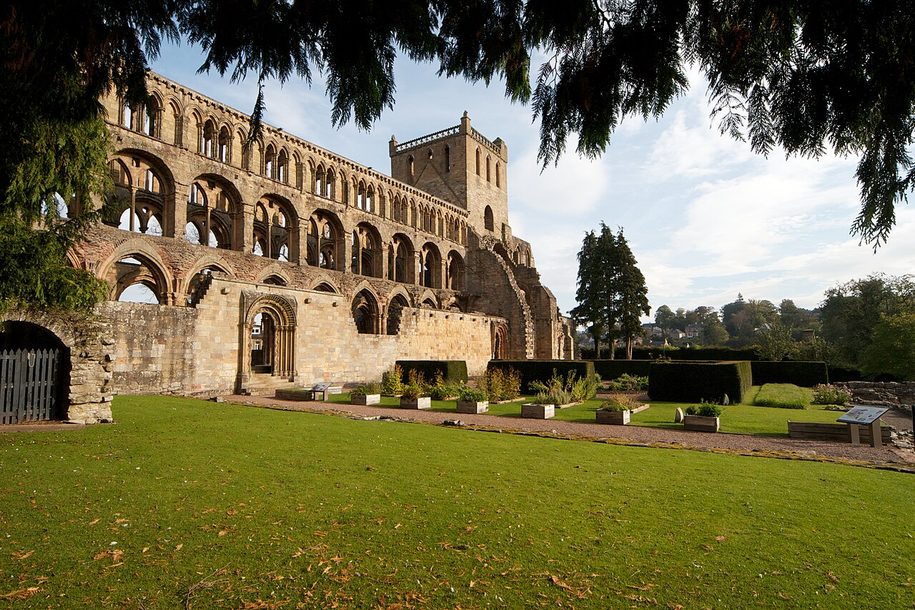
Jedburgh is the first of the great Border abbeys you meet coming north from England, and its church is the most complete of them all. The roof has gone, but the nave still stands to its full height: three tiers of arches in warm sandstone, a rose window in the west gable, and a tower over the crossing, all on a slope above the Jed Water.
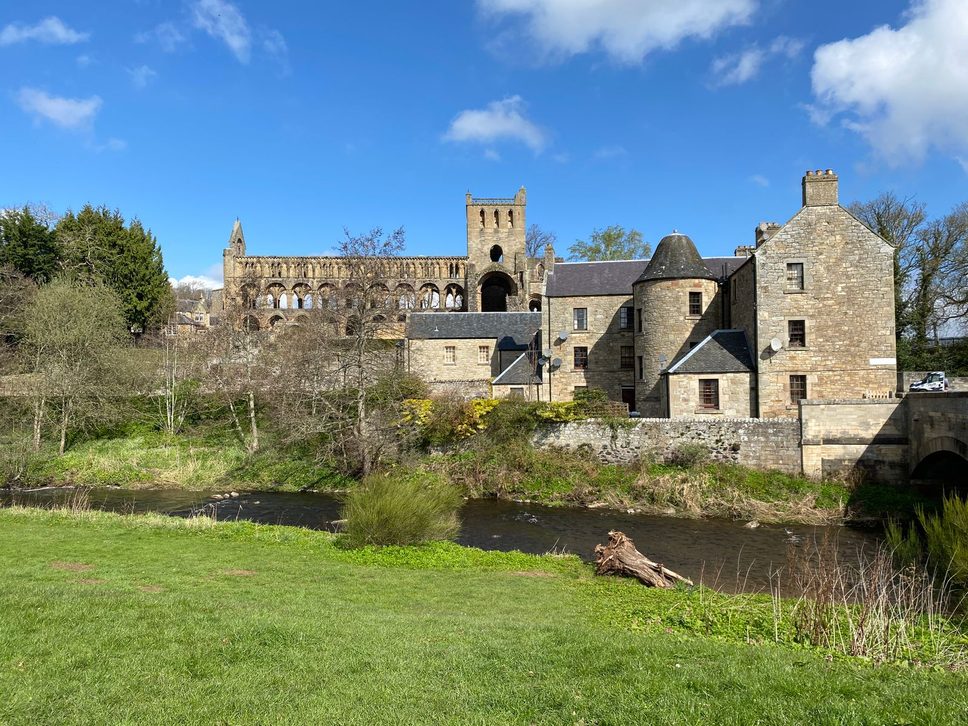
An abbey on the border
There was a church at Jedburgh long before the abbey; carved stones from the eighth to the eleventh centuries have been found on the site. In 1138 King David I founded a priory here for Augustinian canons, and in 1154 it became an abbey. The nave was begun around 1180 and largely finished by 1200. In 1285 King Alexander III married Yolande de Dreux in the abbey church.
Its position so close to England made it a target. Edward I’s men stripped the lead from the roof in 1305; the Earl of Surrey’s army badly damaged it in 1523; and during the “Rough Wooing” of the 1540s the Earl of Hertford’s forces attacked it again. After the Reformation of 1560 part of the church was used by the parish. In 1875 a new parish church was built across the river, and in 1913 the abbey passed into the care of the state.
The visitor's cheat sheet
| Where | 4/5 Abbey Bridgend, Jedburgh, Scottish Borders, TD8 6JQ |
|---|---|
| Getting there | Borders Railway to Tweedbank, then bus 68 to Jedburgh; by car on the A68; public car park about 100m away |
| Opening hours | 1 April–30 September daily 9.30am–5pm; 1 October–31 March daily 10am–4pm; last entry 30 minutes before closing |
| Admission | Adults £7.50 online (£8.50 on the door), concessions £6 (£6.80), children £3.50 (£3.75); Historic Scotland members free |
| How long | An hour to an hour and a half |
| Best time | A sunny morning, when the light comes through the nave arcades |
| Dress code | Outdoor shoes; steps, gravel and cobbles |
| Tours | Audio guide; visitor centre with the Jedburgh Comb; cloister garden |
Hours and admission checked against the official site in October 2026. They change; the official site is always the last word.
The Jedburgh Comb. Found in a 1984 excavation of the abbey’s buildings, this small walrus-ivory comb was carved around 1100. One side shows a man, perhaps Hercules, fighting a dragon; the other a griffin. After conservation by National Museums Scotland it went back on display in the visitor centre in June 2026.
What to see, in the order you meet it
The visitor centre
You enter through the visitor centre, which displays the Jedburgh Comb, early Christian carved stones and fragments of the Jedburgh Shrine, a carved stone tomb-chest, along with gaming pieces and other finds.
The cloister and monastic buildings
Below the church are the foundations of the cloister and the canons’ buildings, with the kitchen and cellar range. The cloister is now a garden of plants the canons might have grown.
The nave
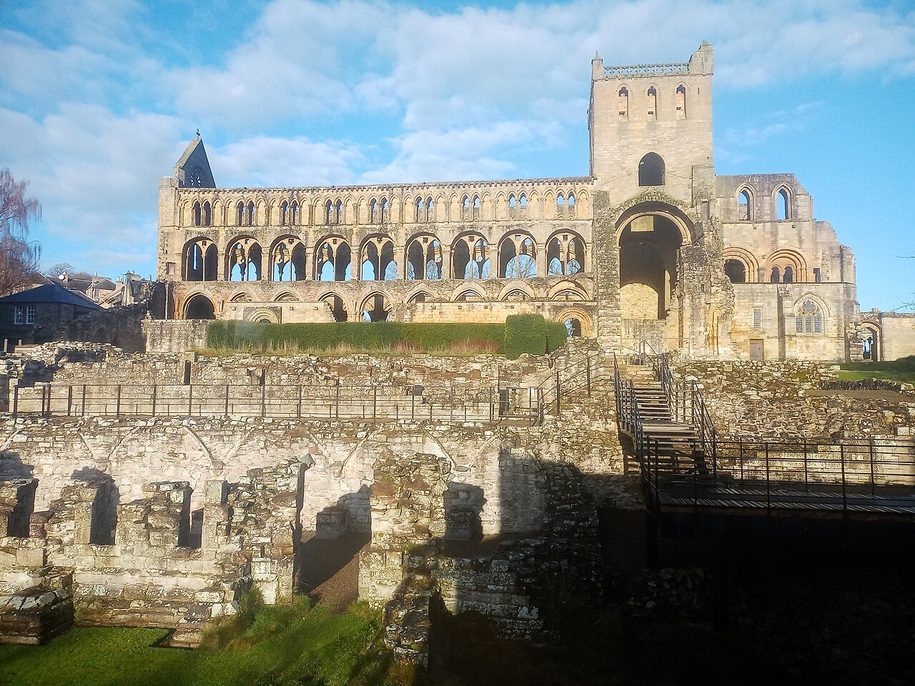
The nave, built around 1180–1200, is the glory of Jedburgh: bay after bay of pointed arches on clustered pillars, a gallery of round arches above, and a row of clerestory windows at the top. Look for the lowered rooflines and partition walls left from the centuries when part of the church was the parish kirk.
The west front
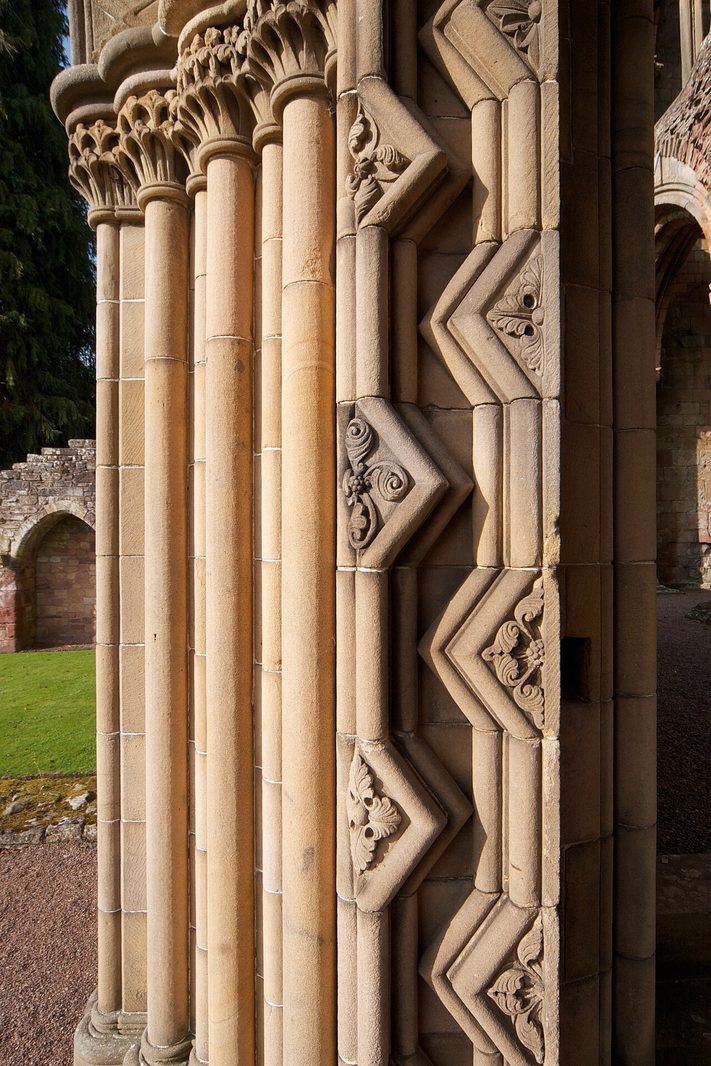
Walk round to the west end for the deeply carved Romanesque doorway and, above it, the rose window, added around 1440.
The east end
The oldest part of the church is the east end, with round-arched windows and tall cylindrical pillars of the 1100s rising through two storeys.
Visiting
Tickets
Tickets are sold at the visitor centre and online through Historic Environment Scotland; online is cheaper, at £7.50 for adults.
The hotel link goes to Booking.com. This site earns nothing from it at present — it is here because it is the quickest way to check what is actually available.
Don't miss
- The nave arcades Three tiers of arches to the sky.
- The rose window High in the west gable.
- The Jedburgh Comb Walrus ivory, around 1100.
- The west doorway Romanesque carving.
- The cloister garden Medieval plants.
- The view from the river Across the Jed Water.
Insider tips
See it from below. The best view of the abbey is from the riverside path and the old bridge below it. With a car, Jedburgh pairs well with Melrose, Dryburgh and Kelso on a day of Border abbeys; Mary Queen of Scots’ House is a short walk away in the town.
Common questions
How much does it cost to visit Jedburgh Abbey?
Jedburgh is run by Historic Environment Scotland. Booking online, an adult ticket is £7.50, concessions (65 and over) £6 and children (7–15) £3.50; on the door it is £8.50, £6.80 and £3.75. Historic Scotland members and Explorer Pass holders go free.
When is Jedburgh Abbey open?
From 1 April to 30 September it is open daily from 9.30am to 5pm, and from 1 October to 31 March daily from 10am to 4pm. Last entry is 30 minutes before closing. It is closed on 25–26 December and 1–2 January.
What is the Jedburgh Comb?
A small comb carved from walrus ivory in the late eleventh or early twelfth century, with a man fighting a dragon on one side and a griffin on the other. It was found in an excavation at the abbey in 1984 and went back on display in the visitor centre in June 2026 after conservation.
How do you get to Jedburgh?
There is no railway. From Edinburgh, take the Borders Railway to Tweedbank, then the 68 bus to Jedburgh, which takes about an hour from Galashiels. By car, Jedburgh is on the A68, about an hour and a quarter from Edinburgh. There is a public car park about 100 metres from the abbey.
Is everything open?
Not quite. Some small areas, including the viewing gallery, are closed for conservation, and some exhibits in the visitor centre are unavailable. The church and grounds are open as normal.
Where to stay and eat nearby
Jedburgh has cafes, pubs and guest houses within a few minutes’ walk of the abbey.
More churches in Scotland
- Melrose Abbey — the finest Border abbey, half an hour away
- Rosslyn Chapel — on the way to Edinburgh
- Hexham Abbey — across the border in Northumberland